
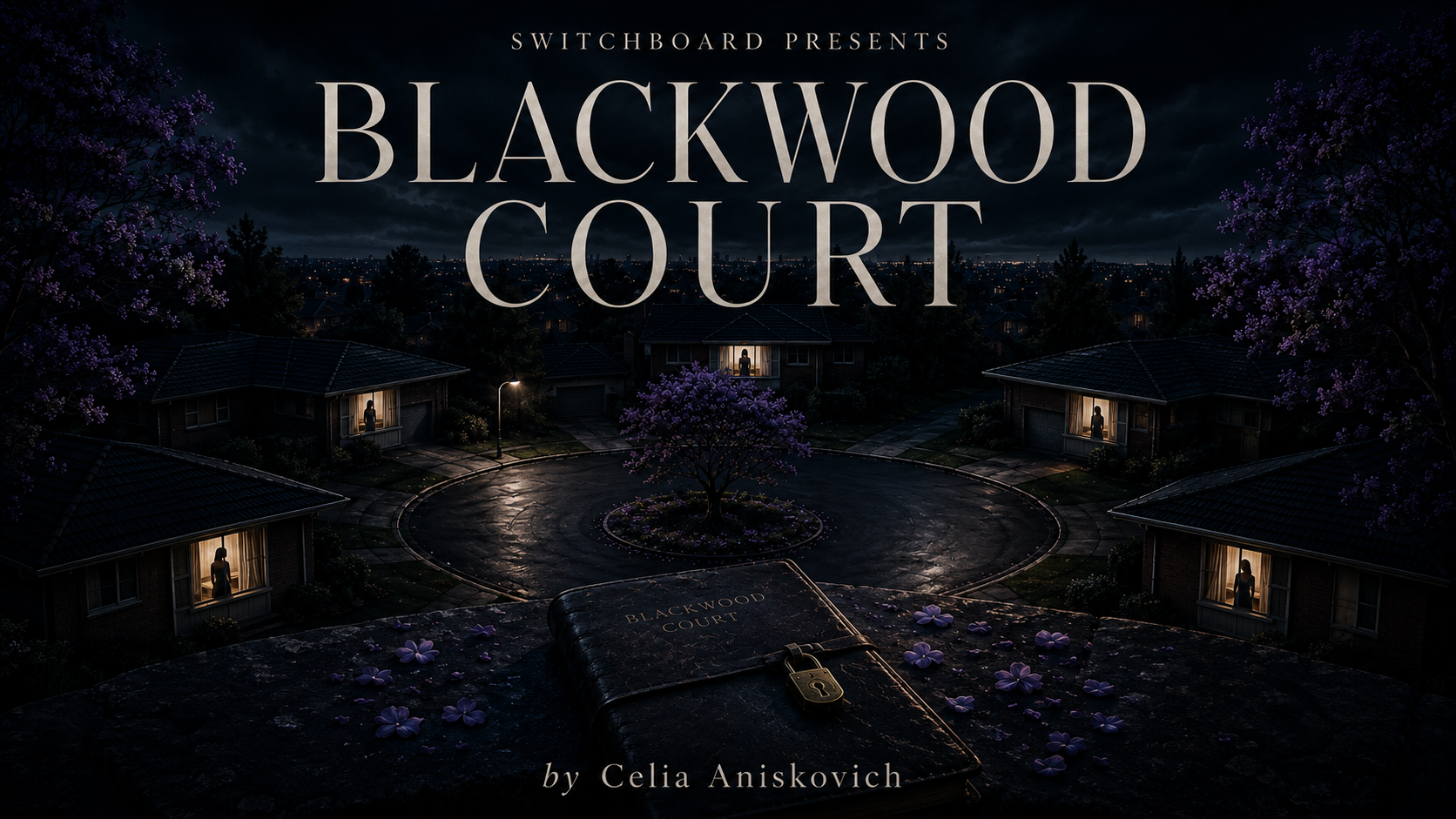
Blackwood Court
By Celia Aniskovich
Prologue
November, 1950
The first woman to leave Blackwood Court did so at 2:47 in the morning on a Tuesday in November.
She walks out of house number five carrying a single suitcase. The car at the entrance of the court has been idling for nine minutes with its headlights off. She does not look back at the house. She does not wake the child sleeping upstairs. She crosses the pavement in a straight line, opens the passenger door, and gets in.
Three of the other four women who live on this cul-de-sac see her go.
They watch from windows they will later swear were draped shut. In house one, it’s the kitchen window, where the reading lamp has been burning too late again. The upstairs hall in house three, where the bathroom light was switched off a few minutes earlier — not consciously, but the way you lower your voice in church. The bay window in house four, where a hand parts the curtain by two fingers and lets it fall again.
None of them come outside.
The woman’s name is Margaret. She has lived on Blackwood Court for eleven months. The others have been watching her marriage unravel through their windows for six of them. They see late arguments, and an unfamiliar car that began appearing in her driveway on Thursday afternoons. They see Margaret at her table at 11 p.m. with a glass of wine and her hand pressed flat against her mouth. They have discussed all of this at their wine nights. They have discussed it with the mailman. They have discussed it in the bread aisle of the grocery store on Elm.
By December, the version of Margaret's life that circulates through the surrounding neighborhood bears very little resemblance to the version Margaret is actually living.
She finds out on a Sunday.
By Tuesday, she is gone.
The house goes up for sale within a week. Her husband stays with the child. She leaves no forwarding address. She does not respond to the letter that Anne, in house two, eventually mails to a last known address in Ohio. She does not, as far as anyone on Blackwood Court ever learns, write to her daughter.
The four remaining women do not speak of Margaret for a long time. They do not need to. Each of them knows exactly what they said, and to whom, and how quickly their careless words traveled.
They also know this:
They were wrong. Wrong about the affair. Wrong about the car on Thursdays. Wrong about everything that had made its way through their grapevine and out past the jacaranda trees and back to her husband.
Their version was flawed. Margaret left anyway.

Present Day
From above, Blackwood Court looks almost ornamental.
A perfect circle of asphalt tucked at the end of a suburban street, five houses arranged around it like stones in a ring. In spring, the jacaranda trees bloom purple at the entrance, their petals drifting across the pavement in soft, accidental confetti. In summer, the lawns burn slightly at the edges. In winter, the windows glow early, warm squares of light against the dark.
It’s the kind of place that appears, from a distance, entirely peaceful. Up close, though, the shape of it tells a different story: circles have a quiet geometry that keeps everyone in view, and on Blackwood Court, very little slips beyond it.
Every house faces inward. Every kitchen window looks onto the same small loop of pavement. From the sink, you can watch headlights glide slowly around the court at night, watch the silhouettes moving in the windows across the way.
Privacy on Blackwood Court was never part of the design.
The houses were built in 1950, after a developer realized that the narrow lot at the end of the street could not be cleanly divided. Instead, he bent the road gently back into itself and sold the homes as something new for the time: a community within a community.
Five houses.
Five families.
Five front doors turned toward one another, like quiet witnesses.
The first winter after the residents moved in, the women of the houses began meeting once a month for wine. No one remembers now whose idea it was.
What they do remember — what has been repeated often enough over the years to settle into something like truth — is this:
You could see everything.
Who argues in the kitchen. Who drinks too much. Who stays out late. Who cries when they think no one is looking.
It didn’t take long for small observations to turn into conversations, and conversations to turn into something sharper. A comment made in passing. A detail repeated slightly differently the second time. The slow, familiar drift from noticing to knowing. From knowing to judging.
Something happened that winter.
It’s been 75 years since Margaret left, but no one describes it the same way anymore. What everyone agrees on is the ending.
A woman left Blackwood Court in the middle of the night. Her husband stayed with the child. The house went up for sale within a week. And in the months afterward, the four remaining women avoided each other's eyes at the mailbox — because each of them knew exactly what they said, and to whom, and how quickly their careless words had traveled.
After that, they understood what sharing the cul-de-sac’s secrets more widely could do to the fragile lives that inhabited the circle. They considered that trusting outsiders could destroy their Eden more quickly than any resident snake could.
So at one of those early wine nights, sometime near the end of that first winter, a compromise was proposed among the guilty parties.
If everyone already knew things about everyone else — if the street itself made that unavoidable — then no one should be allowed to trade in that knowledge.
Secrets, they decided, would not be spoken aloud.
Their own secrets, and those they witnessed by happenstance on Blackwood Court, would be written down and stored away.
At the end of the evening, someone placed a leather notebook on the table. Each woman recorded one truth: something real, something they would not want repeated. After putting pen to paper, she would turn the page and hand it to the woman next to her. When the final entry was written, the book was closed.
No one was allowed to read what the others had written.
That was the rule.
Not because the secrets didn’t matter.
Because they did.
The notebook wasn’t meant to protect them from one another.
It was meant to bind them together. Mutually assured destruction.
And, eventually, to keep track.
The system came after.
The notebook was fitted with a small brass lock — the kind meant for diaries, easily overlooked but difficult to open without the key. The key was kept separately, passed each month to a different house than the one holding the book.
The book and the key were never kept in the same place, except on wine night.
No one person could open it alone.
No one person could read it.
Each woman wrote on the next blank page without looking back. The book filled slowly, over years instead of months. The ritual — at first silly, but then deadly serious — was like a secret handshake in middle school. It was a place to unload some of their heaviest emotional cargo. It’s hard to trace back to when that started to happen, but they each started to look forward to their 5 minutes of book therapy. What the wine was to their circulatory systems, the book was to their nervous systems. A release, a reset, an unwinding. A quiet, unjudging confessional.
When one volume was full, it was closed, sealed, and removed from the rotation. A new notebook took its place.
The understanding was never spoken aloud, but every woman on the court eventually arrived at it on her own: the notebook only worked if what you wrote could ruin you. Anything less, and you were simply taking notes on everyone else for free.
The finished books lived off-site, in a safe deposit box at Merchants Trust, a small, family-owned branch three miles from Blackwood Court. The box was opened in March of 1951 by the four remaining original women. On that day, they set the rules:
The book lives in one of the five houses. The key lives in another. They never share a roof. The book and key come together only on wine night, on the table, in front of everyone.
When a volume is full, it is sealed at the end of that night — wax across the clasp. After that, the lock no longer matters. A full book cannot be opened without breaking the seal, and a broken wax seal cannot be hidden.
Sealed volumes are deposited with their key at the bank by at least one current resident, on a weekday, between wine nights. The box swallows the book. The logbook records the deposit.
The box can be opened only in the presence of two residents — past or present — and only with both of their signatures in the log.
A copy of these rules are supplied to the original teller, with instructions that they be passed down to every subsequent teller.
The current teller is a woman in her early fifties who has worked at the bank for seventeen years. She came on as a cashier in her thirties and moved to the vault window when the previous teller retired. She is polite, and competent, and entirely unmemorable. Her name is on a small gold pin above her pocket. None of the current residents of Blackwood Court have ever looked at it long enough to read it.
Years pass the way they always do in neighborhoods like this — quietly, then all at once. Families move away. Children grow older. Marriages bend and sometimes break. New residents arrive with fresh furniture and careful smiles.
The houses change hands. Each time someone new is invited to wine night, the story is retold.
Someone explains what happened that first winter. The details shift slightly, depending on who is speaking, but the shape of it remains the same.
After that, the rules are explained. The notebook. The writing. The fact that no one reads what the others have written.
The system only works, they tell her, if everyone agrees to it. And if no one breaks it.
It is not presented as a choice so much as a condition of belonging. By the end of the evening, the new woman understands what is expected of her. And what it costs to ignore it. It is always framed the same way:
A cautionary tale.
Still, each woman who joins has to find her own reason to stay.
Morgan inherited her mother's house and with it membership in wine night. The notebook was part of the property, the way a fireplace is part of a living room. She never really decided.
Tara said yes because she had moved across the country for a residency and hadn't made a friend in eight months, and because she was a doctor, and doctors are trained to believe that any system built on careful documentation is probably trustworthy.
Jordan said yes because she read the rules and recognized them. She had drafted enough contracts to know a well-constructed mutual obligation when she saw one. She told herself she was joining a book club with unusual paperwork.
Lila said yes for reasons she did not examine closely at the time. She told the others it was about community. She told herself it was about belonging. Neither answer was precisely the truth.
Elena said yes because she had spent her entire adult life being watched, and the notebook struck her, at first, as the safest kind of watching — private, sealed, contained. A performance she could finally control.
Each of them, in her own way, believed she was the exception. That she would be the one who wrote without being exposed. That the pact could hold her secret and not turn on her.
Each of them was, for a while, correct.
So, on the last Thursday of every month, in whichever house hosts wine night, someone still places the notebook in the center of the table.
Five houses. Five women. One book.
And the same rules have held the court together for nearly seventy-five years.
Write the secret down. Close the book. And never read what the others have written.
Because, on Blackwood Court, everyone is always watching.
And everyone has something to lose.
And secrets, no matter how carefully they are contained, have a way of getting out.
August, Present Day
Six days before August’s wine night, Morgan Wright is standing in her garage surrounded by cardboard boxes labeled in careful black marker.
BLOCK PARTY – LIGHTS
BLOCK PARTY – SIGNS
BLOCK PARTY – EXTENSION CORDS
She pulls one of the boxes down from the top shelf and sets it on the concrete floor with a small grunt. A puff of dust lifts into the afternoon air.
The garage smells faintly of cardboard and lawn fertilizer. She has always meant to organize it properly, but there never seems to be time.
Morgan Wright is the unofficial leader of Blackwood Court, though she would never describe herself that way. She prefers to think of herself as the person who keeps things running smoothly.
She runs a home organization business that has grown surprisingly successful over the past decade. Her brand — The Wright Order — sells a vision of domestic calm: labeled drawers, perfectly folded linens, kitchens where nothing appears out of place. Her Instagram feed is full of pale wood, sunlight, and reassuring captions about creating space for the life you want.
Her own house is immaculate.
Every drawer is labeled. Every closet is color-coded. Everything but the garage shelves are arranged with the quiet precision of a museum display. People often assume this means Morgan’s life is equally controlled. It isn’t.
People think control is something you either have or don’t.
In reality, Morgan has found, it’s something you maintain — quietly, constantly, and sometimes by moving things just enough that no one notices where they were before.
Her husband travels constantly for work, and when he is home, their conversations feel like polite negotiations between strangers. Her teenage daughter barely speaks to her anymore, except to request rides or money. And the business that looks so effortless from afar is balanced on a thin edge of loans and investor expectations that Morgan does not always fully understand.
Morgan has lived on Blackwood Court longer than anyone else currently there. When she moved in twelve years ago, she was newly married and convinced she had finally found the kind of neighborhood people wrote about in parenting magazines.
She discovered the wine nights within a month.
At first, the notebook unsettled her.
But Morgan has always believed that systems exist for a reason. Once she accepted the logic of the ritual, she became its quiet guardian — making sure the wine nights happened regularly, making sure the notebook returned to its drawer.
Order requires maintenance. And Morgan Wright has always been very good at maintaining things.
Her phone buzzes on the workbench.
Another message in the neighborhood group chat.
Blackwood Court Block Party
Morgan wipes her hands on the back pockets of her jeans and reads.
Do we know if the taco truck confirmed yet?
Are we doing the bounce house again?
Last year the DJ was too loud after 10.
Morgan sighs quietly and begins typing.
Yes to taco truck. Waiting on final permit for street closure. I’ll handle it.
She sets the phone down and opens another box, checking the contents against the list in her notebook. Everything accounted for. Everything labeled.
It’s easier to manage things when they stay where you put them.
Money, she has learned in 20 years of running The Wright Order, rarely does. Some months, it comes in late. Some months, it doesn’t come in at all.
And sometimes the only way to keep things looking stable is to move it — quietly, carefully — from accounts her husband doesn’t check, into ones he never thinks to question, until the numbers line up again.
Inside of the next box are strings of white café lights coiled neatly together, bundles of plastic tablecloths, and a laminated sign that reads WELCOME TO THE BLACKWOOD COURT BLOCK PARTY in cheerful blue letters.
The sign is slightly bent at one corner.
Morgan smooths it carefully against her palm.
The annual block party began years before she moved here and the surrounding neighborhood now treats it as the unofficial end of summer.
Food trucks line the outer curve of the cul-de-sac. A DJ sets up near the jacaranda trees. Children run through the street long after dark while their parents stand in small groups holding paper plates and plastic cups.
The rest of the neighborhood calls it The Blackwood Party.
Morgan has been organizing it for the last five years.
Not because anyone asked her to, exactly.
Because if she doesn’t, things fall apart.
Her phone buzzes again.
This time it’s a text from her husband.
Landing late tonight. Don’t wait up.
Morgan glances at the message for a moment before setting the phone face down on the workbench.
From inside the house, she hears the faint slam of a bedroom door.
Her daughter.
Morgan walks to the open garage door and leans slightly into the kitchen.
“Emma?” she calls.
No answer.
A moment later, Emma appears in the doorway, headphones around her neck, expression already halfway toward irritation.
“What?”
“Have you seen the folding tables from last year?”
Emma shrugs.
“No.”
“They were in here somewhere.”
Emma glances around the garage as if it belongs to someone else entirely.
“Did you check the attic?”
Morgan stares at her.
“The attic?”
Emma nods.
“Where you put everything that doesn’t fit.”
Morgan exhales slowly.
“Right.”
Emma turns to leave.
“Wait,” Morgan says. “Are you going to be here next Saturday?”
Emma stops.
“For the block party?”
Emma gives a small, humorless laugh.
“Do I have to be?”
“It’s one evening.”
“It’s an evening where you force everyone to eat tacos together in the street.”
Morgan presses her lips together.
“It’s a tradition.”
Emma shrugs again.
“Okay.”
Then she disappears back into the house.
Morgan stands in the garage for a moment longer.
Across the court, she can see movement through the windows of the other houses.
Tara’s car pulls into the circle, headlights gliding briefly across the pavement before the engine cuts. Jordan is standing on her front porch with a phone pressed to her ear. Upstairs, Lila’s bedroom curtains hang open — she and her husband hover close together, nodding to one another as they gesture toward the street.
If you follow their eyeline, it brings you to Elena Castillo, standing in her driveway, holding her phone up in front of her face. Recording something.
Elena pauses, lowers the phone, and studies the screen. Then she takes three small steps backward, lifts it again, and repeats the motion — walking forward this time, slower, as if arriving for the first time.
She does it once more.
The third version must be the one she wants. She nods slightly to herself, then disappears inside without ever having gone anywhere.
Morgan returns to the box and lifts out the string lights.
They spill across her hands in a tangled silver loop.
For a moment, she imagines them stretched across the court next weekend, glowing above the tables and music and the soft chaos of neighbors talking over one another.
Everything in its place.
Everything working the way it should.
She begins carefully untangling the wires.
Inside the house, her phone buzzes again.
Another message in the planning thread.
Should we put the DJ closer to the circle this year?
Morgan types back immediately.
Yes. The cul-de-sac is the center of the event.
Five Days Before the August Wine Night
Tara Singh is standing beneath the fluorescent lights of St. Catherine’s Emergency Department, watching a heart monitor blink steadily beside a sleeping patient.
The monitor makes the same soft electronic chirp every few seconds.
Tara has worked enough shifts to know the rhythm by heart. A steady line means things are stable. A sudden change means someone starts running.
The patient in bed three is a man in his late fifties who slipped from a ladder while cleaning his gutters. He smells faintly of paint thinner and cheap aftershave.
“Lucky,” Tara told him earlier while wrapping his wrist.
He laughed weakly.
“Lucky doesn’t usually involve an ambulance.”
“Trust me,” Tara said. “I’ve seen a lot worse.”
She finishes wrapping his wrist and makes a small adjustment to the chart at the end of the bed. The dosage listed doesn’t match what she administered earlier. So she fixes it. Just enough to keep the paperwork aligned with the outcome. It’s a small discrepancy, anyway. The kind no one checks unless something goes wrong.
Tara looks at the man again. Fast asleep. Everything is in order.
The hospital is quiet in the way hospitals sometimes become in the very early morning hours of the day. Hallways dimmed. Voices lowered. The strange temporary peace between emergencies.
Tara leans against the nurses’ station and checks her phone.
The Blackwood Court Block Party group chat was active all evening.
Morgan has sent a photo of tangled café lights spread across her garage floor.
Testing these tomorrow. If anyone has extra extension cords, bring them.
Someone else asks about parking permits. Another neighbor volunteers to bring folding chairs. Tara scrolls through the messages without replying.
Block parties have never made much sense to her.
People who barely acknowledge each other for eleven months suddenly spend an evening pretending they’re close friends. Still, she always attends.
Neighborhood rituals are like hospital protocols. You follow them because the system works better when everyone does.
Her phone buzzes again.
This time it’s a private message.
From: Morgan Wright
Can you check if the hospital will loan us the folding barricades again? For the street closure?
Tara smiles slightly.
Morgan believes Tara has influence at the hospital. In reality, she simply knows where the equipment closet key is kept. Access, she has learned, is rarely about permission. It’s about knowing which rules people actually enforce.
I’ll ask, Tara types back.
Across the nurses’ station, a resident physician flips through a chart.
“You live in that neighborhood with the cul-de-sac party, right?” he asks suddenly.
Tara looks up.
“News travels fast.”
“My girlfriend’s cousin went last year,” he says. “Said it was like a movie or something.”
Tara considers this.
From a distance, she can see how it might look that way. String lights. Food trucks. Music drifting across a quiet suburban enclave. A perfect circle of houses glowing softly at the end of the street.
Her phone buzzes again.
But this time it isn’t the neighborhood chat.
It’s a dispatch notification from the county system — an alert that flashes briefly across the hospital board.
Police transport arriving.
For a moment, she wonders who’s coming through the doors this time, what version of the story will follow them in, and how much of it will need adjusting before it can be written down.
Tara glances toward the ambulance bay out of habit.
Sometimes the officer stepping out of the cruiser is her ex-husband. He works patrol for the county now, which means every few weeks he ends up here, walking through the sliding doors with a drunk driver, a bar fight, a domestic call that went sideways.
They usually nod.
Occasionally, they exchange a few careful words.
It’s the kind of polite, professional interaction that happens when two people who once shared a house now share only a workplace.
Tara moved to Blackwood Court four years ago. It was just after her divorce and she bought the house quickly and without much sentiment. The real estate agent described the neighborhood as “tight-knit.” Tara suspected that meant everyone was up in each other’s business. She wasn’t wrong.
Her house is the least polished on the court. The lawn grows unevenly, and a bike she never rides leans permanently against the garage wall. Inside, the furniture is comfortable but mismatched, the kind of place where people can sit without worrying about leaving fingerprints on anything.
Tonight, the doors stay closed.
No cruiser.
No familiar silhouette beneath the parking lot lights.
She pockets her phone.
“It’s mostly tacos,” she says.
The resident laughs. A moment later, an alarm sounds from the far end of the hallway. The calm breaks instantly. A nurse pushes past with a crash cart. Tara straightens and moves toward the noise without thinking.
Work has taught her that life rarely stays quiet for long.
Four Days Before the August’s Wine Night
Jordan Park prefers working at night.
The houses on Blackwood Court grow quieter after ten o’clock, the windows across the cul-de-sac gradually dimming one by one until the only light left is the glow from Elena’s kitchen and the occasional flicker of Tara’s television when she returns from a late shift.
Jordan’s office sits at the back of the house, a glass-walled room that looks out toward the dark curve of the street. During the day, she keeps the blinds half-drawn. At night, she allows herself to leave them open.
From her desk, she can see nearly the entire court.
Elena moves in short, contained motions — pause, adjust, repeat. At one point, she stops completely, staring down at something in her hand.
Then, just as quickly, she smiles. The change is so immediate it feels mechanical.
Jordan looks away.
Tonight, Jordan’s laptop screen casts a pale blue light across the room. Beside it are a stack of documents — contracts, deposition transcripts, and a draft settlement agreement that has already been revised three times.
Jordan reads the last paragraph again.
The language is careful. Neutral. Designed to suggest resolution without admitting anything that could be proven later.
She deletes a sentence.
Then another.
By the time she finishes, the truth is still there. It’s just no longer visible.
The case settles two days later.
The company avoids liability.
The internal report, the one that mentioned the faulty wiring, never makes it into the final file.
Corporate clients like to believe lawsuits end because the law is clear. In reality, they end because someone decides the truth is too expensive.
Jordan has built a second career helping people reach that decision.
Before the divorce, she was a partner at a firm in Los Angeles that specialized in corporate litigation. Now she works independently, taking a smaller number of clients and charging them considerably more. The arrangement suits her.
Her son lives with her ex-husband now, in a house twenty minutes away that still feels, in some quiet way, like the place she used to belong. She sees him most weekends. Occasionally, for dinner during the week. But the nights are usually hers alone. Jordan doesn’t mind the quiet.
She closes the document and leans back in her chair.
Outside, the street is quiet. The jacaranda trees at the entrance of the court sway slightly in the warm night air.
Her phone buzzes.
A message from Morgan Wright.
Do you know anyone who can expedite a permit with the city? The block party permit is still pending.
Jordan smiles faintly.
Morgan approaches problems the way she approaches closets, by assuming the right system will eventually produce the correct result.
Jordan types back:
Let me make a call tomorrow.
She sets the phone down and stands, stretching her shoulders. Influence, she has found, is rarely about changing outcomes. It’s about deciding which version of events becomes official.
Across the court, a light flickers on in Morgan’s kitchen. A moment later, she sees Morgan moving past the window, still working. Jordan walks to the glass and looks out across the circle of pavement.
Five houses.
Five pools of light.
For a moment, the neighborhood looks almost staged, like a set someone has carefully arranged. Her eyes drift toward the center of the court.
Wine night is next Thursday. Jordan knows this because Morgan sends a reminder every month without fail.
Jordan doesn’t mind the ritual. In fact, she finds it strangely elegant.
Five women sitting around a table once a month, writing down the one thing they would never say aloud.
Secrets are leverage. And leverage, properly applied, doesn’t eliminate their problems. But it does redistribute them.
Outside, a car moves slowly around the circle of Blackwood Court before disappearing down the street.
Jordan doesn’t notice it.
She is already returning to her desk.
Three Days Before August Wine Night
Lila Moreno wakes before the sun most mornings.
She likes to observe her surroundings just before the neighborhood begins to stir. Through the open kitchen window, the air still carries the coolness of night, and the jacaranda tree outside drops the occasional soft tap of petals against the pavement.
She pours coffee into two mugs.
One for herself.
One for her husband, Daniel.
Daniel appears a moment later in the doorway, knotting his tie as he walks into the kitchen.
“Morning,” he says.
“Morning.”
He kisses the top of her head on his way past. It’s the kind of small, habitual gesture that happens so often neither of them notices it anymore.
They sit together at the small breakfast table near the window.
Across the court, Morgan Wright’s garage door is already open. Boxes sit stacked inside.
“Block party planning,” Daniel says, following Lila’s gaze.
“It’s next weekend.”
“I remember.”
Daniel takes a sip of coffee.
“Are we volunteering for anything this year?”
Lila smiles faintly.
“I think Morgan already assumes we are.”
Daniel laughs.
“I like Morgan. She reminds me of my fourth-grade teacher.”
“In what way?”
“Everything has a system. Rules and regulations.”
“That’s because everything works better when there’s an order to it.”
Daniel studies her for a moment.
“You like it here.”
“I do.”
When they first moved to Blackwood Court eighteen months ago, Daniel had worried the neighborhood might feel too carefully arranged — too many traditions, too many expectations.
But Lila liked it immediately.
The shape of the street.
The quiet order of the houses.
Daniel finishes his coffee and collects his briefcase.
“I’ll be home around six,” he says.
“Okay.”
He kisses her again before heading out the door.
A moment later, his car disappears around the curve of the cul-de-sac.
The street grows quiet again.
Lila rinses the mugs and sets them carefully in the drying rack.
Their house is smaller than the others on the court — fewer renovations, narrower rooms — but she keeps it neat and comfortable. A small herb garden grows along the side fence, and wind chimes hang near the back patio.
Lila works remotely for a technology company based in Northern California. When people ask what she does exactly, she usually smiles and says something about software infrastructure.
No one presses further.
She walks into the front room and sits at the desk beside the window.
From here, she can see nearly the entire cul-de-sac through the leaves of the jacaranda tree.
Morgan’s garage.
Jordan’s front porch.
Tara’s driveway.
Elena Castillo’s marble-bright kitchen across the street.
Lila attends wine nights regularly, though she rarely speaks unless someone asks her a direct question. The other women have quietly decided she is shy.
In reality, Lila simply prefers observing. Neighborhoods reveal themselves over time.
Cars arriving.
Lights switching on and off.
People crossing the street with grocery bags.
Patterns appear if you watch long enough.
Lila Moreno has always been patient.
She opens the small notebook resting beside her laptop.
Not the one from wine night. Just a plain black notebook.
The pages are filled with careful handwriting.
The entries are dated. Precise.
Not just what people say, but when they say it. When they leave. When they return.
Patterns only emerge if you record enough of them.
She flips to a blank page.
Across the street, Elena Castillo steps out onto her porch, phone raised. She doesn’t speak at first, just stands there, waiting. After a moment, she tilts her head slightly, as if listening.
Then she begins.
Her voice is too soft to hear, but her expressions are precise. Smile. Pause. Small laugh. A second take layered seamlessly over the first.
Lila watches the timing. The repetition. The corrections.
When she finishes, she doesn’t go back inside immediately. She watches the street for a moment longer, her gaze moving from house to house.
Counting, Lila thinks. Then Elena lowers the phone and disappears indoors.
Lila watches the door close.
Then she lowers her pen to the page again. And writes.
She pauses before writing the final detail.
It’s a small thing. Easy to dismiss on its own.
But small things, recorded consistently, tend to become something else. Some systems require participation, while others only require observation.
Two Days Before August Wine Night
Elena Castillo films most of her videos in the kitchen.
The light falls best there in the late afternoon. It’s soft, even, forgiving. It smooths edges. It makes everything look intentional. When she first moved into the house on Blackwood Court two years ago, she spent nearly a week adjusting the room for the camera — shifting stools half an inch at a time, rotating the dining table, testing angles until the frame looked effortless.
Effortless takes work.
The bowl of lemons is always replaced every three days, whether they’ve been used or not. The linen towel is draped, never folded. The cookbook on the counter is open to a page she has never cooked from but likes the look of.
Through the window behind her, the cul-de-sac curves neatly into view. She keeps that in frame on purpose. People like the feeling that her life exists somewhere real.
When Elena bought house number five two years ago, the women told her the story on her first wine night. They told it the way they always told it to a new resident of that particular house: carefully, and without quite meeting her eyes. A woman had left in the middle of the night in 1951. Her husband had stayed with the child. Elena listened. She nodded in the right places. And then she went home and framed her shots anyway, because the light was good, and because she had always believed that the camera belonged to whoever was holding it.
She presses record.
Her posture changes almost imperceptibly. Shoulders relax. Chin lifts. The version of her that exists online settles into place.
“Hi, you guys,” she says, smiling into the phone. “I always get questions about how I reset my space when life starts to feel a little chaotic, so today I’m partnering with Hearth & Grain to show you a few small things that help me slow everything down.”
She pauses.
Rewinds the clip.
Watches it once, expression flat.
Deletes it.
Presses record again.
“Hi, you guys,” she says, softer this time. “Okay, real life—things have felt a little overwhelming lately, so I’m doing my midweek reset…”
Better.
She moves through the motions. Wiping an already clean counter. Rearranging objects that were placed there for this exact purpose. Pouring tea she won’t drink into a mug chosen for how it photographs.
Her phone buzzes once on the counter.
She ignores it. Keeps smiling. Keeps moving.
“Little rituals like this just help me feel grounded,” she says. “Even if everything else is a little messy.”
Another buzz.
She finishes the take. Holds the smile half a second longer than necessary. Then drops it immediately and reaches for the phone.
The screen fills with notifications.
Comments stacking faster than she can read them.
— where is your sweater from??
— snooze fest…
— I thought we were here for REAL wellness tips?
She scrolls quickly. Too quickly.
Analytics tab.
Engagement slightly down from last week. Not bad. Not great.
Engagement dips like this sometimes. The audience senses things before they understand them.
A shift in tone. A detail that doesn’t quite align. Elena has built her entire life on making sure nothing ever feels out of place. The algorithm feels like weather — something she has to dress for every morning without ever really knowing what it will do
She taps into her messages. Brand emails. A reminder about deliverables. A gentle follow-up about posting cadence. A contract that requires three more “organic integrations” before the end of the month. It’s all too much. She clicks off her phone.
For a moment, her own face looks unfamiliar on the black screen.
Not wrong. Just… slightly out of sync with the version people expect.
Another buzz. Her face disappears as her phone illuminates.
She opens it.
A message from a number she doesn’t recognize.
No text. Just an image.
For a moment, she assumes it’s spam.
Then she sees a page from a leather notebook.
The lighting is dim. The angle slightly off. Taken quickly. Not staged.
Elena leans closer to the screen.
At the top of the page is a date.
Below it, a paragraph written in careful, deliberate handwriting.
She doesn't recognize the handwriting. That's the first thing that registers — not the words, but the hand. It isn't hers. The letters are small, even, unhurried. The writing of someone who had time.
She reads it once.
Then again.
The words describe a notarized property transfer filed with the county assessor's office in Riverside. A shell company. A forged signature on a quit-claim deed. An inheritance redirected before probate could begin.
Something she did years before she ever moved to Blackwood Court. Something she has never said out loud. Not in a video. Not to a friend. Not even to herself in any way that used complete sentences.
She doesn’t move.
Across the cul-de-sac, Morgan Wright’s garage door is open again. Boxes stacked. Lights tangled.
Elena sets the phone down carefully on the counter.
The kitchen looks exactly as it did a moment ago.
Perfect.
Composed.
Safe.
She considers finishing the video. Posting it. Letting the comments fill in the rest of the narrative the way they always do.
But the version of her that exists online — the one who knows exactly where to stand, what to say, how to move — doesn’t quite fit anymore.
Her phone buzzes again.
She flips it over.
Another message.
Same number.
No image this time. Just a single line:
You forgot this one.
Elena’s throat tightens.
For two years, she has filmed her life in this kitchen. Curated it. Smoothed it. Reduced it to something clean and shareable.
Control has always been the point.
She looks up.
Through the window, the cul-de-sac curves quietly back into itself.
Five houses.
Five kitchens.
Five sets of windows looking in.
For the first time since she moved here, Elena has the distinct, disorienting sense that the camera isn’t hers.
And that it never was.
One Day Before August Wine Night
By early evening, the cul-de-sac is full of extension cords.
Morgan Wright stands in the center of Blackwood Court studying the line of café lights that now stretches from one house to another, suspended above the circle of pavement like a loose constellation. A ladder stands nearby, and several coils of wire snake across the asphalt toward the open garage where the rest of the equipment waits in its labeled boxes.
From a distance, the scene might look festive already.
Up close, it feels more like a work site.
Morgan tilts her head slightly, evaluating the angle of one of the wires.
“It needs to come down about six inches,” she calls toward the ladder.
The man from the oddly shaped house — the one with too many lawn decorations — at the top of the street adjusts the hook again while she watches.
“There,” Morgan says finally. “Perfect.”
He climbs down and wipes his hands on his jeans.
Tara Singh arrives carrying two plastic barricades under her arms, the kind used to redirect traffic at construction sites. She drops them beside Morgan with a loud thump.
“Looks like the hospital is good for something,” she says.
Morgan smiles.
“I knew there was a reason we kept you around.”
Tara glances up at the lights overhead.
“You realize most neighborhoods solve this problem by simply not shutting down the street.”
“That’s because most neighborhoods don’t know how to organize things properly.”
Tara laughs and steps back toward the curb.
Across the street, Jordan Park walks over while finishing a phone call, her voice low and calm in the evening air.
“Yes,” she says into the receiver. “If the documents arrive tonight, I’ll review them in the morning.”
She ends the call and slips the phone into her bag.
“The permit’s approved,” she tells Morgan. “The city just needed a reminder.”
Morgan exhales in quiet relief.
“Thank you.”
Jordan shrugs slightly.
“Turns out bureaucracy moves faster when someone knows who to call.”
Lila Moreno has stepped out of her house by then, though she lingers near the edge of the driveway rather than joining the others immediately. From where she stands, she can see the entire curve of the street — the ladder, the barricades, the extension cords threading across the pavement.
Daniel carries two folding chairs out behind her and sets them near the curb.
“Where do these go?” he asks.
Morgan gestures toward the center of the court.
“Near the DJ table.”
Daniel carries them over without further instruction.
Lila remains where she is, watching the slow choreography of the street as neighbors drift in and out of the small orbit Morgan has created.
Cars move cautiously around the circle.
Children ride scooters between the cords and barricades.
The evening light settles gradually across the houses, turning the windows into warm mirrors.
Eventually, the front door of the white house opens.
Elena Castillo steps outside.
She pauses on the walkway for a moment, as if orienting herself, then crosses the street toward the others. Even dressed casually, she has the composed ease of someone used to being observed — soft sweater, loose hair, the faint suggestion of a smile that seems to appear automatically whenever someone looks her way.
As she crosses the street, Elena lifts her phone briefly, angling it toward the lights overhead and the gathering crowd.
“Just grabbing a quick clip,” she says lightly, though no one asked.
She turns slightly, positioning herself so the café lights frame her from behind. For a moment, her expression settles into something brighter, softer.
Then she lowers the phone, and it’s gone.
“Looks like I missed the heavy lifting,” she says.
“You’re just in time for the glamorous part,” Tara replies. “Holding ladders.”
Elena laughs politely.
Morgan gestures toward the ladder beside her.
“Actually, could you steady this for a second?”
Elena places a hand on the side rail while Morgan climbs up two rungs to adjust the wire again. Up close, Tara notices something slightly different about her tonight. Elena’s attention drifts repeatedly toward the street, as though she’s listening for something the others can’t hear.
“You alright?” Tara asks.
Elena looks at her.
“Of course.”
The answer comes a fraction too quickly.
Across the cul-de-sac, Jordan has begun unspooling another strand of lights, stretching it toward the jacaranda tree at the entrance of the court.
“This is going to look impressive on Saturday,” she says.
“That’s the idea,” Morgan replies.
She climbs down from the ladder and steps back again to inspect the lights overhead.
All five women stand there together in the middle of the street.
The houses curve around them in a quiet circle.
Five doors.
Five driveways.
Five front doors facing inward.
From somewhere down the block, a car turns slowly into the cul-de-sac and begins making its way around the circle before disappearing again toward the main road.
Elena watches the headlights glide briefly across the pavement and then vanish.
Above them, the café lights sway gently in the warm evening air, casting small moving shadows across the asphalt.
Morgan folds her arms with quiet satisfaction.
“Saturday night,” she says, “this whole place will glow.”
Elena looks up at the lights.
The expression on her face is difficult to read.
Then she smiles again.
August Wine Night
Tonight, the wine is served at Morgan Wright’s house.
The kitchen lights glow warm against the dark windows, turning the glass into mirrors. Outside, the court is quiet except for the occasional sweep of headlights circling slowly past the houses.
Inside, five glasses sit waiting on the counter.
Morgan moves easily through the kitchen, opening a bottle of red and setting out a second one beside it. Her house is in perfect order, as always. From the sink, she can see across the court to the other houses, their windows bright in the early evening.
Tara’s car pulls in first, rolling around the circle before stopping at the curb. She climbs out with the distracted exhaustion of someone who has spent the day around other people’s emergencies.
A moment later, Jordan arrives, stepping out of her car while finishing a phone call. Morgan sometimes wonders if Jordan is ever not speaking to someone.
Lila walks over from across the street, her footsteps soft against the pavement.
Elena arrives last.
Her entrance is quieter than the others. She pauses just inside the doorway, her eyes flicking briefly to the kitchen window, checking the light, the angle, the reflection.
Satisfied, she steps fully into the room.
Earlier that afternoon, she posted a photograph to her three million followers. It’s a bright, sunlit image of her kitchen with the caption Thursday dinners are my favorite ritual. Now she steps inside Morgan’s house with a polite smile that doesn’t quite reach her eyes.
“Wine night,” Tara says, raising her glass once everyone has settled around the table.
Morgan smiles and pours.
At first, the conversation stays where it always does.
Children.
Work.
Someone’s husband has started running marathons for reasons no one fully understands.
Outside, the court grows darker. One by one, the houses turn on their porch lights.
The first bottle empties.
Morgan rises from the table and crosses the kitchen.
No one watches her open the drawer. They never do.
When she returns, she places the leather notebook gently in the center of the table.
The room grows a little quieter.
The ritual has never needed explanation.
Morgan sets a pen beside the book.
Jordan, this month’s keeper of the key, reaches for the notebook first, unlocking it and flipping it open to a blank page. She writes something quickly, tears the cap from the pen with her teeth, then closes the book and slides it across the table.
Tara groans softly but takes it.
Tara writes.
Lila accepts the notebook next, hesitating for only a moment before bending over the page.
When she finishes, she closes the book and passes it across the table.
The leather cover slides to a stop in front of Elena.
She doesn’t move.
The others wait.
Elena stares at the notebook as if it contains something she has never seen before.
Then she pushes it gently back toward the center of the table.
"I'm not writing anything tonight," she says.
The room goes still.
Morgan tilts her head slightly.
"We all write."
Elena shakes her head. She looks at the notebook for a long moment before she speaks again, and when she does, her voice is quieter than usual. Almost conversational.
"I've been asking myself something lately," she says. "I've been asking why any of us agreed to this in the first place. Why we sat down one night and decided that the right response to living somewhere where nothing stays private was to make a book where the most dangerous things about us are kept in one place."
She looks up at Morgan.
"Doesn't that seem strange to you? Now? Looking at it from the outside?"
No one answers.
"Not this time," she says.
The silence that follows is different from the usual quiet of the ritual. This silence has weight. Every woman at the table is thinking of the same story — the woman who lived in Elena's house seventy-five winters earlier, and who left in the middle of the night.
Across the table, Tara lets out a small laugh that isn’t really a laugh.
“That’s not how this works.”
Elena doesn’t answer.
The notebook sits in the middle of the table between them, its pages closed, its leather cover worn smooth by decades of hands. Its key, firmly grasped, in Jordan’s right hand.
Outside, another car moves slowly around the circle of Blackwood Court.
Inside, no one reaches for the pen.
The next day, Elena Castillo is gone.
No one on Blackwood Court notices at first. People leave all the time — errands, school pickups, last-minute flights. The court is quiet during the day anyway.
But Elena's car is still in the driveway.
It sits there all morning, angled slightly toward the street the way she parks it when she has come home late, the windshield dusted with jacaranda petals. By mid-afternoon, someone notices the garage door has not opened once. When routines break in a place like Blackwood Court, people begin to consider why.
Elena's mother calls the police at 11:47 a.m.
She and Elena have spoken every morning at nine for four years. The 9 a.m. call is the first fixed point of Elena's day — the one rhythm in her life that predates the cameras, the sponsors, the three million followers who believe they know her. Her mother has never had to wait past 9:03 to hear from her. Today she has waited two hours and forty-seven minutes.
The officer who responds is Tara Singh's ex-husband. This is a coincidence neither of them has registered yet, and one that will matter later.
By the time he walks up Elena's front path, the door has been unlocked for approximately eighteen hours.
Inside, the kitchen is staged the way Elena always stages it. Bowl of lemons, replaced on Tuesday. Linen towel draped, never folded. Cookbook open to a page she has never cooked from. The counter smells faintly of the cleaning spray she uses before she films.
There is a coffee cup on the counter. Half-finished. Cold. A thin film across the top.
Her phone sits beside it, face down, at the precise angle Elena places it when she does not want to be interrupted. The officer lifts it. The screen wakes. Forty-one missed notifications — a number that, in any other life, would be unremarkable. In Elena's life, the longest she has gone without touching her phone in four years is six hours and seventeen minutes. It is an admission her brand managers have extracted from her on calls. It is in a deposition somewhere.
The back door is ajar.
Not open. Ajar. The way a door sits when someone has closed it carefully but has not pulled it tight — the way you close a door when you do not want it to make a sound.
Beyond the door, the small paved patio shows no disturbance. No broken pot, no dragged chair, no footprints in the thin August dust. Only the back gate, standing half-open onto the greenbelt, and at the base of the gate, lying face-up on the gravel, a single small gold earring.
Elena's.
The officer bags it.
He does not seem especially concerned. Adults leave without explanation all the time, he tells Tara later, across the cul-de-sac, with the careful casualness of a man who has been divorced from her for three years and is still choosing his words. Maybe Elena needed a social media detox. Maybe she was annoyed with her mother.
Tara does not say what she is thinking.
Neither do the other women.
What he doesn’t know — what no one outside of four houses facing inward on a quiet cul-de-sac could have known — was that the night before Elena vanished, she had sat down at a table with the women who are physically closest to her in life, looked at a leather notebook placed in the center of that table, and broke a rule that had been unchallenged for 75 years.
And somewhere three miles away, behind the teller window at a small family-owned bank on the corner of Willow and Third, a woman who was named after her grandmother opens a paper log that has not been audited in seventy-five years, and writes a single new line.
The block party is postponed. A week passes with no sign of Elena, and the concern that once felt private now spreads far beyond the cul-de-sac. Elena’s millions of followers are asking questions. By the following Thursday — exactly one week since anyone on Blackwood Court last saw her — the women break their routine for the first time anyone can remember.
They call an emergency wine night.
The kitchen fills slowly, but the room feels different tonight. The routine has been broken, and the women move carefully, as though unsure what rules still govern the evening.
Outside, dusk gathers over the court.
Morgan rises from the table. She crosses the kitchen and opens the drawer beside the refrigerator. For nearly seventy-five years, the notebook has lived there between gatherings. It has always been exactly where it was left.
Morgan reaches inside and lifts it out.
She pauses.
Then she carries it back to the table and sets it in the center.
The leather cover looks the same as it always has — soft at the corners, darkened where countless hands have touched it over the years. The lock is secured.
But when Morgan places it on the table, the weight of it surprises her.
It feels heavier than she remembers.
Morgan rests her hand on the notebook for a moment before asking Tara for the key to open it. After their last wine night, they’d all agreed that they could move the key as per the usual schedule, which meant Tara, house number 4, was next in line to keep watch over the key.
Inside the cover, a thin strip of ribbon marks the place the book is meant to begin each month — the next empty page waiting for new confessions. The ribbon has been moved forward so many times over the years that it now rests nearly at the back of the book.
Morgan slides it aside.
The leather cover lifts easily, the spine bending with the quiet familiarity of something handled for decades. The women lean forward slightly around the table, more from habit than curiosity.
For nearly seventy-five years, the ritual has always worked the same way.
The notebook opens.
Five women write.
The book closes again.
No one reads the pages.
That’s the rule.
Morgan finds the marked page and turns the notebook toward them. The paper is blank, waiting.
The silence stretches.
None of the women have said it out loud, yet they all arrived tonight with the same thought. The same questions turning slowly in the back of their minds.
Why is Elena missing?
And somewhere inside this book — inside the pages they have all agreed never to read — might there be the reason why?
Morgan keeps her hand resting lightly on the notebook.
“We don’t know that this has anything to do with —” she begins.
She doesn’t finish the sentence.
Across the table, Tara Singh interjects: “— that’s not your call to make.”
Morgan’s hand tightens on the cover.
“Tara,” she says quietly.
But Tara is already standing. She’s gotten out of her chair and is walking toward Morgan’s side of the table, palm outstretched.
No one speaks.
The rule has existed so long that it has begun to feel less like a choice and more like gravity.
Jordan Park breaks the silence. “Let’s put it to a vote,” she says calmly. “That’s the only fair way to settle this.”
The word vote hangs in the air.
Morgan lets out an exasperated breath.
“But that’s not how this works,” she says. “The rule has always been —”
“The rule was written by people who aren’t here anymore,” Tara interrupts.
Morgan looks at her.
“For years, that rule has kept this neighborhood from turning into a gossip circle.”
“For years,” Tara replies evenly, “no one disappeared.”
No one responds to that.
Jordan reaches for a wine glass and moves it slightly aside so the notebook sits clearly in the center of the table.
“Simple majority,” she says. “We either read it, or we don’t.”
Morgan looks around the table.
Lila sits very still, her hands folded in her lap.
Morgan considers closing the notebook and returning it to the drawer.
Ending the conversation before it can happen. But Elena’s empty chair sits between them.
And the silence has grown too heavy to ignore.
“Fine,” Morgan says quietly. “We vote.”
Jordan nods once.
“Who thinks we should leave the book closed?”
Morgan raises her right hand.
Slowly, Lila raises hers as well.
It seems the decision has already been made.
Then Jordan lowers her glass onto the table.
“And who thinks we open it?”
Tara’s left hand goes up immediately.
Jordan raises her own.
Two against two.
The room falls quiet again.
Morgan’s eyes drift toward the empty chair at the table.
If Elena were here, she would have cast the deciding vote. But Elena isn’t here.
Which leaves only one choice.
All four women turn back toward Lila.
Lila hesitates.
Then, very slowly, she lowers her right hand and raises her left.
The decision is made. No one speaks. Morgan looks down at the notebook resting beneath her palm. The rule has lasted nearly eight decades.
It ends tonight.
She opens the book.
No one stops Tara as she takes the book from Morgan.
The pages begin to move beneath her hands.
The first few pages look exactly as they should — dense with handwriting, each entry dated, each confession sealed away by the rule that no one would ever read them.
At first, the entries feel almost harmless.
Small betrayals.
Petty resentments.
The sorts of confessions people make when they believe no one will ever read them again.
But as the pages turn, the tone darkens.
The handwriting changes again and again.
Secrets spill out across the paper.
Not just small ones.
Affairs.
Financial fraud.
A prescription written for someone who didn’t need it.
A car accident quietly settled without insurance.
A charity fundraiser whose donations never quite reached the charity.
The more they read, the quieter the room becomes.
Jordan suddenly speaks.
“Wait,” she says.
There is something different on the page. A small blue notecard has been taped into the book.
It sits slightly crooked on the page, as if it had been added later.
Morgan flips forward. A few pages later, another appears. Then another. Each blue card interrupts the rhythm of the notebook. But the differences don’t stop there.
These entries are not written in the first person. They don’t read like confessions at all.
They read like observations.
The handwriting changes from card to card — different pens, different hands — but the writer always seems to know the details.
The earliest ones mention names none of the women recognize. People who must have lived on Blackwood Court long before they did.
Jordan holds up a hand to stop the others from speaking. Her eyes narrow.
"Who had the key last month?" she asks.
The question lands like a stone dropped in still water.
Morgan answers first. "I had the book. It was in the drawer, where it always is."
"And the key?"
"Tara had the key." Morgan looks across the table. "You had the key."
Tara nods slowly. "I've had it since July wine night. It's been in my medicine cabinet."
"And before July?"
"Jordan had it," Tara says.
Jordan's jaw tightens. "The book and the key are never in the same house. That's the whole point of the system. So either someone picked the lock —"
"It's a diary lock," Tara says. "You could open it with a hairpin."
"— or," Jordan continues, her voice dropping, "two people cooperated."
The word cooperated settles over the table.
No one looks at anyone else.
Morgan turns another page. Then another. And then she stops.
The ink on this card is darker than the others, still faintly glossy beneath the kitchen lights.
Fresh.
Morgan’s brow tightens.
The others lean closer.
At the top of the page, written in neat, deliberate letters, is a heading.
Entry #123: A secret withheld is a secret revealed.
Below it is a name.
Elena Castillo.
And beneath that name, several paragraphs of careful handwriting.
The words are precise, almost clinical. They describe a notarized property transfer filed in March 2019 with the Riverside County assessor's office. A shell company registered six days before the transfer. A forged signature on a quit-claim deed. An inheritance of $340,000 redirected through a series of accounts before probate could begin.
A transaction.
A falsified set of documents.
A quiet exchange of money.
Illegal. Career-ending, if it were ever made public.
By the time Morgan reaches the final line, the kitchen has gone completely silent.
No one speaks.
The women look at one another, searching each other’s faces for recognition, accusation, denial.
Finally, Tara breaks the silence.
“Who wrote that?”
No one answers.
The realization settles slowly over the table.
The notebook has never been only their confessions.
Someone else has been adding to it.
Someone who has been watching.
Entry #89
They think confession is the point.
It isn’t.
Tara begins flipping through the book more quickly now, her fingers moving from page to page
“Look at the dates,” she says.
The others lean in.
The unfamiliar entries appear at irregular intervals — sometimes weeks apart, sometimes months.
But always after wine night.
Someone is writing things down afterward.
Building a record.
Jordan turns to the final page, where the final confession from last week’s wine night should be.
It looks almost blank. Then she notices the small list in the lower right-hand corner.
Five names written in a column:
Morgan Wright.
Tara Singh.
Jordan Park.
Lila Moreno.
Elena Castillo.
But Elena’s name has been crossed out with a single dark line.
The women stare at the page. When Morgan turns the page again, there’s another list.
Older. Names none of them recognize immediately.
Women who once lived on Blackwood Court.
Some of the names she remembers faintly from old neighborhood gossip.
One moved away after a divorce. One sold her house suddenly and said she was moving closer to family. Another died years ago in what the police called an accident. Every name on that list has been crossed out.
Morgan feels a cold tightening in her chest.
“This isn’t just a record of secrets,” she says quietly.
No one responds.
They are all staring at the final page.
At the very bottom of the page, in the same unfamiliar handwriting as Elena’s entry, a new line has appeared.
Entry #124
Elena refused the covenant.
The street requires honesty.
One name removed.
Four remaining.
Next confession due Thursday.
No one moves.
Outside the kitchen window, the neighborhood looks exactly as it always has. But everything has changed. Tara reaches forward and closes the notebook.
Jordan drives to Merchants Trust on Wednesday morning, three days after they opened the book. She does not tell the others she is going. She tells herself she wants to see the access log — to see whether anyone has signed into the box in the last six months without one of them present — but by the time she walks through the doors she understands she also wants to see the room. To see what kind of place could hold seventy-five years of confessions without anyone asking what was in them.
The teller is at the window when she arrives. Jordan has, she realizes, seen her before. Many times.
"The log for box 214," Jordan says.
"Of course, Ms. Park."
The ledger is brought out and set on the counter between them. The teller does not leave. She stands with her hands folded on the edge of the counter, polite and unhurried, while Jordan turns the pages. Jordan notes, in the particular way she notes things across conference tables, that the woman is not nervous. She is attentive.
Every entry in the log is accounted for. Every access is two women, past or present. The deposits — always a single signature, always separated by roughly the same number of years — seem to line up in a logical pattern.
Until the last one.
The most recent entry is dated the Friday Elena disappeared. A single signature, in a hand Jordan does not recognize.
Jordan looks up.
"There's a deposit here from last Friday."
"Yes."
"No one from Blackwood Court sealed a volume last Friday."
"Deposits don't require two signatures. Only withdrawals."
"That isn't what I asked. I'm asking who handed you a sealed book on Friday."
"The log records that a deposit was made. It is not required to record the name of the depositor."
"Since when?"
"Since the box was opened, according to my training. I was told it's not part of the original rules."
Jordan holds her eyes for a moment. The woman does not look away.
"Of course," Jordan says.
"Is there something specific you're looking for?" the teller asks.
"No," Jordan says. "Just being thorough."
"Of course, Ms. Park."
Jordan closes the ledger, thanks her, and walks back to her car.
She is pulling out of the lot before she registers it — the small, cool detail underneath everything the teller had said. She had not given her name at the counter. She had never needed to.
The woman behind the window knew who she was.
When Elena disappeared, no one wanted to postpone the block party. But it felt like the right thing to do. Besides, if they delayed it a week, surely, she’d be back by then.
By Thursday morning of the following week, the neighborhood group chat is already filling with the same question.
Are we still doing it?
Morgan Wright stares at the screen for an extended moment before typing.
Yes.
The city permit has already been issued. The DJ has been paid. Three food trucks are scheduled to arrive at noon.
We’ve already postponed it a week. Summer is over, we won’t have another opportunity. Canceling now would be complicated.
Besides, Morgan needs the distraction. After what they discovered the night before, none of them knows what to do or say, and until they figure it out, she can’t see how a little order and routine could hurt anyone. More than that, she worries that breaking from their usual routines might raise questions — questions from husbands, children, neighbors — before the women have a chance to decide what they’re going to do.
Saturday afternoon arrives bright and warm.
Blackwood Court fills slowly with the soft chaos of preparation.
Extension cords snake across the pavement. Folding tables appear along the curb. The taco truck parks near the cul-de-sac entrance while the DJ unloads speakers beneath the jacaranda trees.
Neighbors from surrounding streets begin drifting in with lawn chairs and coolers.
Music starts.
Children run in widening circles through the court.
Morgan moves constantly through the crowd, clipboard in hand, answering questions before people finish asking them.
“DJ closer to the tree,” she tells one volunteer.
“Trash bins by the truck.”
“Someone plug those lights in before it gets dark.”
Every few minutes, her eyes drift toward Elena’s house.
The driveway is still empty.
The windows are dark.
By early evening, the party is in full swing.
Paper lanterns glow overhead. The smell of grilled meat and fried tortillas hangs in the warm air. Laughter drifts across the circle of pavement. From a distance, it looks exactly like the kind of neighborhood gathering people imagine when they think about places like this.
Morgan stands near the entrance of the court, watching the crowd.
She almost convinces herself that everything is normal.
Then a white SUV pulls slowly to the curb in front of Elena’s house.
A woman steps out of the driver’s seat wearing a navy blazer and sunglasses. She looks at the house for a moment before walking up the path, the way someone looks at a house they have already seen in a photograph.
She’s a realtor. She walks briskly across the lawn carrying a wooden post and a folded sign.
Morgan starts to feel nauseous. She watches the woman hammer the post into the ground beside the walkway.
The sign unfolds with a soft metallic click.
FOR SALE
People nearby pause, noticing.
Tara appears beside Morgan, holding a paper plate.
“What the fuck is going on?” she whispers.
Morgan doesn’t answer.
The realtor finishes adjusting the sign and steps back.
Another car pulls up behind her.
A dark sedan.
The engine shuts off.
A moment later, the driver’s door opens and a woman steps out.
She stands for a moment beside the car, looking slowly around the cul-de-sac.
At the music.
The food trucks.
The string lights stretching across the street.
The easy chaos of neighbors talking and laughing beneath the jacaranda trees.
Then she turns toward the house.
The realtor waves.
“Perfect timing,” she calls cheerfully. “We’re just getting started.”
The woman walks up the path toward Elena’s front door.
Behind her, the block party continues.
Music drifts through the warm evening air.
Children run across the pavement in widening circles.
Five houses.
Four women.
And, perhaps, soon —
another.

Celia is a New York based documentary filmmaker, the owner of Dial Tone Films, and the Editor in Chief of Switchboard Magazine. The only thing she loves more than a good story is the New York Mets (who rarely provide a good story).
