
Ikea Love
By Galt Niederhoffer
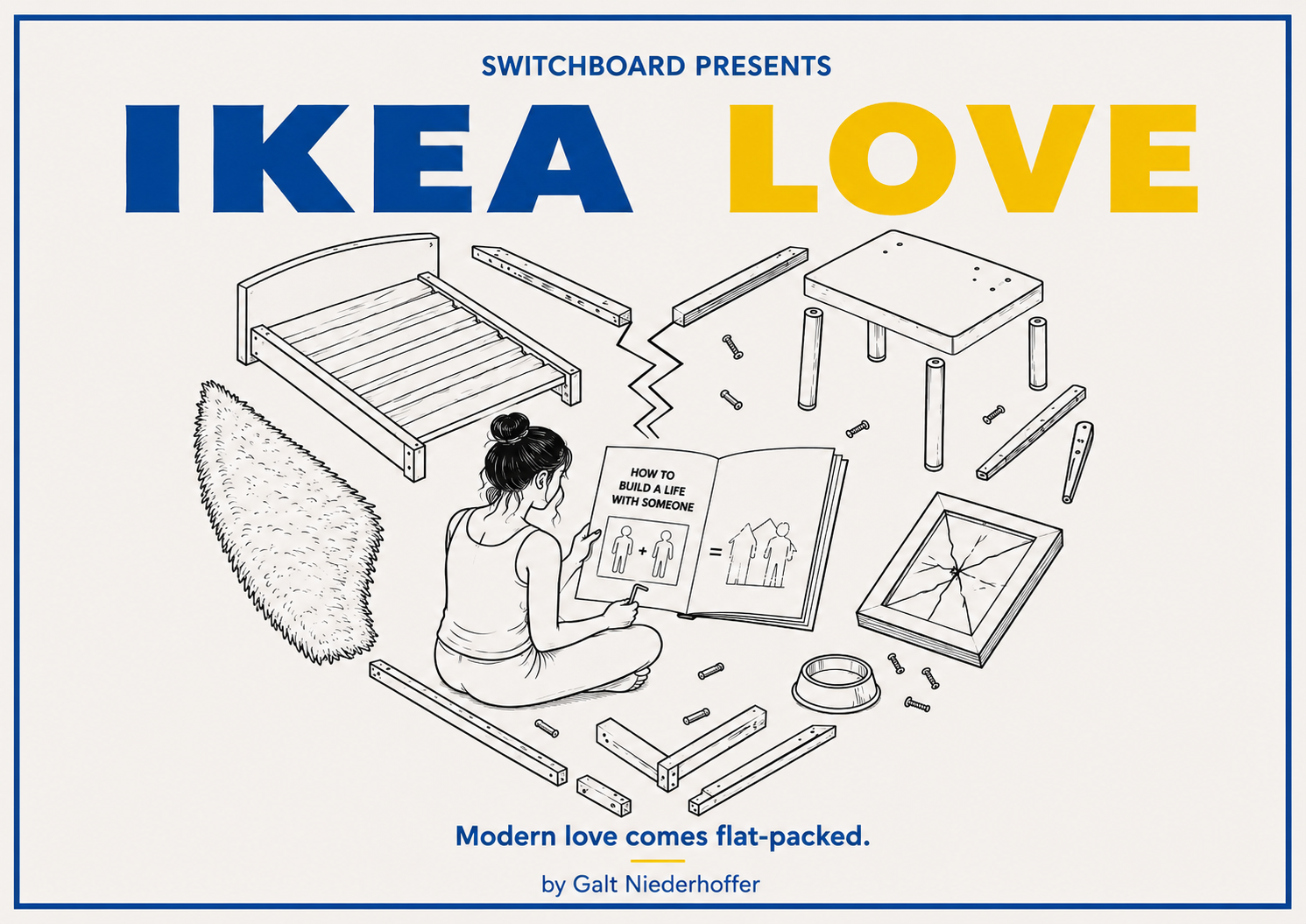
Abby’s boyfriend broke up with her in the best of all possible ways, by telling her he was fantasizing about other women.
“I promised I would be honest with you if this ever happened,” he said.
Weight pooled in her chest. “If what ever happened?”
“If I started to think about other women.”
“You cheated on me?” she asked.
“No,” he said. “But I want to.”
“Who is it?” she asked.
“No one specific."
“More than one?” she pressed. “No.” He paused.
Abby sighed.
“More like hundreds.”
Which was, despite the drama of the statement, strangely comforting. The antagonist was a faceless monster. It had less to do with Abby or any one girl, but rather an unknowable them. Extra points for honesty.
Abby and Eli had been together for about two years in a weirdly happy relationship. They laughed and talked and kissed a lot. One night, when they were cooking dinner, Abby told him about a movie where a guy asks a girl to say ‘I’m so obsessed with you’ again and again while they’re having sex. A new take on ‘say my name’. Eli kissed her and turned her over the counter.
“I’m so obsessed with you,” he said. “I’m so obsessed with you.”
Abby believed him.
Within a month of the break-up, they were hanging out and hooking up again, but it was pretty clear that the hundreds were still on Eli’s mind. They considered a non-exclusive arrangement: polyamory, like Gen Z and the tech bros. They would game the system. Date freely and engage in radical honesty. Open the relationship to save it. They shared locations to kick it off.
Abby assumed it would go like this: the novelty would wear off quickly. She would have some fun, make him jealous, and ultimately call his bluff. He would realize their profound connection outweighed all frivolous new ones. He would beg her to take him back, renewed in his commitment. Baby in. Bathwater out.
For Abby, it was a little like taking a cold plunge in the Arctic.
Still, they dove in. They re-upped their apps and commenced scrolling, vetting, and chatting with the unknowable them. Sharing locations allowed them to monitor–or torture–each other virtually, to imagine–but never fully know–what was going on under the blinking blue dot. They had been at it for about three days when a wholesome divorced dad on Hinge asked if Abby wanted to meet at IKEA as a quirky first date. She needed new kitchen stools anyway.
They met at the entrance as though they were meeting for coffee and proceeded to walk through the store. Most of the times she had been to IKEA, she was furnishing a new home as part of a couple. The contrast between that shiny optimism and her current state was stark. Instead of making witty banter with the date, she found herself pointing out items she had purchased over the years. The first sofa she and Eli bought for their apartment. Those faux fur area rugs they ultimately trashed. The weird night lights in their bathroom. The store is one long allegory. A walking tour of the fragile rig of domestic bliss. A map of broken dreams, built of particle board. The detritus of modern love. The date was an accidental elegy.
Wandering through the maze, high on cinnamon fumes, Abby felt dosed. She imagined a reality show in which two strangers were paired up at the entrance, challenged to make their way through the grid and cosplay falling in love. Then the doors lock shut and the game devolves into horror. The players have to survive on Swedish meatballs, armed with knives from the kitchen section.
They got acquainted in a bedroom. They had plenty in common–lived in the same neighborhood, liked the same writers, songs. The shared affinity meter was high. But Abby was distracted. Her phone kept buzzing. Eli was sending a stream of texts, clearly anxious about her date. In one of them, he was wearing the flannel shirt she had bought him for Christmas. It was the sexiest thing she had ever seen. And the saddest. The first dick pic that made her cry.

She slept with the next one she met the first time she met him, breaking all her own rules. It was exciting and scary. Also pretty stupid. But it felt like an important part of the project. Or plot.
A Google forensic confirmed this guy was a Marine who had seen some shit in service, had probably lost a friend or two and had a fair amount of trauma. In other words, the sex might be rough. She recklessly agreed to meet him at her apartment. Her building had a security camera out front.
He arrived in a red pickup truck, his pecs bursting from a white t-shirt. Brown hair fell in cherubic curls. His biceps bulged like balloon animals.
Abby asked him what he liked and he said ‘doggy’ and ‘reverse cowgirl’. He said he wanted her to ride him. She was more asking for a genre of sex—gentle, rough, sensual. But this seemed to be his comfort zone.
She provided Magnum-sized condoms in the hopes of killing him with kindness but she underestimated his interest in dominance. His genre was rough, slightly painful. The manic energy of a meth head but with the lingo of seventies porn. He recited a bunch of cliche dirty epithets like ‘that’s my good girl’ and ‘take it all’’. He said ‘you like that’ so many times that she couldn’t tell whether he was asking or telling her. He said ‘this is your cock’ and ‘that’s‘my pussy’ enough that she started to experience gender dysphoria. Then he flipped her onto her back and continued in a way that hurt her hamstrings.
She wasn’t sure why she thought this should be the first leg of her journey. But at least, she knew now that Millennials were wrong. ‘Sex positive’ was problematic.
Afterwards, they exchanged a few pleasantries before the text thread went dead. The only lasting evidence of the encounter was the half empty box of condoms in her underwear drawer and the pain in her thighs. It hurt to walk for a couple days.
The next date started off badly enough she should have ended it up front. He was ugly in a way that was hard to describe. The ugliness came from within.
Abby had the good sense to divert the date from coffee to a walk. Sitting down for coffee would have bound her to an hour at least.
“So, where do you live,” he began as they walked towards the river.
“Nearby,” she said.
“You said you went to school in Providence?”
“I did?” she asked. The river was about a quarter mile from the coffee shop.
“Your profile said you went to school there.”
“Oh, right,” she said.
“High school?” he asked.
Abby paused. She could say ‘I’d rather not answer that’ or just continue in this passive aggressive way. “Also nearby.”
“What year did you graduate?”
She stopped like a mule. “I’d prefer not to say,” she said. And then, trying for playful, she said, “I’m actually kind of shy.”
“Fair enough,” he said.
They had nearly reached the river but Abby was actively looking for a graceful exit.
“So you liked Providence?”
“I loved it,” she said.
“When were you there last,” he asked.
“I dunno,” she said. “Before Nine Eleven.”
Shared affinity was the uranium of the digital age. A pyrrhic victory. It provided conversation among strangers, bonded two people with no common ground, and created delight in a desert. Online, of course, it profiled us for infinite consumer opportunities. Abby already knew that shared interests were a false positive. A dead-end, an emotional cul de sac. But right now, she was semi-trapped. She took the opportunity to opine on Rhode Island. The clean, green towns. The breezy beaches. Clam shacks.
She began to wonder if the things she loved about the place were the men she remembered in it. Like the college boyfriend who took her to a graveyard on their first date and kissed her in front of a mausoleum. Or the one who taught her to drive a stick in the sand. Or the mix tape he gave her with every song was written by a dead musician. Sometimes, it seemed like the whole point of falling in love was to have someone to think about when it ended. The memory was better than the experience. Love could not fully fill a life, but yearning for one, mourning could.
“So you graduated before 2000?” he asked.
Abby turned to face him. “Are you trying to calculate my age?”
“No,” he lied. ‘No.”
“You are,” she said. “Just admit it.”
”I just realized we might have friends in common.”
“So just ask me,” she said. “What are their names?”
“Okay,” he said. He threw out some names that did sound familiar.
Then Abby realized they were in a class a few years above her Hehad lied about his age. A man is always most paranoid about the lie he is telling
“I’m gonna go,”Abby said.
“Wait,” he said. “That’s it?”
“I’m not feeling it,” she said.
“I think you’re a little hypocritical,” he said.
“I think you’re a little creepy,” she said.
He stood for a moment in silent resistance then reluctantly started to walk. She waited until he was a full block away before she started moving. Right before turning the corner, he looked back and stood still for a moment. “I’m not creepy,” he shouted. And then louder, “I’m not creepy!” He kept yelling, “I’m not creepy” like an irate Rumplestiltskin.
The strangest thing about Abby and Eli’s relationship was how peaceful it was. They were equal parts nerdy and fun. Boring and weird. Homebody and hellion. They almost never fought.
He had answered the most generic dating prompt: what are you looking for?
“A woman smarter than me,” he wrote.
It was both a compliment and a boast. Praise embedded in an insult.
“It’s your lucky day,” Abby wrote.
He made comments like this a lot, comparisons without metrics. Compliments with veiled insults.
Once he told Abby, “I missed you more than I expected.” No way to know if he had expected to miss her a lot or not at all. He was diabolical that way.
All of it made Abby feel like the relationship was a game, won by not expressing emotions. Every day she survived, she was closer to winning Eli’s love. She developed a case of emotional anorexia; the one who expressed the least got the most.
But the absence of fighting was not a virtue. It reflected something more nuanced, negative even. If Instagram was right, she was not ‘bringing her authentic self to the relationship’. She was ‘self-abandoning’. Pretending to be a version of herself that was false. Unbothered, quiet, chill. A cool girl with muted emotions. Not the messy, untethered, passionate freak she really was. The Bronte character, running through the moors, hair flying, tears streaming, corset ripped. The dissociated dreamer, staring blankly into space like a raver in a k-hole.
One of two things was true: she had been admirably restrained, or she was hiding her true self. Flattening herself like someone lying on the floor to avoid a shooter’s flashlight. This was not all bad. It conditioned her with a certain discipline. She liked the way she was around him. Measured, aloof. But this was only part of Abby. She was actively hiding other parts. In the relationship, she was half herself. And therefore, wholly fake.
The phrase ‘the truth, the whole truth and nothing but the truth’ is comically redundant. The truth is blurry. This phrase understands that anything more or less than truth is, in essence, a lie.
There were times when Abby erupted. When it became clear she would have to extract emotion from Eli like a surgeon removing a gall stone. Every time, he reacted in the same way, answering with the quippy defiant tone of a frat boy on trial for date rape.
She mistakenly thought trips might be a good time for these conversations. So began a tradition of ruining very fun trips. Emotion overwhelmed her when they were away together, and she had him cornered. It was a tactical move, albeit a dumb one. The conversations had a way of turning into confrontations.
The first time was a sneak attack. They had been together about three months and it was a valid time for the ‘what are we’ conversation.
At dinner, Abby said something like where do you see this going. He said something like ‘let’s not ruin this with labels’ and they sat in silence for a little while.
“I obviously have strong feelings for you,” he said finally. He sounded like a child accused of stealing cookies. As though he was saying ‘okay, yeah, I did it’.
This pacified Abby for the moment. What else could he do — promise her the moon, marriage, a crystal ball? He was not wrong that actions mattered more than words.
The next time, they were in Maine, hiking in a national park.
“Sometimes, it’s nice to use words precisely. It makes things more real.” She felt like an ESL teacher, explaining conjunctions to a confused classroom.
But Eli seemed more bored than confused.
“Words are good. They help you store up for the winter,” Abby tried.
“Maybe there won’t be a winter,” he said.
Dry leaves crackled under their feet.
The next time, she tried to be more strategic. They were swimming in the Sound and had just made it to a floating wooden dock.
“How do you even feel about me,” she blurted out.
“I like you,” he said. Now, he sounded like a teenager, telling his mom, ‘I took out the garbage. Like you asked.’
On a trip to Miami, Abby tried asking in Spanish.
“Porque nunca dices te amo,” she asked.
He looked away.
“Porque no quieres?” she asked.
“No,” he said.
“Porque no sabes”
“No,” he said.
“Porque no conoces,” she tried.
“No. No, No.” He sealed his mouth like she was an aggressor and he was refusing consent.
But something was shifting. The next day, they were sitting on the beach, playing cards. He looked distracted. Wrestling with something. When they stood to walk back, he grabbed Abby by the shoulders and turned her to face him.
“Of course, I’m in love with you,” he said. “Okay?” Now the tone was criminal confessing to a crime. “I wouldn’t have stayed with you this long if I weren’t in love with you.”
Abby nodded, unsure what to say.
“It’s just a scary amount of commitment, okay?”
He explained the concept of ‘revealed preference’.Love, for this man, was such a mysterious concept that the only way he could know its presence was with its evidence, its by- products. Love was found to be present or proven, not from the feeling per se, but by the actions it inspired. Preference spoke louder than words.. It was empirical proof. Love was not a feeling, but an urge. Measured by where the body leaned, what it craved, what it directed you to do. The heart wants what the heart wants. The body votes with its feet.
People liked to say ‘love is like a drug’, but it was a pretty bad one. Not pure at all, but cut with synthetic junk. Why not invent a love that lasts? Less like street cocaine and more like matcha or green tea. It might not get you amped but it’s gentler on the system. A mellower high. The girl next door, as opposed to the slut down the street.
Instagram had its own theories.
“You are dating a man with an Avoidant Attachment Style,” it declared. “Did you know that this lights up the same regions in the brain as addiction to an actual drug, causing the same dangerous highs and lows, the same crushing dependence and withdrawal? Depression, anxiety, self-loathing, intrusive thoughts. As with any other addiction, you must go cold turkey. No contact is the only way forward. I’m sorry. You’re going to get through this.”
Instagram was smart but Abby was clever. She knew she had to ask a more pressing question: who was the real avoidant here? A man who studiously suppressed emotion or a woman who consistently chose him.
Heeding the advice, Abby took a break from the app. Her next date was with a dad at her kids’ school. She was pretty sure he liked her before they met. At a cocktail party for parents the week before, he kept touching her back. In fairness, she was wearing a backless dress which was slightly brazen for a school event.
“I heard you shoot guns,” she began. He was notorious among the moms for being the one liberal who liked guns.
“Yeah, but only to kill animals,” he said. “And to scare other parents.”
"They must love sending their kids to playdates at your house."
“Oh they do. The kids have a blast.”
They stood in silence for a second.
“What do you do with the animals you kill?”
“I eat them. Or throw them away.”
“Do you hang them on the wall in some special way? Or is it more like statues? Or busts.”
“I think you’ve watched too many westerns.”
“What do you do with the deer after you hang it?”
“I eviscerate it,” he said. Then, elaborating, he said, “I cut the heart out.”
Abby considered that he was a psychopath. Not in the serial killer way. More like the clinical definition: low empathy for people (and animals), high drive for thrills, a penchant for long-term planning.
“Want me to show you how,” he asked.
Before she answered, he was touching her back. Pinching the muscles on either side of her spine, right behind her heart.
“I go in through the back with a very sharp knife.”
Abby winced. “What does it taste like?”
“It’s actually very tough. The heart is a muscle,” he said.
“Good to know,” Abby said. “I will remember that next time mine breaks.”
He asked her out the next week and they arranged to meet in a park. He arrived with a backpack filled with textbooks, a homemade weighted vest, and a plan that involved circling the park, doing stairs and pull-ups.
He stopped at a circuit-training station and did an impressive set of pull-ups.
“I used to wrestle in college,” he said.
‘Oh,” said Abby.
“I know what you’re thinking. It’s homoerotic.”
“I wasn’t thinking that,” Abby said.
“Because of all the touching.”
“I wasn’t thinking that.”
He looked relieved. Like this was a secret shame he’d wrestled with.
“Everyone looks at boobs, even women,” he added. As though it was further evidence.
“You have really good posture,” Abby said, trying to change the subject.
“That’s from wrestling. Wrestlers walk like ballerinas.”
“How do ballerinas walk?”
“Tits up,” he said.
She smiled. This was getting a little weird.
It was becoming clear he was not going to change the subject. Abby tried to embrace it. “So tell me more about wrestling. You get the other guy on the ground? On his back? Is that the point?”
He paused as though he was searching for the right word, then he got really low to the ground, squatting, hovering like a goblin. Then he lunged toward Abby, causing her knees to buckle and tackling her to the ground. She lay on her back on the cement, panting, staring up at the sky.
“That’s the point,” he said, standing over her.
Abby nodded, still catching her breath.
Thus far, she’d been sharing her location for convenience, for safety, and occasionally to mess with Eli. He had no way to know if she was on a hot date or sitting in a diner alone.
But tonight, she wanted privacy. So she left her phone at home and ventured out, naked of technology. She wanted to be anonymous as she walked into a meeting for an addiction she wasn’t sure she had or hadn’t acknowledged yet. Did that make her a fraud, a mole, a snoop, or just another addict in denial? Or worse, a loser lonely enough to make up an addiction.
Surely, she had addictions of some sort. She was addicted to sex, to love, to chocolate, to not eating chocolate. The addict gene ran in her family. She had plenty of childhood trauma–and some as a young adult. She certainly should have been an addict. Was maybe already an addict. Seen differently, she might soon be in recovery from this relationship. Regardless, right now, she needed to be there and that was reason enough.
Church basements and meetings were a perfect pairing, somehow divinely ordained. The ground floor of the church was for regular sinners, the basement was for lost souls. The daylight of vaulted windows was reserved for people in the later stages of redemption. This dark, damp liminal space was for those in earlier stages. Troglodytes encountering the light.
Folding chairs were lined up in neat rows. Two men sat in front, facing the group.
Abby walked to the back, looking for a place to blend in. A metal urn with coffee sat on a table near the back. She poured herself a cup. The urn might as well have held her ashes. She was about to be buried alive.
A man entered slowly, his gait cautious, eyes scanning. He opened a metal chair and took a seat. Abby gaped in a reflexive expression of shock. This is what shock looks like, she told herself. Remember this next time you have to describe it. Eli gestured a couple times before she realized it was him, and that he was beckoning her to come sit next to him.
She crossed the room and sat on the chair beside him. She spent the next fifty minutes, crossing and uncrossing her legs, consumed with the shape of her thighs in her jeans. They looked like lobster claws.
Near the end of the meeting, his phone buzzed. He took it out of his pocket and smiled, giddy as a schoolboy. He may as well have run a bread knife through Abby’s heart.
After the meeting, he asked Abby where she was parked. She felt the particular panic of someone who knows they are moments from death. Words jumped. Image blurred.
“You okay?” he asked.
“Totally,” she said.
“Why are you here,” he asked.
“I was in the neighborhood.”
He nodded, sparing her further explanation.
“I should go,” she said. “I have a date tonight.”
He seemed relieved to hear this. Unlike her, he actually had somewhere to be.
He opened his arms and they both held tight. like drowning swimmers, going down.
“Have fun tonight,” she said. They were in the phase of conversation when a word was hurled like a life-saving device.
“Try to get some sleep, okay.”
“You too,” Abby said. Then she remembered he would be sleeping with someone else.
They hugged again, the magic of the first hug long gone, then he pulled away like Abby was a creepy uncle. She looked at him like she had to memorize his face.
“Well, it was good to see you,” she said.
He started to turn away, then turned back. “Maybe we shouldn’t talk for a week or two,” he said. He sounded like a parent losing patience.
“I agree,” she said.
“Not for me, but for you.”
“Totally,” she said.
“I think you should take a few weeks away from me and find your equilibrium:”
“Good idea,” she said.
“Maybe you just need to have sex with someone new.”
If you could die from being patronized, this was a murder attempt. “Maybe,” she said.
“I’m gonna go, okay?”
She felt the drowning sensation again. Water gushing into tightened lips. She inhaled, signaling one last question.
“You’re sure you're okay?”.
“Thanks,” she said. “Yeah.” And he walked away before she could say I’m gonna miss you to death.
It didn’t occur to her until later that, during this whole experiment, he had never checked her location at all.
It was one of the shortest dates but in some ways, the most complete relationship. It encompassed all of the stages of love. Just faster and more furious. Curiosity. Hope. Euphoria. Boredom. Contempt. Indifference.
He had the dry sense of humor of a midwesterner. Meeting her quips with comically low affect. It did not occur to Abby that she might have mistaken sarcasm for someone who struggled to detect emotional cues.
He checked a lot of boxes. Played the guitar. Read a lot. Worked in tech. Interests that aligned with Abby’s algorithms. The app had pegged her to a constellation of likes.
“I’m glad you’re here,” he said when they met at a local bar.
She was immediately distracted by a large stain next to his pant zipper. He smelled like Listerine or very strong alcohol.
“Want to go for a walk?” Abby tried. She had learned her lesson. If you’re going to bolt, do it fast.
“You don’t like this place?” he asked.
She shrugged. “It’s so nice out.”
They stood from the bar and strolled silently down the street. A block later, they passed the wholesome divorced dad Abby had met in Ikea. She gasped.
“That’s weird,” she said.
“What’s weird?”
“I know that guy,” she said.
“Oh,” he said. “Do you want to say hi?”
“No,” said Abby. “It’s okay.”
They walked another block in silence. Something shifted in the mood.
“I think people who say ‘weird’ are close-minded.” the guy said.
“How so,” she asked.
“I think that word is mean.”
Abby looked at him carefully, unsure if this was a joke. If this was the wry humor of a disaffected dude. If he–or she–was misreading the tone. “I just meant it was surprising.”
They walked a few more steps in silence. Laughter drifted from a nearby park.
“You know what I’m gonna go,” he said.
They had reached a Citi Bike terminal and he started fumbling to unlock a bike.
She was not sorry to see him go but miffed to be beaten to the door by a guy who arrived with a stain next to his zipper. “Did I say something?” she asked.
“Yeah, you know what you did.”
“Please tell me what it was,” she said.
He fumbled with the bike dock some more then looked at her with ferocious intensity. “Most nights, I lie alone in my bed, thinking, what would it be like to be lying here with someone. Lying here, looking into someone’s eyes. Maybe she has her head on my chest. Maybe I’m stroking her hair. Maybe we’re just listening to music..
And then I meet someone and I think ‘fuck, who knows’. Maybe this could be the one. I let myself imagine. I plan it all out. I picture our apartment. Our furniture. The stuff we buy together. And then she says something shitty like you just did, and I realize this is just another girl who thinks she’s out of my league, who wants to be taken on vacations, who wants me to be ‘more established’. Another girl who thinks I’m weird. So you know what? Just fucking forget it. I’d rather be fucking alone.”
He released the bike from the dock in a graceful but violent flourish and sped into the night. The bike made s’s, weaving. It was almost balletic. Just before he disappeared, a thought came to Abby, a faint memory of a conversation she had had with someone else.
There are eight characters and eight conversations. Everyone could be anyone, fighting with their spouse in the living room over the laundry or who gets to sleep in on Sundays. A fight their mother and father had a thousand times, and grandmother and grandfather, and forefathers and foremothers. Nothing has ever changed. Not only the way couples fight but this desperate, clamoring need for connection, and the consistenlyt tragic ways people destroy the thing they want the most.
Unique pairs are not that rare. It was possible, even likely, that dating apps pulled the same metadata that sell you bikinis on Instagram. Every click, every query fed the algorithm. Who might you like? Who might like you? What was your shared affinity with a total stranger? What subject could provide ten minutes of sparkling banter with someone with whom you’d otherwise have nothing to say? What topic could elicit an orgasm of coincidence?
Statistics offered an explanation. Put twenty-one people in a room and odds were high two would share a birthday. Add mutual friends, hobbies, college towns, vacation spots, sports. The permutation multiplied exponentially into an explosive illusion of destiny. And identity.
But another possibility unsettled Abby. That ‘the one”, that ‘your person’, ‘your soulmate’ was a delusion too. Like the idea that we’re alone in the galaxy. With enough to talk about, the requisite number of stupid sparks, you could fall in love with anyone. Could you fall in love with anyone?
Men began to blur in Abby’s mind–the marine, the wrestler, the biker, the dad, the ex, the other ex, the love of her life–all of them reduced to their favorite cities, songs. Who they’d loved, lost, fucked. What we thought was desire was just pattern recognition. What we believe to be uniquely us is something we stole from someone else. What we think is special is just a clawing grasp at any common ground. That ‘yeah, me too!’ feeling.
A month passed and Abby and Eli made plans to get together and regroup. They were still dating other people, Abby, half-heartedly, Eli with unsettling focus. She found herself increasingly icked out, avoiding unwanted hookups, declining invitations. Eli was tenacious, scrolling with a drive that made him seem decidedly DTF–Not just down. Determined. Desperate. Or worse. Desperate to find love.
He went on a date with someone that seemed like a classic pick-me. Abby felt like MacGyver, racing the clock.
“Was it good,” she asked as they lay in bed.
“It was hot in its own way,” he whispered.
Something stabbed her lungs.
She began to grill him about the standings of his current dates. Which ones were girlfriend material? Which were just sex. Fuck, date or marry. She assigned the traditional nicknames: Soccer Mom. Pretty but not Sexy. Funny Professor. Learned the new lexicon. Eli told Abby Pretty but not Sexy might be a ‘keeper’. This sent her into a tailspin. If Pretty but not Sexy was a keeper, what did that make Abby: Sexy but not Pretty? Fuck but not Marry?
Opening up the relationship was like taking a psychedelic trip. A sometimes thrilling, sometimes terrifying plunge into an unknown realm. Infidelity was not just possible. It was inevitable. The worst of all possible fears would come true and life would go on the next day.
A chilling reminder to Abby that she had no control over anything. We can wear seatbelts and helmets. Fret obsessively about the future. Chance favors the prepared a little bit. But given the difficulty of gaming disasters—pandemics, accidents, heartbreak—best-laid plans start to seem stupid and detachment seems like a good bet.
By this logic, opening a relationship was a courageous act. A jump off a cliff with the hope of a parachute. An acknowledgement that even the strongest vow is always vulnerable to changes of plans or partner or heart.
Still, it was not for Abby. It was not her like. With every day that passed, she grew more upset. She tried various means of self-soothing. Excessive exercise. Meditation. Obsessive letters on her notes app. Soliloquies she knew better than to send:
I don’t know if you know what this is doing to me. I do know that you don’t care
This whole thing has been surreal, somewhere between thrilling and waterboarding
There’s something sick about staying with your partner while they look for a new one. Like chilling by the fire as a chicken. Like sunbathing in front of a shooting range
Then, the more indignant ones:
Am I just a dick-warmer?
I love you too much to do this anymore and have too much self-respect to do this to myself
And finally, to the point:
We have to stop. This is killing me.
She was sick of pretending she wanted anyone else. Pretending it turned her on to date other men or hear about other women. So she told him the truth.
She devolved into a chaotic recitation of her notes app. She told him all the things she had been afraid to say. That this was making her doubt herself. That this made her feel — that he made me feel — that she was not enough. She did everything she promised herself not to do. Losing her dignity while attempting to reclaim it. Saying everything she needed to say despite the well-known advice never to give a man the satisfaction of knowing he has broken your heart.
She fell way the fuck apart and he held her as she cried. Her emotionally avoidant boyfriend held her tight.
It was the most intimate they’d ever been.
The poly experiment concluded. It was fruitful in that it revealed Abby’s preferences. She wasn’t capable of detaching, or sharing, or giving up on her dreams. She wanted more–a home to furnish with one person, even with Ikea furniture.
It was a little like coming down from a drug. She remained unconvinced by both paradigms, exclusive and non-exclusive relationships. Both fail. Both end. Both have an inevitable expiration point where things fall apart and land, cracked in a dumpster.
The next morning, Abby texted IKEA Guy.
“I have a favor to ask,” she said.
“Shoot,” he said.
“I left my place suddenly yesterday and my cat is still there. I’m wondering if you could feed her.”
“Sure!” he wrote quickly. “Happy to feed your cat.”
He started telling Abby how much he loved animals, how he’d always wanted a pet. So began a new relationship, as easy as assembling a new kitchen stool.
She marveled at how fast they could form this affordable intimacy. Perhaps there was a third option, a different paradigm. A wordless manual for something that abided by less brutal laws than love.
“It’s an IKEA friendship,” Abby wrote.
“Let’s hope it lasts,” he said.

Galt Niederhoffer is the author of four novels, producer of a bunch of indy films, and teaches at Columbia University's School of the Arts.
