
Pardon the Fool
By AJ Clauss
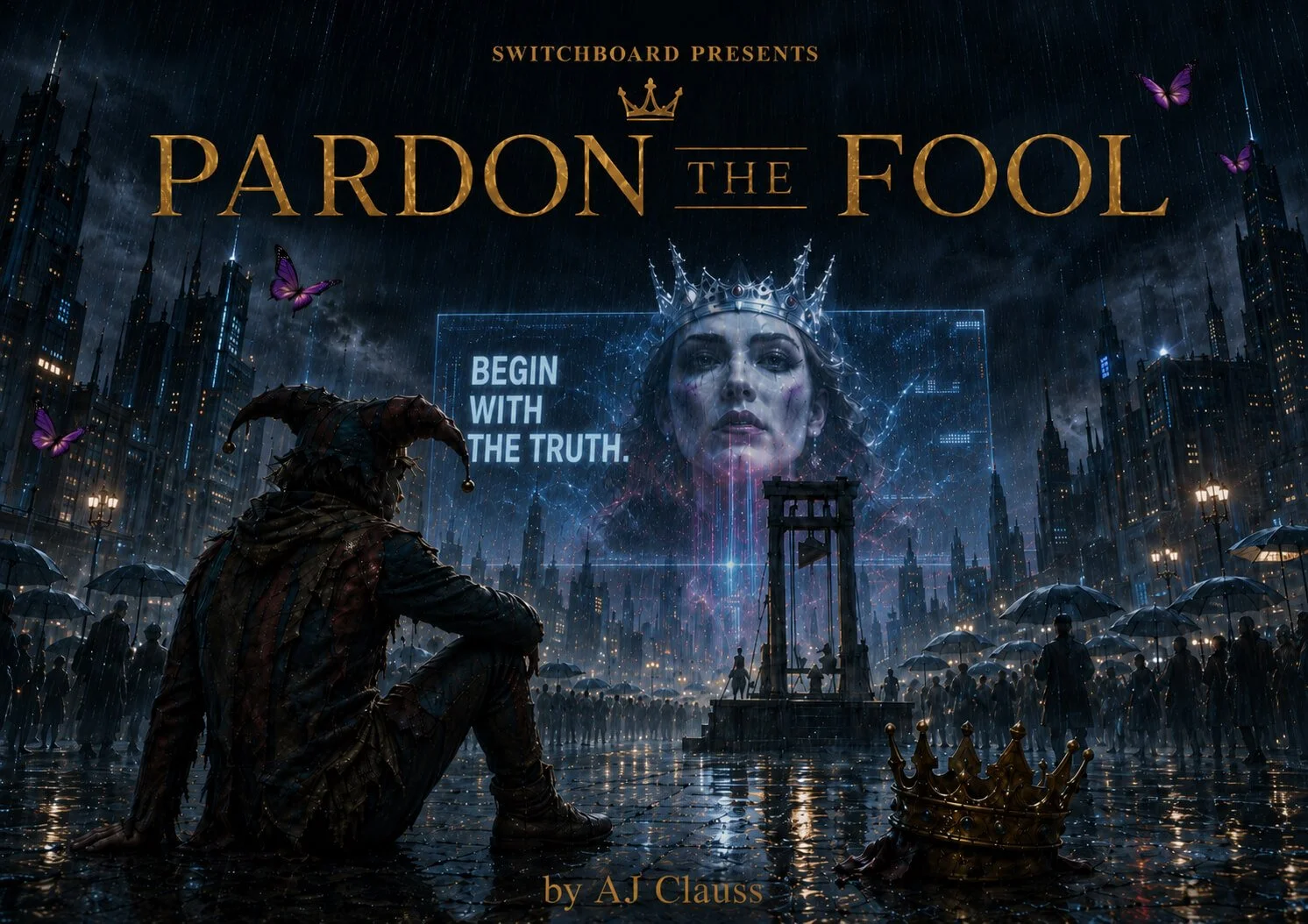
They say you get eight seconds.
After the guillotine drops.
After the crowd cheers and the trumpets flinch.
Eight seconds of knowing and not. Of being.
I used them all.
One: The sound of metal through the air. That long, clean whisper.
Two: Thinking of her. Of Queen Siva. And how I used to joke, “I’ll get you to go outside someday, you beautiful coward.”
Three: The sky was gray the day I died. I didn’t see it, I imagined it.
Four: I always imagined gray when I pictured her walking through it.
Five: I wanted her to breathe. Just once. Unfiltered, unpromised air.
Six: I remembered her last words to me—“Your job was to make me laugh.”
Seven: I finally understood the punchline.
Eight: And so I decided not to ruin it.
I don’t think this will be what you think it will be.
It’s not a love story, though I do love her. And it’s not a tragedy, though my head did roll.
My title was Fool. Which is technically the oldest profession in the world. People always say prostitution is the oldest profession but that feels unfair because somebody had to make the first prostitute laugh.
I made my living by making the Queen forget her nightmares. And when I died, she went outside for the first time in forty years— just to carry my head through the rain.
Tell me that’s not love.
Tell me that’s not a mother fuckin’ punchline.
Rule #1 to writing a good joke: always begin with the truth.

They were holding open auditions the day I arrived.
Which is funny, because I didn’t know I was auditioning. I just wanted to see Charlie.
The palace was colder than expected. Not regal, just refrigerated.
I walked in wet, humming something I couldn’t place, trying not to squeak in my shoes. My name wasn’t on the list, but I smiled like it was. That’s half the game, you know. Smile like you belong, and people assume you do.
“Name?” the assistant asked.
“Ebony,” I said. Which was a lie. My sister’s name. She drowned.
But it felt like the right answer.
They handed me a slip and I waited under a portrait of the Queen. Her eyes were soft, metallic like the kind of aluminum you can’t recycle.
When I was finally called, the Queen didn’t look up. She just said, “Next.”
I stepped forward. Cleared my throat.
“Hi. Hello. Sorry, I’m—uh—I’m sorry.”
“Did you just apologize for being here?”
“More like... sorry for being. In general. Habit.”
I panicked. Started rambling about flies. How I could catch them with my hands. How that might be a useful skill to hire in the palace.
“I mean, do you have flies here? You don’t look like the type of people who get flies, but you never know—sometimes the rich can get very still and the flies, they come to them.”
The Queen blinked. “We do not hire fly-killers. That is not a job.”
I knew then that I had her. She wasn’t impressed—but confused. And confusion is just curiosity with a real cute costume.
“I’m actually not Ebony,” I admitted. “I’m Margery. Margery Staph. Ebony was my sister. People thought she was a witch because she was so beautiful. But she drowned. So. Guess they were wrong.”
The Queen smiled something crooked and dry. “Margery,” she said. “Tell me something funny.”
Funny?
I did not.
I couldn’t.
No, not yet.
But she gave me the job anyway. My job description was: to make her laugh. But my real job was: to make her forget.
I was allowed access to all her inner chambers. Even the bathroom. Especially the bathroom.
And I got to see Charlie more, which mattered.
Here’s the thing no one tells you—it was never about the power. It’s about proximity. Who you get to be near when it’s happening. Who might look at you a second longer just because you're wearing a legit looking name tag.
One like mine.
One that says: Fool.
Rule #2: Timing is everything.
I came home soaked.
Toes wrinkled in my boots, mud clinging to the hem of my pants.
Charlie doesn’t look up when I come in. Just says, “You’re bleeding again.” Like I’m always doing that. Like it’s something I do for fun.
“Oh,” I touched myself. “Fuck.”
Blood was trickling from the underside of my arm, I didn’t even feel it. I took the nice way home, stupidly. The part of the city with marble stairs and broken surveillance. Two men followed me. The quiet kind. Not calling for cats, but just there in a way you have no choice but to stomach and move past.
When the one grabbed my arm, the other pulled out his knife.
“Take whatever you want,” I said. “But don’t take my left hand. I touch myself with that one.”
It just came out of me. I wasn’t trying to be funny. But the guy holding me laughed. Like, really laughed. That kind of startled, gut-punched laugh you don’t mean to make. And in that split second he lost his grip. I fell. Hit my elbow. Scraped my knee. But they let me go.
Charlie’d already gone quiet. He was either exhausted or just focused on folding his laundry.
I pressed a napkin into the cut and watched it soak.
“You ever think about the fact that I might die coming home?” I asked.
He didn’t answer. Just reached into the pile of clean socks mercilessly trying to find something that matched.
Our apartment smelled like spoiled dirt and burnt plastic. Charlie tracked in soil from the Queen’s garden and from the cemetery job. He never fully washed it off.
“You aren’t even gonna wash your face?” I asked.
He shrugged. “Skin is falling off my big toe. I get charley horses, everywhere, every time I stretch. My dreams are mean to me. My whole body is revolting. Our ceiling is dripping. There’s money. Our lock is broken. More money. I’d like to get this weird mole removed I think it might be bad—”
“The one on the back of your neck?”
“Money we don’t have.”
I handed him my half of the month’s rent.
“And a little extra,” I said. “Because I fuckin’ love you.”
He takes it like it’s heavier than it is.
I don’t tell him what happened at the palace.
I just sit on the edge of the bed, peeling off my wet socks.
There’s a version of me that laughs about this. How absurd that day had been.
But there’s another version—the quiet one, with my heart still sprinting, or, some type of gymnastic flipping like a kid simultaneously ready for her first day of school and strapped in for a roller coaster, handlebars everywhere, a crooked smile and antsy knees, having been strapped in all day.
I stared at the ceiling and waited for the next drip to fall.
Charlie always counted backwards when he couldn’t sleep. I never liked numbers. I don’t trust ‘em.
But curious little facts that never leave me alone? Those work much better for me. My sister used to call it eating the sheets and that’s how I counted my version of psycho-sheep.
Sharks existed before trees.
Bananas are technically berries.
Tomorrow I’ll go back to court.
Bubble wrap was supposed to be wallpaper.
Do butterflies remember being caterpillars?
Tomorrow I’ll make the Queen laugh until she pees.
And who the fuck invented mirrors?
But tonight, I am just a body trying not to be afraid of itself.
Rule #3: If you’re not nervous, it’s not funny.
Knock knock.
“Enter,” she said.
The Queen was perched on a white ceramic throne. Not a metaphor. With a golden flush handle and a tiny bell she used to summon extra wipes.
“I hope I’m not interrupting,” I said.
“You always are,” she said. “But I prefer it that way.”
She liked an audience on the privy. Said it helped her think. Sometimes she’d sit there for hours. No urgency, just ritual. She called it her thinking seat. Said the neurons fired better when she was grounded.
“There used to be this saying,” she said once, not looking at me, “about how you are always greener, always jealous of how the—”
“I think it’s the grass.”
“Really?”
“Yeah, the grass is always greener.”
“But, why?”
“Like, your neighbors, they have better grass—”
“They do not!!”
“No, but that’s the saying when you—”
“I have the greenest grass!”
“Truly, I’m not arguing with you I just—”
“In fact, it’s some of the only grass.”
“No, you’re right, it’s just green, then.”
And there always came this point where she’d stop sounding like a person and start sounding more like a prophecy.
“I think,” she’d continue, “there’s a little me and a little you inside us. And they’re just here to want. That’s it. They walk through the world with open mouths. Wanting. It’s embarrassing.”
“What do they want?” I asked.
“Everything. Anything. Something.”
We sat in silence for a moment, letting the room air out whatever it needed to. The Queen made a face and muttered something about oatmeal while I tried not to gag.
The Romans had communal toilets. Imagine trying to have oatmeal diarrhea while discussing zoning laws with your neighbor. The Queen would've loved Rome.
“Why don’t you ever go outside?” I finally asked the question I was told never to ask.
She didn’t answer at first. Just pulled a bit of toilet paper and folded it into a perfect triangle. Then, without looking up:
“The day of the first explosions, I snuck out. I told Kip—my caretaker—that I’d be back before Mother noticed. I was gone twenty-two minutes. And in that time, three blasts went off. The third hit my home.”
She paused.
“My mother began snowing down on me. And Kip. And everything else I knew.”
My mouth went dry.
“So I don’t trust the air anymore,” she said. “Besides, if there are more bombs, this is the safest place in the world.”
You know there are birds that never land? I read that once. Or maybe Charlie told me. Where they sleep while flying. Imagine. Trusting the sky more than the earth. Queen Siva somehow managed the opposite.
I picked an eyelash off her cheek and made a wish.
She gasped. “You stole my wish!”
“Sorry,” I said. “I was raised poor. We were hunter-gatherers.”
She made me give her one of mine. I plucked an eyelash and held it out.
“Here,” I said, “Blow.”
She reached down and flushed. The roar of water between us.
“You know, you’re not just funny,” she said.
“That’s the worst thing you could ever say to me.”
But I smiled anyway.
Rule #4: You are never too old for potty humor.
The first time we rehearsed my execution, it was her idea.
She called it a light run-through.
“You want me to what?”
“Just kneel,” she said. “It’s funnier that way.”
We were in the throne room, which doubled as a rehearsal studio. Velvet drapes. Spotlights. A tiny guillotine someone built for a birthday party.
“Shouldn’t we have a prop blade?” I asked. “Like rubber?”
“No, no. People will know it’s fake.”
I knelt. She encircled me.
“You may now deliver your final words,” she said, slipping into her announcer voice. “Please make them memorable.”
“I thought I had more time!”
She stopped just behind my shoulder, whispering, “That’s good. Keep going.”
“I thought if I kept you laughing, you’d keep me alive?”
She leaned in closer, her breath summoning bumps on my neck.
“Now die funny.”
I let my head fall.
There was a beat of silence.
“Not bad.” She clapped.
After that, she started requesting little “bits” every day.
Not just jokes. Scenes.
What-if’s. Daydreams.
I didn’t know if she was using me or if we were playing together.
But honestly? I didn’t care.
She laughed more when I was around.
Sometimes she’d fall asleep mid-laugh, head cocked back. I’d stay there, watching her mouth open and close, like the air was almost safe again.
When I watched her sleep, sometimes I’d think:
If I can get her to go outside, even once—
If I can just get her to breathe—
Maybe she’ll love me forever.
That’s how it started.
The fix-her feeling.
Like love was a magic trick, and if I just pulled the right thread, the broken girl disappeared and a grateful one would take her place.
But the only trick I ever learned was how to make people laugh right before the fall.
Rule #5: The best jokes leave a scar.
Actually, that might be Rule #6.
I don’t know. I’ve never been that organized.
My name started showing up on flyers.
Not big ones. Not palace-approved. But the kind handed out in alleys and posted to cracked screens in the markets.
The Fool Performs.
Sometimes there was a time. Sometimes just a sketch of my face—eyes too wide, mouth mid-scream or mid-laugh. Hard to tell the difference.
It started to really take off after the Queen let me improvise.
No script. Just bits. “Let her speak,” she said. “Her mouth has merit.”
And so I did. I spoke. I joked. I danced in and out of state secrets without knowing which ones were still redacted.
People started quoting me. Laughing in public.
I was contagious. The good kind. It started to feel like all of a sudden not everything invisible in the world wanted to kill us.
When I returned to the court, I’d kneel at her feet and she’d say, “You smell like someone who’s been praised.”
“Jealous?” I asked.
“Of whom?”
“Of me.”
“No,” she’d say. “You’re all mine.”
And then—
One night, during a public appearance—charity banquet, off-mic—I told a bad joke.
I thought it was harmless. I thought I was funny.
I said the Queen hadn’t breathed real air in decades. That even her garden was fake. That her butterflies were branded.
I didn’t say it with malice. I said it like a kid forgetting which side was the brake and which side was the gas.
The laughter came slowly. People were checking if they were allowed to laugh.
The next day, I was not summoned.
The day after that, my flyers disappeared.
The day after that, the guards stopped looking me in the eye.
Charlie knew before I did.
“They’re saying you knew something you weren’t supposed to,” he said. “That you said something you couldn’t have known unless—”
“Unless what?”
“Unless it was real. Which would mean treason or the Queen is lying to her people.” He said, “You need to run. You need to, fuck, I’ll help you pack.”
But I didn’t move.
I couldn’t.
Because part of me still thought: She’ll forgive me. She’ll remember that I made her laugh. That I braided her hair while she dreamt of bombs. That I saw her face when it was unpainted and raw.
That night, they dragged me to the dungeon.
She came to see me only once, before the trial.
No guards. No speeches. Just her, stepping into the dark like she was visiting her own funeral.
“Where is she?” she called out.
“I’m right here,” I said.
“Where is she!” she repeated, louder.
“You’re so dramatic when you have to walk places,” I said, shifting in my chains, dragging the candlelight across the floor until it hit my face. “Better?”
She stared.
“Look at you.”
“Look at me.”
She knelt. Not close, but enough. “How are you?” she asked. “Are you keeping?”
“I’m good,” I said, with a bite. “Haven’t bathed, haven’t slept, haven’t eaten. You know. Human things.”
She nodded. “I’m so sorry.”
“How about you? Have you bathed, have you eaten?”
She almost smiled but I could tell that I’d lost my touch. The lack of calories will do that to a Fool.
“We used to talk about how to Do,” she said. “How to kick up the dust. What I would give—”
“To be simple again?”
“To dream about the edge. But not actually standing on it.” She traced her finger on the cobbled floor, drawing something in the dust. “You have the attention of the country, Margery. I guess we both do.”
“Please,” I said. “You get the hiccups and they invent a new sex position.”
She looked tired.
“They want you dead,” she said.
“I was afraid of that.”
“I’m so—”
“Stop. I know what this is.”
She reached out a hand. “Do you still have my ring?”
I nodded. “I ate it. No one’s taking it from me, I promise.”
Her hand dropped. “Very well.”
I waited.
“I came here,” she shifted, “to tell you: you have options.”
“Options!” I could cry. “Well! Why didn’t you say so?”
“Option A: refuse to apologize. Refuse to say your joke was a lie.”
I take a beat. “I choose Option A.”
She blinked. “Then death. By guillotine.”
“Ah. Hmm. Okay. Ow. Could we hear Option B?”
“Retract the joke,” she inhaled. “Say it was false. And I will pardon you. You’ll live. In exile. But it’s for your own safety.”
“Exile?”
“Yes. People want to spike your head on a spear.”
“You know, that never really…why they do that, and on the way to the market! I mean, then I go home and have to make beef goulash?”
“You could get a dog,” she said, almost hopeful. “They say exile is where the greatest works are born.”
“The truth,” I said, “is louder in the silence.”
“I want you to live, Margery. So badly. It kills me.”
I stared at her. My Queen was shaking.
“I will have a new life,” I decided. “Yes. My answer is yes.”
“Really?”
“Yes. To the moon. Without question.”
“Really?”
“Yes.”
“Really??”
“Uh-oh, she’s broken,” I muttered. “Someone help?”
She laughed—half-laughed, half-cried. “I’m so happy. I’ll let them know that you choose—”
“Option A.”
She paused, her cheeks bruised.
“Please,” I added. “With the potatoes.”
“Margery—”
“My new life will be here.” I tap her chest. “And here.” I tap her forehead. “And in everyone who comes to see. To watch. The Fool who refused to frown.”
She looked at me like a girl about to break her own heart.
“There are other people out there,” I said softly. “In the world. In the universe—”
“This again.”
“They’re watching.”
“I wanted a whole book with you. This is a paragraph.”
“If we were born another time,” I asked, “could we have been something else?”
“Please, Margery.”
I reached for her. “Do you think—”
“Don’t.”
I kissed her.
Just once.
She didn’t pull away. Not right away. But when she did, I had to wipe a tear from her cheek.
“Your job,” she said, “was to make me laugh.”
“And yours,” I said back, “was to keep me safe.”
Rule #6: Never perform for someone who holds your life in their hands.
An average head is fifteen pounds. We’ve put them on spears, spikes, whatever— ever since we’ve had spears or spikes, really. My favorite was the Old London Bridge. Spears on display up and down. Kinda reminds me of Disneyland.
Heads are weird. Newborn babies can't even hold theirs up. Which means the first thing your mother ever did was support your head.
When Dr. Joe Guillotin invented the blade of death, he was so proud of it. He described her machinations like poetry.
The blade falls like lightning, he said.
The machine was built by a harpsichord maker.
Dr. Joe was horrified—surprise, surprise—the first time he heard his baby speak.
History eats itself and then bakes the same damn pie.
There was a group of women who would park in the front row and knit. Between events of head-on to head-off. Housewives with crooked knuckles. Swapping superstitions. Sewing sweaters. Shhhhhp.
You have to believe in karma and coincidence to enjoy this but—
Dr. Joe died choking in his sleep.
His last words were: ack ack burp.
The sky was gray the day I died.
Not because I saw it, but because I knew it.
I tried to use my eight seconds deliberately, but if I’m being honest, the moment is never what you think it will be.
Sharks existed before trees.
Bananas are berries.
Wait, I never told the Queen that.
Butterflies remember.
Good, that’s good.
Bubble wrap.
My sister laughed like bubble wrap?
Was that it?
Wait, what?
Was that eight seconds?
Was that it??
I wonder what they saw that day.
If they saw a Queen in mourning or a woman in love.
If they saw a body broken by power, or just a vessel delivering a consequence.
When the Queen hesitated, Charlie said, “We do not have all day.”
“Not true,” she said. “We have every day.”
“It’s now or never, my Queen.”
“And every day after that.”
“It was her last request, we have to.”
“In fact, I could make up days. Could put days where there never were days. You know who has no days? Her head sits in this box.”
“I know,” Charlie said. “But it was her last request. We gave her our word—”
“WE have nothing to do with this! This was her. She chose. I merely put on a face, one of many. Should she care the face I wear today, she can come back to life and tell me herself… the flies will eat her, Charlie.”
They say the Queen stepped outside at exactly 9:03 a.m.
That she wore her second-favorite cape. No crown.
That her hair was unbrushed.
And that her eyes looked like the ocean before a war.
Charlie held one handle.
She held the other.
My head was in a box between them.
I’d like to tell you it was a metaphorical box.
But no.
It was an actual box. Lacquered wood. Clear top.
Like something you might keep a wedding cake in if you were deranged and rich.
The Queen didn’t speak. She walked. Slowly. Measured.
As if she were afraid my head would tip and roll.
Charlie didn’t look up.
I don’t think he could.
And from wherever I was—call it spirit, call it memory, call it bad reception— I watched it all.
I saw the Queen glance up at the clouds like she wanted them to punish her. I saw the way her lips moved without sound, when someone in the crowd shouted:
“Long live the Fool!”
But the Queen didn’t stop walking.
The rain got heavier. The guards finally opened umbrellas but the Queen waved them away.
“Let it soak me,” she said. “Let me feel it.”
I wanted to say something sentimental to her. Something like: I heard you had them cut me open to get the ring back, I love you. But I couldn’t find the words.
Rule #7: Even the dead get stage fright.
Years have passed.
And like most things, I have faded.
They built a statue in one province—not my nose, but good smile—
and they banned statues of me in another. Said I was a terrorist.
Charlie died.
Of grief, or guilt, or something even slower.
He slipped out one morning and never came back.
They found him in the cemetery he used to work at, curled under a hedge like a tired animal. They said his pockets were full of unfinished jokes he’d written out on receipts and napkins.
And the Queen grew old.
She shrank.
She spent most days lying down until one morning, she rose. Summoned the royal scribe and asked if there was a day that hadn’t been sanctified yet.
“April 1st,” they said.
She stepped out on her balcony to speak, but, see, because of the fluids and the body shutting down, some things got lost. But this is what she wanted to say:
“I would like to say I am sorry.
This is not the world we were promised.
The world my mother promised me.
Nor the world that I promised you.
We set out to build a new world that looked after each other.
After the collapse of the old, the rubble—
We took action, to take care of you, and you, and you.
And to rebuild.
But when that dust settled, it seems things just went back to normal.
I would like to claim this day as a holiday.
A holy day.
That shall henceforth be known
as All Fool’s Day.
We have lost something very dear.
Clearly we will never forget her laugh.
Thinking about her anytime we are miserable.
Or having fun.
She is a little like Death in that way.
Always in the next room, smiling, even now.
Long live my promise to keep you safe.
Long live you, and you, and you.
And long live the Fool.”
But again, because of the fluids, what she really said sounded something more like, you know I could havery have all this so verently, I could haverently done differy, could havery donedall so differy, I could haverently donedall so verily.
And then finally, ack, ack, burp.
Nevertheless. I can’t tell you how much it meant to me.
Rule #8: Never forget, it’s just a joke.
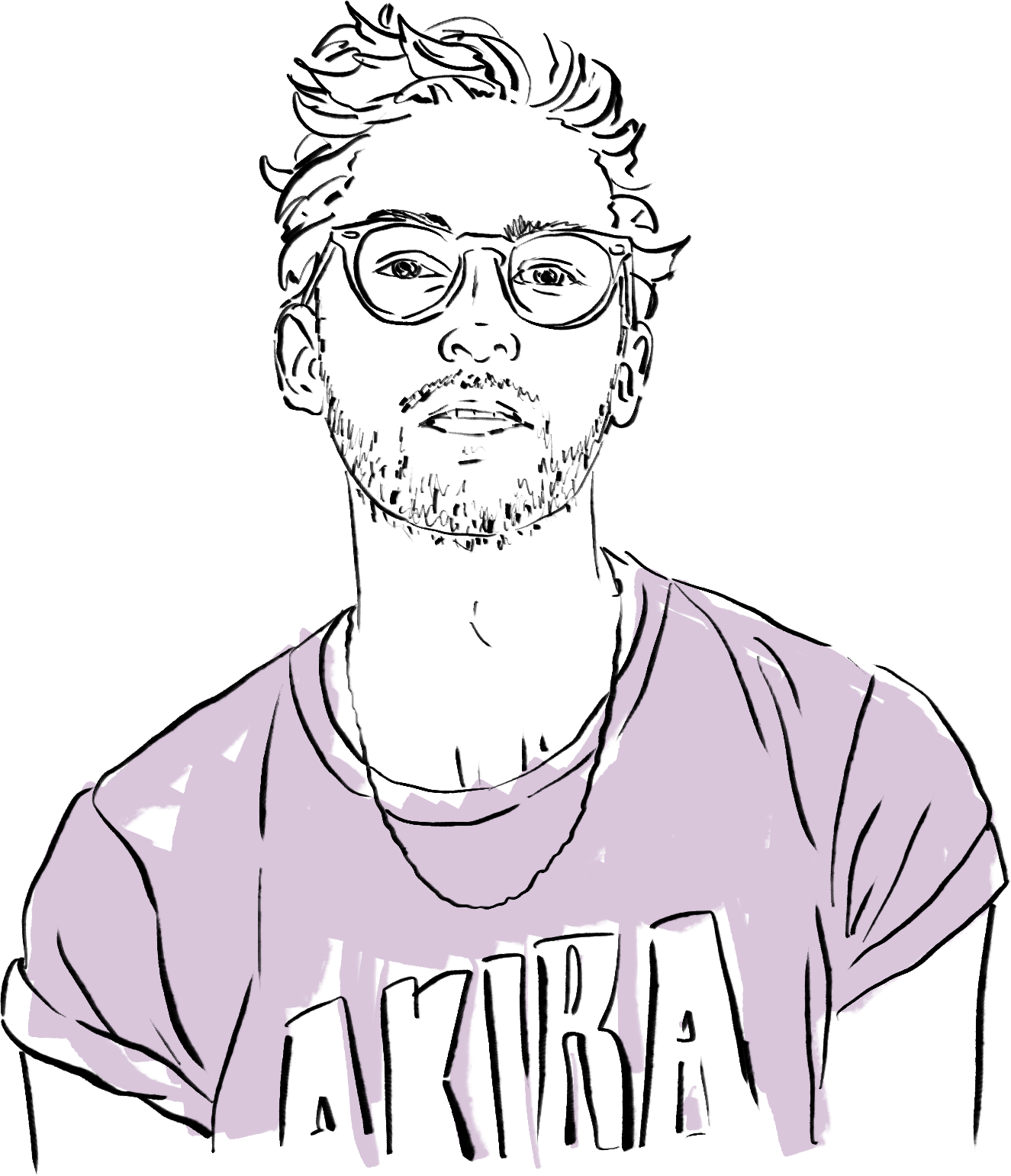
AJ Clauss is a playwright spawned screenwriter from the borderlands of Kentuckiana. A recent graduate of the Obie-award winning playwriting fellowship Youngblood with Ensemble Studio Theatre, a New Voices fellow at Playwrights Horizons, and two-time recipient of the Sloan Foundation for both theatre & television-- AJ’s work often explores queer intimacy, rancid humor, and the absurd rituals we find to survive. AJ is currently finishing his debut novel Numbskull, a selection of short stories, & developing multiple projects for stage & screen. MFA Columbia.
