
Roll of a Lifetime
By Celia Aniskovich & James P. Gannon
There’s one in your corner dive bar. And in the bowling alley on the outskirts of town. Probably even at your local VFW. You have walked past it a thousand times.
It sits in the corner, or along the back wall, or wedged between the ATM and the emergency exit: a cabinet the color of dark wood grain, chest-high, a screen showing a golf course and a ball the size of a billiard ball sunk into a flat surface at waist level. It looks like something from the nineties, because it is something from the nineties. You have probably played it once or twice, probably drunk, probably badly, and moved on. The machine stayed.
The trackball is the thing. Roll it soft and the ball floats. Roll it hard and the ball screams — hundred yards of digital air, a trajectory bent by wind and elevation and the particular cruelty of whatever imaginary course the game has chosen for you. The physics have not meaningfully changed since 1989, when the game was first built in an office park outside Chicago. The man who has designed the courses since then — more than 150 of them — still plays every day, still trying to beat his own best score. According to the company, they have produced over 150,000 machines since 1989, placed in every state, and in twelve countries worldwide. And once a year the people who are best in the world at rolling that ball fly to Las Vegas to find out who is better.
You have walked past them a thousand times, too.

LAS VEGAS, JUNE 2025
In a now-defunct restaurant located inside the Palms Casino Resort in Las Vegas, the best Golden Tee players alive are bent over their machines in absolute silence.
To wander the room is to meet a roster that sounds invented. There is Swervais — Sean Gervais — whose handle is at once a pun on his name and a description of the inside-out shot he hits. There is Turk, born in Istanbul, who found the game while he was falling out of love with pool. There is Downtown, who is Gordy Brown, whose softball team was sponsored by a Cheers bar in Orlando and who, by his own admission, "took a hundred years to shoot under par." There is Giuseppe, and Border Jumper, and Mr. Misunderstood, and a kid whose chosen handle is, and this is real, “no wins today.” There is Andy Haas, who plays as SHIP IT!. And there is Pay the Girl, who earned it the night a drunk man tried to stiff her on a side bet and the whole room turned on him and began to chant. Under names like these they found each other. Under names like these they became, to one another, famous.
A person walking in off the Strip might expect noise. Drinking, a party, the loose atmosphere of grown men playing an arcade game for money. They would instead find a roomful of people taking a thing very seriously that the world has decided is not serious.
The only sounds are the machines themselves — the tinny crowd cheer that plays when you hit a good shot, the electronic birdsong between holes, the low rumble of a trackball rolled hard that you feel before you hear it in the air. The players range from their twenties to their mid-50s. Many wear headphones. Several have small towels tucked into their waistbands to keep their hands dry, the moisture question being, at this level, genuinely consequential.
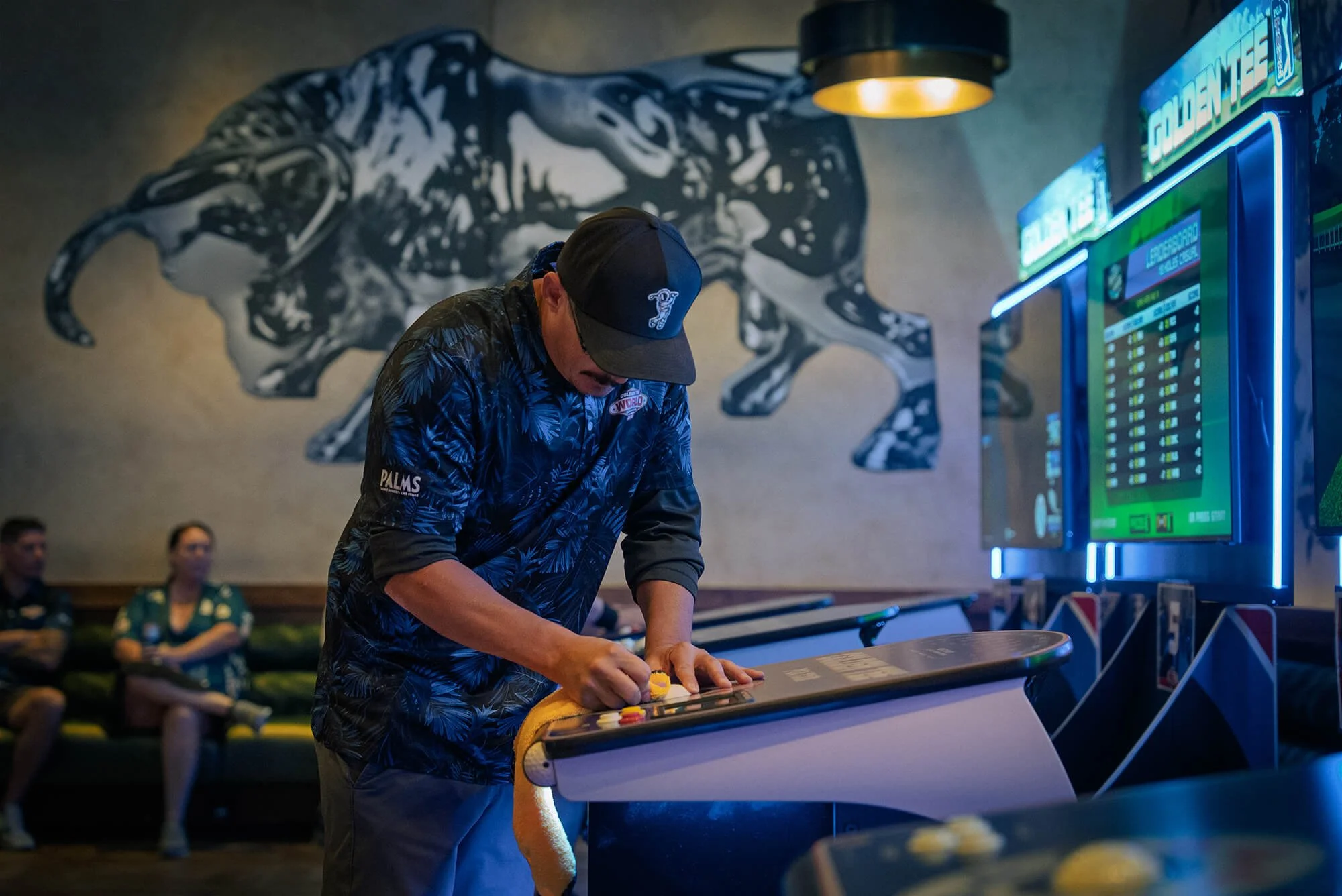
Caption: Golden Tee player wiping down his trackball
Source: James P. Gannon
These are, by and large, not the people who were most popular at the party. They will tell you so themselves, cheerfully, without being asked. They were a little too loud or a little too quiet. They missed the fraternity or the varsity letter or the easy belonging that comes to other people. They come to it from everywhere — poker rooms, softball teams, long commutes home — and they play nothing alike, want nothing alike, are nothing alike. But somewhere, every one of them wandered into a bar and rolled a trackball and found out they were good at it. The best in a room full of the best. And on the other side of the machine they found the thing that actually kept them: other people. A room that needed them, knew their names, and noticed when they were gone.
Spend enough time among them and one word keeps surfacing, and it isn't golf: community. They found one here. Some of them have lost pieces of it. All of them keep coming back for it. And in this particular era — after a pandemic that emptied the bars and taught everyone exactly what a screen cannot replace, in years when machines keep learning to do the human parts of human things — what they built around a trackball looks less like a hobby and more like a survival skill. They need real human connection to thrive. Everyone does. These people just make it a point to know where theirs lives, and they fly to Las Vegas once a year to stand in the same room with it.
The room has lost some of its familiar faces though, pulled away by the ordinary forces that pull anyone away from anything: age, work, family, grief, grievance. And then there is the man who is not here, and never will be again. If you scroll through the selectable player avatars inside any Golden Tee LIVE machine — in your neighborhood bar, in bars across the world — you will find his face there still, a little pixelated now, watching from inside the screen.
Incredible Technologies is not in Silicon Valley. It was started in 1985, in the basement of a suburban Chicago house, by Elaine Hodgson, a biochemist, and Richard Ditton, a software engineer, who were married to each other at the time — an arrangement the company has since outlasted. Early on they hired a programmer named Larry Hodgson, and if you're wondering why the programmer and the founder share a surname: Elaine and Richard divorced in 1998, decided the business was worth more than the grudge, and kept running the company together; the following year, Elaine married Larry. All three are still there. "Bye honey, I'm going to spend the next eight hours with my ex," is how Ditton summed up his mornings to the Daily Herald back in 2007 — a commute he is, for the record, still making. Elaine runs the company to this day, and the game itself was built in the late eighties by Jim Zielinski and that same Larry Hodgson: two men who, by their own telling, were never going to be professional golfers. They were guys who liked a couple of beers and a round with their friends, and they lived in Chicago, where the weather cancels half the golf year. So they built the round that fits indoors, next to the beer.
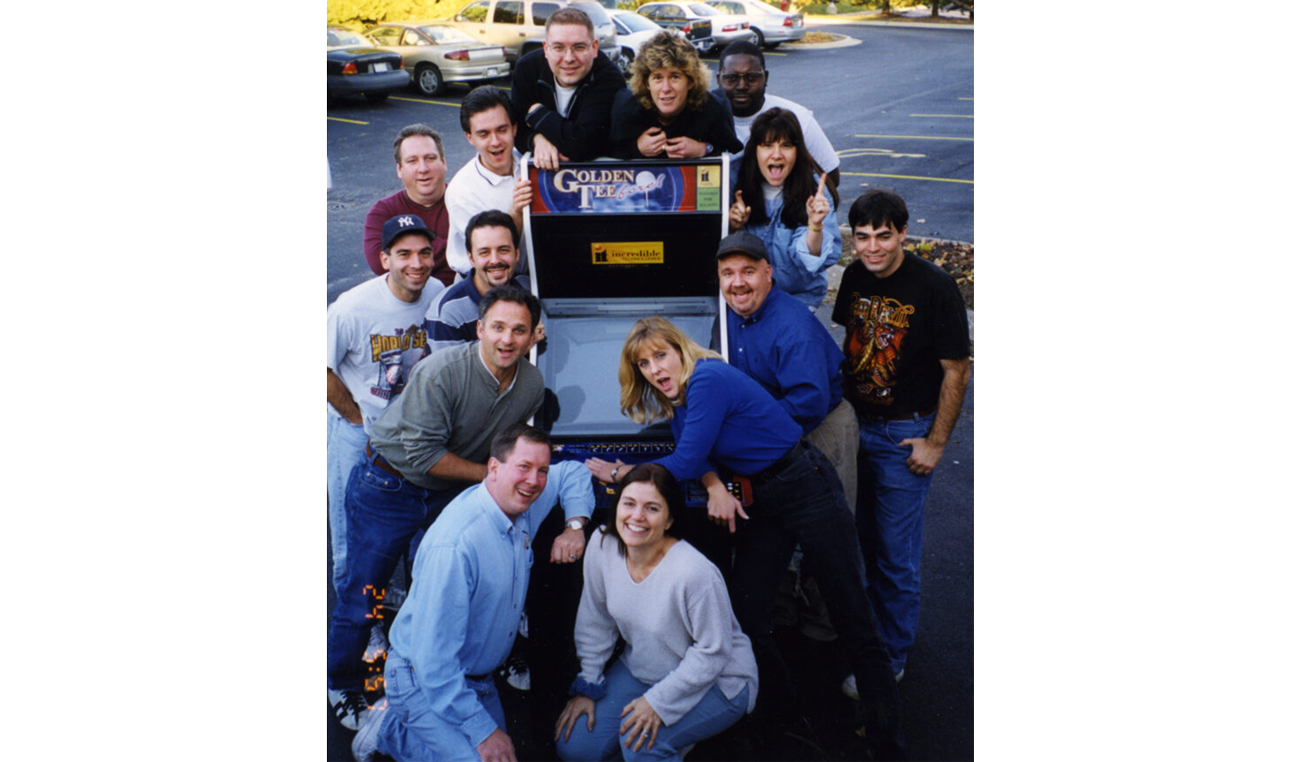
Caption: Golden Tee “Fore!” development team posing outside the IT headquarters in 2000
Source: Incredible Technologies
“We knew our player,” says Don Pesceone, who ran the amusement division for nearly two decades before retiring just ahead of COVID and moving to the mountains in Colorado. You can roll a ball with one hand and hold a drink with the other. You can play drunk. You can play badly and have fun. The machine is in a bar because the machine was built, from the first line of code, for the casual, the curious, the guy whose softball team just lost and is killing twenty minutes.
That is the person the company loves, and that love comes from a lesson the company had to learn the hard way: you cannot let the experts design the game. “One thing we learned from casino gaming,” Pesceone says, offering it as a law of human nature. “The almost-win is psychologically more powerful than the actual win.” The win makes you cash out. The almost-win makes you pull the lever again. So close. One more round. The trick, to Don, was finding balance: feed the casual player his almost-wins without punishing the handful of monsters who had figured the whole thing out.
But for some, the monsters were a problem that needed to be solved. At one point, according to Don, a project lead came into a meeting with a plan he called the "shark tank": take the top twenty-four players, the ones winning everything, and wall them off in a division where they would play nobody but each other. Pesceone didn't see the problem. "I'm like, so?" he remembers. "They're the best." He went to the dry-erase board, took the man's pyramid, and drew two more pyramids beside it. "I said, I want more pyramids. Why are you punishing the best?" The shark tank got its trial anyway. The top twenty-four, suddenly walled off from everyone else, simply quit playing — players who had been putting up 70, 80 games a day.
In the gap between the game the company built and the game it accidentally produced, a class of people was forming. People who treated a bar game as a vocation. People who drove to strip malls to practice. People who would one day fill a silent ballroom. The company and its best players have been affectionately at odds ever since — the company building for the many, the elite building themselves into something the company keeps having to account for.
Which brings us to Tommy Tuesday.
Ask anyone who was around and they smile before they answer. In 2003, the company ran a contest called Hole-N-Win, and it was simple: twice a game, the machine offered you a side bet — fifty cents on a par 3, a dollar on a drivable par 4 — and if you paid up and hit the ace, you won the pot. In those days the pot was fixed in advance, and on one drivable par 4 it was set at $1,000 — on every machine, in every bar, all at once. The top guys put their odds of holing it at one in three.
The catch wasn't the shot. It was the phone line. This was the dial-up era, and each cabinet only called in to the company's network every couple of days. When somebody hit a Hole-N-Win, the pot was supposed to reset — but an individual machine didn't know its pot had been claimed until it phoned home. The players figured out the lag, and then they ran it like a stickup: bar after bar, one ace per machine, move on, always one step ahead of the modems.
"It was close to $2 million," Pesceone says, "and we couldn't stop it. We couldn't stop it. We just watched it happen."
Someone had seen it coming though. Gary Colabuono, the marketing director — the man who, more than anyone, turned the players into something like stars — went to Larry Hodgson before the contest launched and asked him to build in a kill switch. Just a way to yank it, Gary said, the instant it ran away. Larry waved him off. “We have algorithms,” Gary remembers him saying. “We know how it’s going to go. We have the math.” And Gary said, you can’t underestimate these players.
The math was excellent. The math was also wrong about the one variable it could not model. “Players are anglers,” Pesceone says, and he does not mean it as an insult. “They’ll find every mistake you’ve made, and they’ll take advantage of you. And that’s what they should do.” The hard part of building anything, he says, is that you cannot think that way while you build — you are trying to make the thing good, and the whole time, out there, are people whose entire pleasure is finding the seam you left and tearing it open.
That war has never ended. Years back the players all discovered a ball called the stout, which cut wind resistance in half and flew nearly as far as anything else, so everyone switched to it at once. The company knocked its distance down, and the players said the company had nerfed it, and adjusted, and went hunting for the next edge. There is always a next edge. Finding it is the whole sport behind the sport.
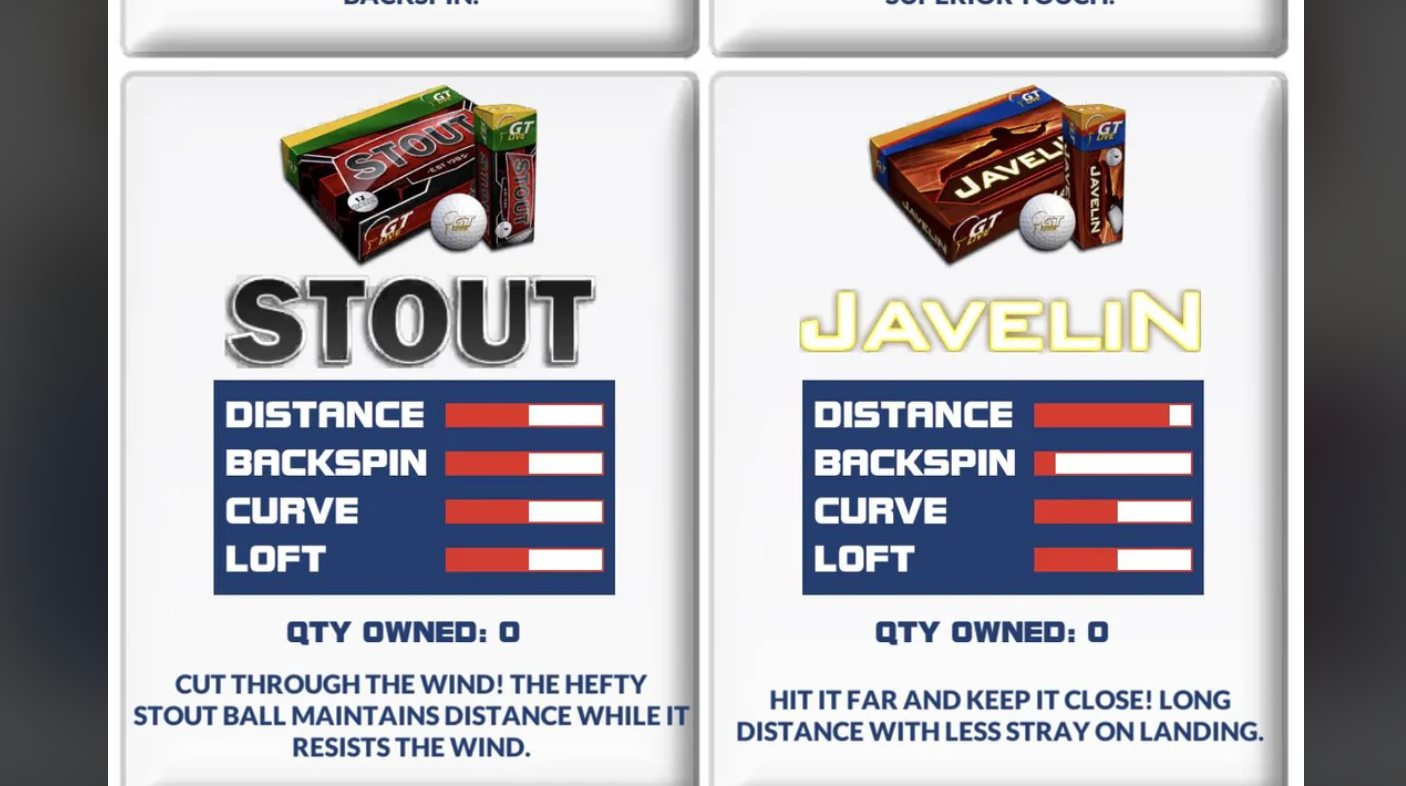
Caption: Current description of the stout ball and the javelin ball
Source: r/goldentee forum on Reddit
Kevin Lindsay has watched the war from both trenches. He is the company’s director of marketing now, but he entered the story at age five, when he ran away from his father’s teasing at a family friend’s bar and collided — literally — with a Golden Tee cabinet he could barely see over. He figures he still owes his parents ten thousand dollars in five-dollar bills. Thirty years later, his job includes absorbing the 2 a.m. text messages of the very anglers Don Pesceone is describing. He has also watched what the war does to the man who builds the courses. Jim Zielinski still designs every hole, still watches the streams, and when a player bends a shot around a tree that was placed there specifically to forbid that shot, Jim’s reaction comes in two waves. First, in Kevin’s telling, “damnit, when I put that tree there, that was not intended.” And second, something that looks suspiciously like respect.
THE PROFESSIONAL
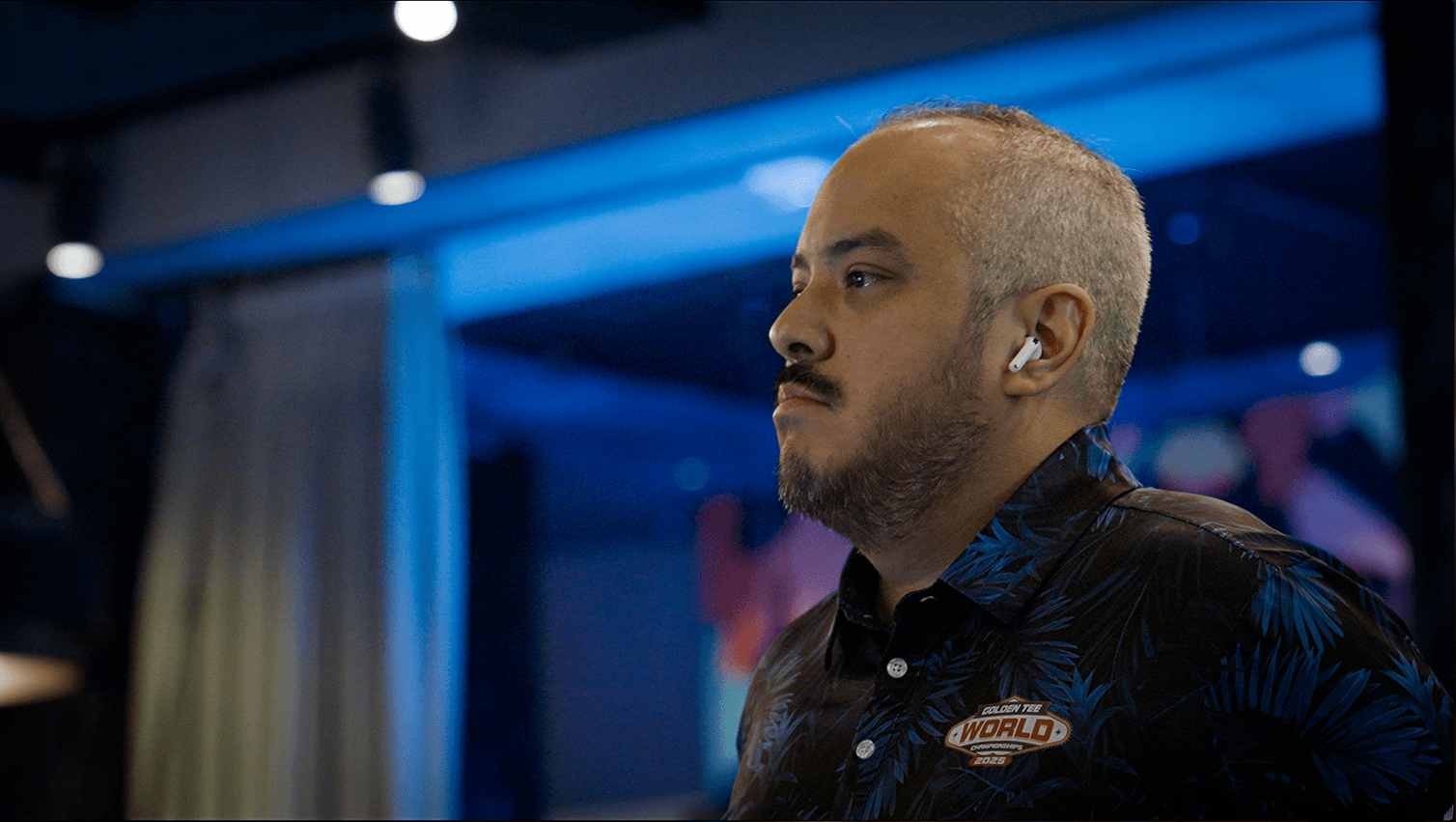
Caption: Paul Luna, 2025 Golden Tee World Championship
Source: James P. Gannon
The unit has no sign. If you did not know to look for it, you would drive right past it. It’s one more anonymous door in a row of anonymous doors in Cypress, Texas. Inside there are eight Golden Tee machines, fluorescent lights, a few regulars. And there is Paul Luna, five days a week, running two machines at the same time, as his full time job. He moves between them like a chess hustler working two boards, keeping both games alive so the grind (and his earning potential) never has to stop and wait for a screen to reset. There are two calluses on his right hand, hard and exact. He does not think about them. He thinks about the shot.
Paul is in his mid-40s, 5-foot-5, one of the two or three best players alive. How he came to the game tells you plenty about him. For ten years, starting at age 21, he had a job dealing poker in Houston. On their breaks his buddies would drift next door and gamble a few dollars a game on the Golden Tee machine, and Paul, who did not enjoy losing to his own friends, started playing to make it stop. Then, in his own words, he "basically just fell into" Golden Tee.
According to Paul, you do not win Golden Tee by holing out. You win by not messing up. “Golden Tee is pretty much a game of mistakes,” he says. Lightning — the hole-in-one, the miracle — is real but rare, and you cannot count on it. Watching Paul play, you see a man declining tempting shots for a living. “I think that’s something I’m one of the best at. Not making too many mistakes.” He says it casually, like you would state your own height. In 2022, he won the World Championship.
Almost everything he has now — the game, his wife, his titles — can be traced back to a man who is no longer here.
Paul didn’t meet Mark Stenmark. He went and found him. Paul was new and getting serious. Mark was the best player anyone had ever seen. The way Paul remembers it, the Golden Tee website, in those days, showed you where players were logging their games. So Paul used it like a tracking device. He learned Mark was playing at a place called Mama’s Cafe, drove over, walked up to the best player alive, and asked if he could get a game. After that they were more or less inseparable. They traveled the tour together, lived together twice. Mark stood six-foot-four to Paul’s five-foot-five, and Paul tried, at the start, to copy the taller man’s technique, but found his body simply would not do it. He was the wrong shape for it. So he was forced to build his own. He could not be Mark. He had to become himself.
And it went deeper than the game. Mark drank at a bar where a woman named Rachel worked, and that is how Paul met her. It was COVID. They drank to-go margaritas and had after-hours parties back at the apartment where Mark and Rachel would stay up talking long after Paul had gone to bed. Mark was in the building the night Paul won it all in 2022, and gave him the biggest hug in the room. And then, fittingly, Paul and Rachel got married in 2024. In Vegas. During the World Championships that year.
When people say Paul plays every game with Mark on his mind, they are not being sentimental. He is still, in a way, paying a friend back.
The complication is that the game is not quite the game it once was.
There is a technique, according to many players, that is hollowing out the game. It's called click chipping. Paul Luna hates it. Chipping — the short, delicate shots around the green — used to be the hardest thing in Golden Tee, years of feel in the fingertips. Then a player named Joe Massara figured out you could roll the trackball in a precise, clicking sequence and short-circuit the whole difficulty, take the touch out of it, drill it until it was automatic. The rest of the elite watched him do it, understood instantly what it meant, and adopted it. “Somebody figured it out,” Paul says, “and everyone was like, holy shit, this is kind of revolutionary. And everyone started doing it.” He can hear the problem as he explains it, because his entire theory is that the game is about mistakes, and this is a technique for erasing them. “When you can mess up and then not be penalized for it...” He trails off. “It shortens the skill count.” Someone else we spoke to referred to it as a hack. “I don’t like it. But I feel like I have to, in order to keep up with the times.”
So he drills the thing he wishes did not exist, in an unmarked room in Cypress, because the alternative is losing to people who don’t wish it away.
PAY THE GIRL
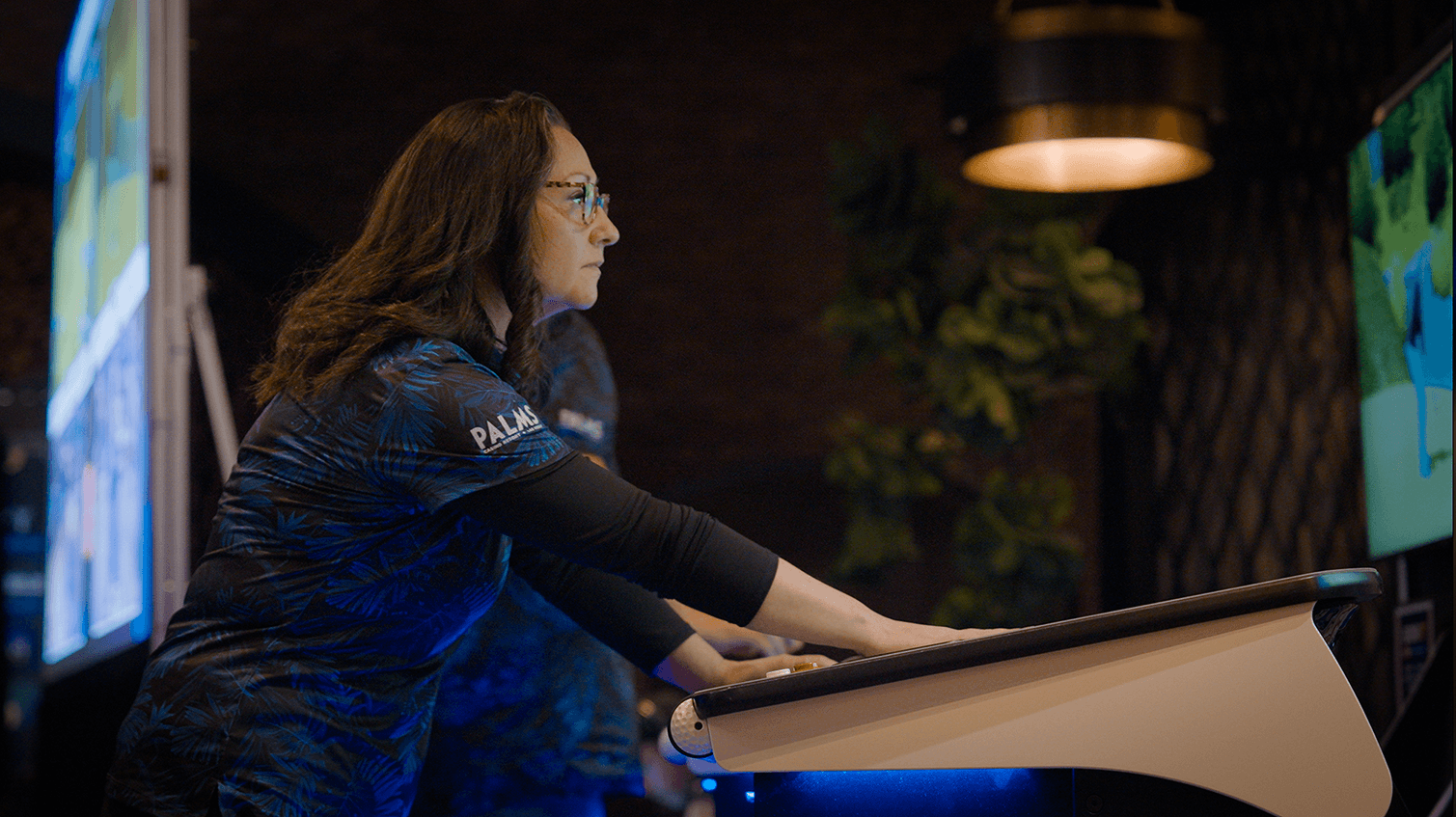
Caption: Jamie Arrington, 2025 Golden Tee World Championship
Source: James P. Gannon
The best way to picture Jamie Arrington’s life is to picture her bedroom, because that is where the machines are. She and her husband, Mike, live near Tacoma, in University Place, Washington, and their bedroom is in the basement, large enough that they simply divided it. One half is a bed. The other is two Golden Tee PGA TOUR machines side by side — his and hers — a couple of chairs, and a streaming rig wired into Discord, where their friends around the country log on most nights to play and practice and see each other's faces.
Visitors stand in the doorway and try to work out why a married couple keeps two arcade golf cabinets where most people keep a dresser.
It started, like a lot of things in Jamie’s life, as Mike’s idea. Mike is an industrial engineer, and his senior project in college was to optimize something — he and a partner were sitting in a bar trying to think of what — when they looked over and saw a Golden Tee machine in the corner. Mike got interested, then good, then competitive, and one day he announced he was going to enter the little pop-up qualifiers at bars, and that Jamie should come along. Then, without telling her, he signed her up to play.
This was around 2003, before children. She placed the first time. She won the second time. That meant she had qualified for a real tournament, which also meant — she remembers asking it almost as a complaint — “Does this mean I have to learn how to play?” It did. They started stopping at a bar on the long commute home from work when traffic got bad. Beer, Golden Tee and dinner. Nearly every day, a couple killing time. The local guys taught her things. Then kids came, and she stepped away, and Mike kept playing, and she drifted back as the girls got older, and then COVID hit and Mike bought a machine for the house. Their three daughters grew up watching their parents on streams while other kids were watching cartoons. Once the family watched the Minecraft movie and hit a scene where a character mashes buttons at an arcade machine like a maniac, and the girls fell out of their chairs laughing, because that, exactly that, is what their parents sound like at home. That’s you!
Her handle came from a bar, the way these things do. Years ago, she was in one of the side games where the men run the floor — the little wagers on this shot and that — and she shot a good score. She had not, it turned out, been playing all the sub-bets the men layer on top, and one of the guys, who had maybe had a few, got upset about having to pay her. He started refusing on a technicality, and the rest of the room turned on him and started chanting the obvious thing. Just pay the girl. Pay her. It would be worse if she were in on all your side bets, they told him, because then you’d owe her double. Someone said she should change her handle right there. She did. So now, she’s Pay the Girl.
In 2022, Jamie became the first woman to win a World Championship pass, at a women's tournament in Florida. Normally, she would never have traveled that far, except that a Worlds spot was on the line. She calls her win what it was: "kind of a breakthrough," she says, "for women that love this game." But a pass is good for one year, and at 2025’s qualifier, another woman won it, which meant that if Jamie wants to get back to Vegas in 2026, she will have to qualify like everyone else. So through the winter she grinds away at the tour mode — a twenty-week online qualifier, one course a week, played five times under five different setups, points by placement.
The qualifier also made her do something she had been avoiding. There is one hole, on one course, in one of those twenty weeks, where the click chip is simply the right play. "I never was doing the click chipping before," she says. "I just kind of did an old-school-fashion chip style." She watched Bryce do it, and Luna. "And so I just decided I better finally learn that."
In addition to learning clip-shipping, she recently did a thing that seems to have unlocked the rest: she took her headphones off. She had worn them to focus, to seal herself in. At some point she decided they were doing the opposite, sealing her into her own head, into whatever was already going wrong in there, and cutting her off from the room. Without them she plays looser. She can talk between shots. She is a person at a machine instead of a person in a tunnel.
Ask her what kind of person the game attracts and she describes, gently, the population of the silent room. She is protective of the community. All of them are. The men would love more women in the game, she says. They back the women’s tournament. She has rarely felt out of place. Only occasionally is she aware of being the only one.
The friction, when it comes, comes from strangers. She and Mike travel and stop at a bar, and there is always some guy who is the best player there and has no idea who just walked in. Once, one of them, not knowing, put a large wager down, clearly expecting the woman to fold. She accepted. He raised the stakes, adding terms, calling what he assumed was a bluff. She accepted that too. He quit.
The goal for this June is the Gold bracket. The gold bracket is the next rung — the top 32 at Worlds. Break into it and she's no longer just the best woman in the room. She's one of the 32 best players in it.
THE KID

Caption: Bryce Aubart, 2025 Golden Tee World Championship
Source: James P. Gannon
Bryce Aubart came to the game the way a certain kind of American kid comes to everything — through youth sports and long car rides. He was a travel-baseball player, and travel baseball meant tournaments in far-flung towns, and far-flung towns meant killing time with his parents. His mother knew a man who sold Golden Tee machines, and the man got the kid down to Latte Lounge at K&B Auto, which is an auto body shop in Wisconsin with a couple Golden Tee machines in the back. Bryce started playing with Mark Gomez, the man who would go on to win the 2024 World Championship as a 31st-seed with nothing to lose. Bryce was 16 at the time. Now, he plays Golden Tee like a ball player. For him, every hole is a new at-bat. He goes at it pitch by pitch, puts pressure on the other guy to see if he cracks. He uses the click chip fluently, because his generation never had to unlearn anything. For the young players, it is simply how chipping is done. In Florida, in early 2026, he won the Young Guns exhibition, then lost his second match in the main bracket to Paul Luna, who holed out on 18 on stream to beat him. Bryce dropped to the loser's side and started grinding: three straight wins, one of them a rematch with Luna, this time going his way. The run ended against Chris Juszczyk on a single overhit ball — a mistake that cost Bryce two strokes to Juszczyk's one — good for third place in the field. "Nobody thought it was going to go long," Bryce says. "But the game wants to do whatever the hell it wants."
He wears earbuds when he plays, and the reason is not music. “I’m trying to drown out my own voice,” he says. “Trying to drown out my own thoughts.” Without them, he gets into a match and starts thinking about weird shots that might work instead of the shots he knows will work, and the weird shots always lose. His own head is the opponent he can’t beat. A game where grown men, some of the best in the world, treat a shy kid as a peer and want him around is not nothing to a person like that. When he first showed up, he says, “everyone didn’t think of me as an outsider. They helped me.” His mentors — Gomez, a guy named Brian Roske, the whole crowd at the lounge — taught him how to start a match, how to carry himself, “how to talk.” He says it plainly. “They’re kind of my base for how I want to proceed in my life.”
But the friendships are hard to keep. “There’s a lot of guys where it’s like, they’re too far away to have a meaningful conversation,” he says. “It’s just kind of hard to build on something.” Between tournaments the community thins to a group chat and a livestream, and a young man can feel that thinness even while he treasures the thing itself. His first Worlds, he says, was a “honeymoon” — the lights, the whole world of it, opening up in front of him.
He is now a professional baseball umpire. He got an invitation to the Frontier League, an MLB Partner League, and he travels six days a week. During Worlds week, he will be working a series in Washington, Pennsylvania. He qualified for the 2026 World Championship and is giving his spot away, ceding it to a last-chance qualifier because he cannot be in two places at once. He has not touched a machine in weeks. He has not played a single game on the new tee boxes everyone else is frantically learning. He knew back in January, he says, when umpire school started, that this was coming: “I had a feeling I wasn’t going to be able to go to Worlds.” He plans to play a couple of tournaments late in the year — in Carolina and Dallas — and take a run at qualifying for 2027.
The door that stood wide open a year ago has swung shut, not because the kid failed but because the game could not offer what a life needs. Golden Tee gave him a room where he was somebody. Baseball gave him a paycheck and a season and a place to be every single day. He saw it coming as far back as January, and he made his peace with it, mostly. "There is a small bit of me that was trying to find a way to do it," he says. "Just didn't work out." For now he is calling balls and strikes in a minor-league park in western Pennsylvania while, two thousand miles away, the room he grew up in plays on without him. In December there is a tournament in Dallas, and he is planning to be there.
THE MOUTH
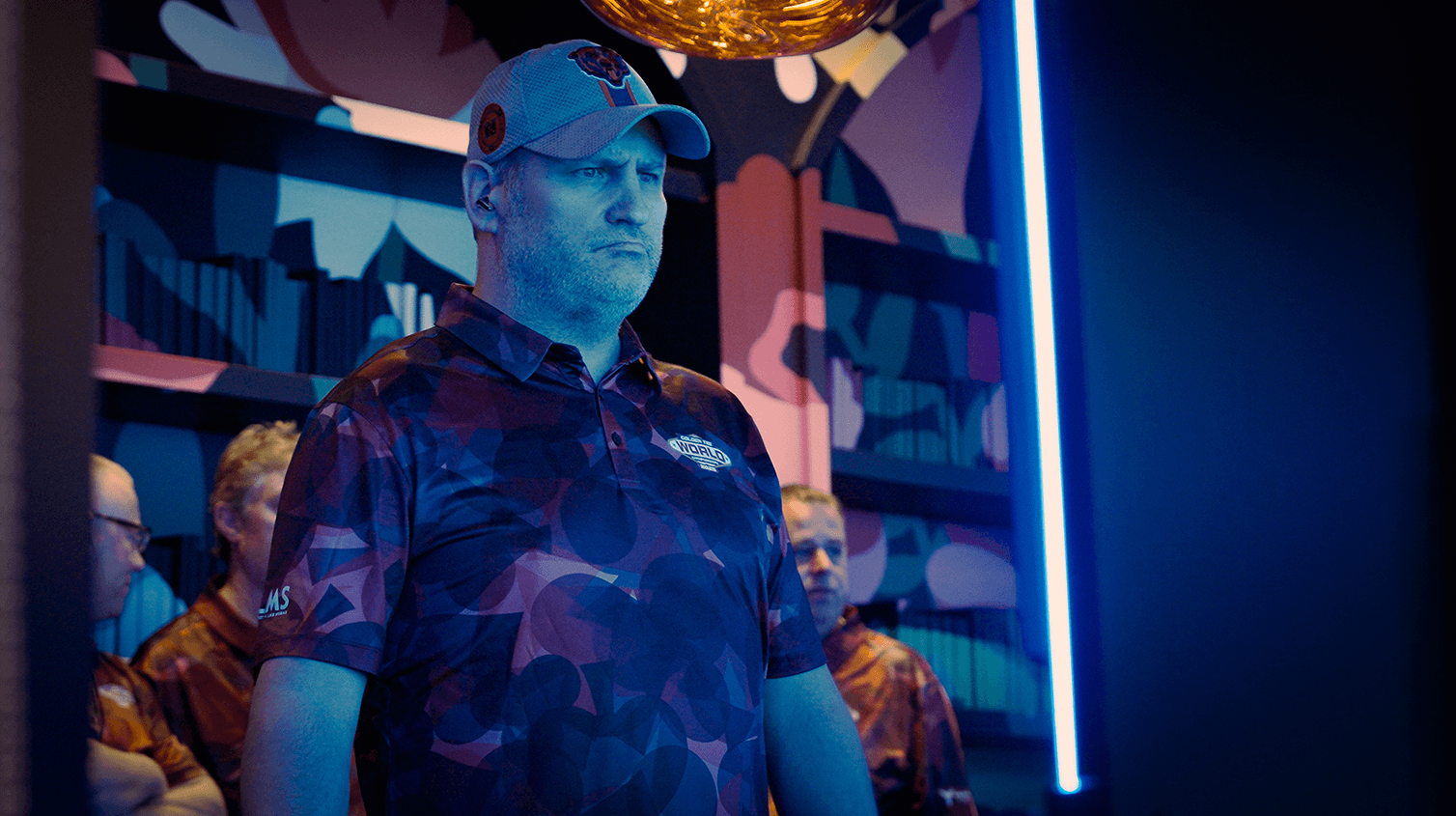
Caption: Marc "The Mouth" Muklewicz, 2025 Golden Tee World Championship
Source: James P. Gannon
The clip is out there somewhere, and multiple people tell us about it: Mouth, on his livestream, breaking a television over his own head. That is the version of Mouth people will introduce you to first. He’s a man who walked into his very first tournament, in 2005, as a total stranger who had never played a tournament in his life, and announced to the room that he was there to play for high stakes. He finished respectably. He came back the next year louder, and the year after that louder still, and for 20 years he was the loudest voice in a community of people who care deeply about a bar game.
He has never been slowed by modesty, and he has said so on television. When ESPN’s overflow channel put competitive Golden Tee on the air, Mouth used his airtime to inform the country that he was the equal of anyone in the room, if not better, and to point out — unprompted, on camera — that this was not humble and was not trying to be. At Worlds in 2025, by his own gleeful telling, he was in the “zone”: running on a private chemistry he described as a happy medium of high, drunk, and — he adds — adderall, which is either a bit or a warning label. With Mouth, it is honestly hard to tell.
But his volume was never his point. His point was that he was right. When something went wrong with the game’s physics, Mouth was on social media within hours with a correct, exhaustive breakdown of exactly what the company had gotten wrong, and he was right more often than not, because he holds the mechanics of the trackball in his head like some people hold music. He can hit 142 miles an hour on a full forward swing with pullback, he says, and 123 without, and this matters because the maximum is the only truly repeatable number — get below it and you are adrift in a range of variance no human can perfectly control. A 142 straight, he can hit nearly every time. A 132 straight is almost impossible, for anyone. He knows the machine the way a locksmith knows a lock, and there is a loneliness in it, because almost no one else alive can follow him all the way down.
He has turned certainty into a method, and he will walk you through it like an engineer. “I became more of a narcissist,” he says, almost clinically, “because I had to think in my head that I am right on everything I’m saying.” Any doubt and he would not communicate as well, so he trained himself to know, cold, when he was right — 99 percent of the time, by his own count. To be fair, he also concedes the other 1 percent loudly, because giving up the 1 percent is what buys you the 99. He means it, unmistakably, as a compliment to himself.
The company knows both versions of him by heart, because for years it had the good one. Kevin Lindsay was one of a handful of Golden Tee people invited to Mouth’s wedding, and what he misses is specific: the teacher. Mouth would stream five and six hours a night, and if one viewer — any viewer, a stranger who barely played — asked why he pulled the trackball back a certain way, he would stop, mid-round, and explain it so meticulously that a person who had never touched the game could follow. He’d worked tech support at Microsoft once, and it showed. On the forums he could diagnose a stranger’s broken machine from a single sentence. “He was one of the most passionate people about Golden Tee,” Kevin says. “I miss the teacher that Mouth was.”
Moreover, Mouth does not use the numbers to belittle anyone. He is a connoisseur of the hard way. He will watch a woman who cannot reach the max keep pace with men who can, or a player with almost no use of his arms build an entire game around his own body, and what lights him up is the thing he is terrified is disappearing: people solving the problem the hard way, and being made great by it. Ask him what he was ever really after and the answer comes out plain, almost defenseless, from a man who is otherwise never defenseless. “I just want to be the best at something,” he says. “The competition always mattered to me.”
There is a code under the competition. Years ago a glitch turned up — a shot that, hit a certain way, would double itself, an obvious flaw. Some players found it and hid it and used it against their friends in match play, because they wanted to win, and it has never once sat right with him. “It sits bad to me,” he says, “because we’re all supposed to be friends.” His ethics were never about the rules. They were about the room — about the almost unbelievable fact that these people are, against every odd, each other’s people, and you do not cheat your people, not even to win.
Click chipping, he says, and the long drift of changes that led to it, is going to kill the game. The argument is mechanical and precise. That’s just how Mouth’s brain works. “We’re taking the limitations of a trackball and making it the limitation of the player.” A human being cannot pull the ball back in a perfectly straight line, but the trackball can be made to, with the click, and once you have handed the shot to the device, “there’s no human element now.” The players found the seam in the physics, just like they found Tommy Tuesday, and this time instead of the game’s difficulty governing the player, the player has found a way to let the machine’s limits do the work. Strip the trackball out of it and you have heard this argument everywhere lately. Everywhere, the human element is being engineered out of the things people love — one shortcut, one convenience, one automation at a time — and the machines keep getting better at the parts that used to require a person. When Mouth says there is no human element left, he is talking about a chipping technique. He is also, whether he means to or not, talking about everything else.
Not everyone signs on to the eulogy though. Plenty of the best players simply shrug and adapt. But no one disputes that a schism opened, purists on one side and pragmatists on the other, and that Mouth planted his flag on the purist hill and, more or less, went to war. To him, the click chip is the oldest hypocrisy in the game wearing new clothes. The same players who once wrote off the company’s walled-off elite as talentless are now reaching for the biggest crutch in the sport’s history and calling it progress.
Mouth has even handed the company the fix, because he cannot help himself. He told them to raise the minimum speed a ball must travel to register a click from 35 miles an hour to 50 or 60 If they do that, the whole trick collapses. It seems that he has an answer for everything. The only question is whether anyone is listening. When asked for comment about where things stand as of late, Mouth let us know that he hasn’t touched a Golden Tee machine since Worlds 2025.
Kevin watched the fracture from inches away. For years the company worked with him — brought him to the office, sat him down, and tried to transform Mouth into a programmer. “At a certain point he just felt like he wasn’t getting the attention he wanted from us,” Kevin says, and then it stopped being just about the company. “It went from Mouth the player having grievances with Incredible Technologies to, like, personal. When you start saying that you’re going to sue a company ... you can’t just step back and say, oh, I didn’t mean it like that.” And the community, which had forgiven him everything, began to peel away too — even the staunch ones. “Once he started to lose a lot of his community support,” Kevin says, “I think that was when he kind of said, all right.”
The loudest man in Golden Tee has become its loudest silence. He is gone in part because he was right and could not stop being right long enough to stay. He found a room where he was valued, and then — through a fight with a company, a job he believed was coming that never did, a certainty that the thing he loved was being engineered to death, and something harder to name that is partly nobody’s fault and partly his own — talked and fought his way back out of it. He now sits in silence somewhere far from it all, still right about the click chip, with no one left to tell.
His peers hold both halves of him at once, and Andy Haas — who has known him since 2006 or 2007 — perhaps sums it up best. “He is one of a kind, for sure. The life of the party, always.” Andy takes a beat. “Other than that, I wouldn’t really have anything more to say.” Offered the charitable read — that Mouth says out loud what everyone else is thinking — Haas takes it, to a point. “Zero filter, a hundred percent.” And, he adds, “you can be right. But if it’s not delivered in an appropriate way...” He lets the sentence finish itself.
THE AMBASSADOR
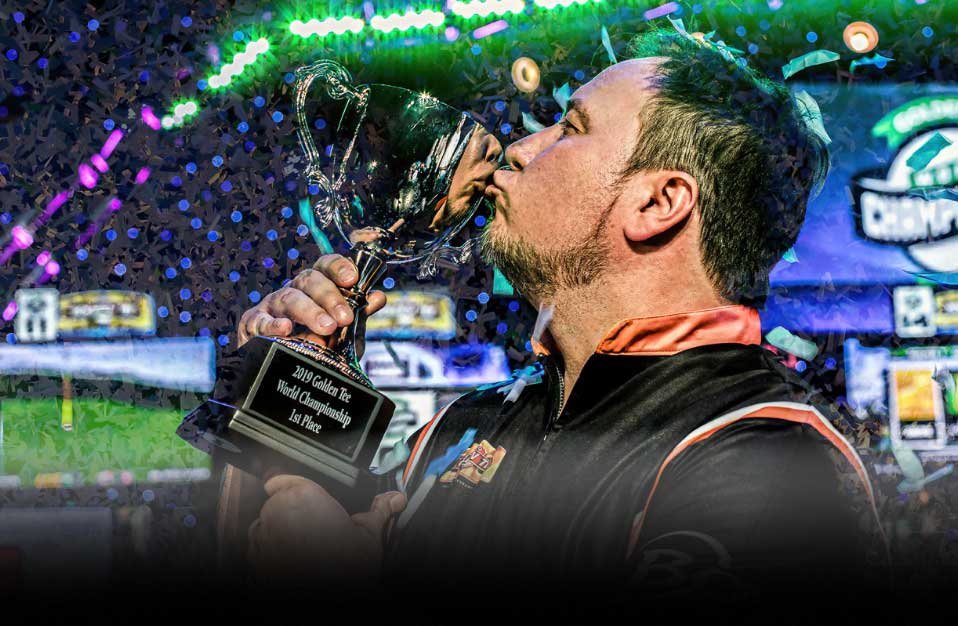
Caption: Mark Stenmark, 2019 Golden Tee World Championship
Source: LIVEWIRE
Mark Stenmark was the best player most of them had ever seen, and if that were all he was, this would be a stat line. It is not all he was. He was the reason a lot of these people are in the room at all — not because he recruited them, but because of the specific way he was great, which was generous. He was the best, and he used what he knew to lift people rather than to tower over them, which turns out to be a rarer thing among the very best than you would hope. When Don Pesceone tries to explain what Mark meant, he reaches for something larger than his Golden Tee prowess: “There are many Mark Stenmarks out there at lower levels of success within the game,” he says, “who are ambassadors of the game. It’s what has made Golden Tee such a great game — the best guy at the bar. He might just shoot a fifteen, but he’s the best guy at that bar, and he’s gonna get these other people to come and try it. That’s what Stenmark did.” A player like that toiled for years, Pesceone says, got great, and then could have just kept it to himself. “But he didn’t. He helped people.” He stops. “I couldn’t put a value on that. Because it’s invaluable.”
Kevin Lindsay can tell you what that looked like from the receiving end, because he was 19 when it happened to him. Sunday match play, a real bracket, and Kevin — a college kid who had grown up on the game — drew Mark Stenmark. That meant he had already done the math: “I already know I’m going to lose, but hopefully I can have fun.” And mid-match — mid-match, in competition, against him — Mark leaned over. “Hey,” he says. “Why don’t you try a five wood here instead of a three wood? Watch what I do on this hole.” Fifteen years later, Kevin knows that he didn’t have to do that. “But he did. Because that was just the kind of person he was.”
To understand Mark, you have to understand that he was three things at once.
He was a killer. By Kevin Lindsay’s memory, he held the record for consecutive tour-match wins, about 36 of them, over the course of six events, with over 250 total matches won overall. The legend the players tell is that when Andy Haas got close to that record, Mark Stenmark came out of retirement, drove to Dallas, and tried to stop him. “The last time I played Mark, we did play a match in Dallas,” Andy says, “but I did get the better of him.” Two hole-in-ones on the back nine, he adds, in a mistake-free game. To the very end, the two best players of their era were measuring themselves against each other.
He was the funniest, and, in Mouth’s estimation — and Mouth does not give this to many people — the smartest. “I always said he was me, but an introvert,” Mouth says. “Think of how much time you have inside yourself if you’re never talking to anybody.” At a “play with a pro” event once, the foursomes finished and everyone drifted off except Mark Stenmark and Mouth, who grabbed a trackball and took it apart to show the amateurs the rollers inside. Then Mark started in on the launch angle of every club and how he wanted to change the angle of his own pullback by a single degree, and the amateurs looked at him like he was speaking a language they didn’t have.
Ask Andy Haas and he will tell you that Mark was the only opponent who ever intimidated him. At one point Mark beat him 10 matches in a row. “I’ve never struggled like that against anyone else,” he recalls. Their lifetime record settled somewhere around even. “He was just an absolute monster,” Haas says. “I always loved Mark. He was the best for a time there.”
He also embraced the changes that should have threatened his reign. At one point, the company put a shot meter on the livestream, a little top-down view of the trackball showing exactly how each player pulled back and pushed forward and how hard. The best players lost their minds because it gave away their secrets. Not Mark. Mark shrugged. “He said, yeah, I get what you’re trying to do, this is the right thing. Just because my opponents can see what I do doesn’t mean they can replicate it.” Don Pesceone still sounds a little amazed by it. “He was humble, and he saw the greater good.”
And then, as we know, he was the bridge to Paul Luna’s entire life — the drive to Mama’s Cafe, the years living together, the bar where Rachel worked, the biggest hug in the building the night Paul won it all. His death did not just take a player from the community, it took a founder of it.
There is also a fourth thing we discovered along the way, the thing that made the company love him. Its programmers listened to Mark Stenmark more than they listened to Mouth — for one reason. When Mouth thought the physics were broken, he went on the internet and told the world the game was rigged. When Mark Stenmark thought the physics were broken, he got on a plane and went to go fix it. He once insisted the ball was accelerating strangely off the back of the screen, and the company’s own quality-assurance people couldn’t reproduce it, because they weren’t Mark Stenmark, so he flew out and did it in front of them. They watched the code run and found the bug, a stray multiplier buried in the physics since the year 2000. He had found a thing the company hadn’t known was there for two decades.
So they put his face in the game. “Mark was the last head we put in the game,” Don Pesceone says. He tells it like a man opening a gift he wishes he could give again. They flew him out under the pretense of showing him what was coming. “I always looked at it like the Willy Wonka thing, we’re gonna let you in and see the Oompa Loompas.” They rigged every monitor in one section of the office to show a different angle of his own face, the last one wearing the company’s mascot, and “he lost it. The biggest, shitty grin on his face.”
He wanted, after that, a job. He thought he could help make the thing better from the inside. He wanted to be the outsider let in — the same dream Mouth had. He asked for a six-day-a-week role testing the game. The company told him that for the price of him they could hire three testers, and told him no. And then he was gone, and Don has clearly turned the timing over in his head more than once. “I felt really awful,” he says. “I liked him a lot. He was a great guy. Really great guy.”
Mark died in the fall of 2023, and the community was blindsided because no one knew what he had been carrying. “It was tragic,” Don says, and that is as far as anyone who loved him wants to go. Paul Luna fielded a flood of messages in the days after, and still, years later, gets people coming up to him at tournaments to say they’re sorry. These are people who hadn’t seen him in ages, who drove out, in part, to find the one person who had been closest to Mark. Ask around and you find him everywhere, in other people’s best memories.

Caption: Post from Mark’s brother on his passing
Source: Official Obituary
The news came the way it does these days. Mark's brother posted on Facebook, and the texts fanned out. Haas got one. Kevin got one. “A breathless moment,” he calls it. “You have an idea that somebody’s struggling,” Haas says, “but you don’t really know the extent. He was such a smart guy. I’ve got to imagine he just never found a line of work that utilized his immense intellect.” It changed Haas in a small permanent way. There are a handful of guys now that Haas always texts, always checks on. “It definitely made me think about things.” And at the company it never fully arrives, and never fully leaves. “Every time we’re in Texas,” Kevin says, “everyone’s kind of waiting for Stenmark. But you unfortunately know it’s not going to happen.”
The end-of-year cup on the pro tour has been renamed the Stenmark Cup. Joe Massara won the first one. Paul Luna won the second. And, at that second tournament, held in Dallas, Mark Stenmark’s mother and sister followed Paul around the room the whole event, just like they used to follow Mark.
“He’s on the Mount Rushmore of Golden Tee,” Pesceone says, and pauses. “For sure.”
Mark’s face is still in the machines — the Golden Tee LIVE cabinets, the ones in the corner bars. Scroll through the golfers and there he is: selectable, smiling, ready to play. The new cabinets, the ones the pros bend over now, don't carry him. To find Mark Stenmark, you have to play the old game.
THE YEAR
Between each World's showdown — June to June — is everything else, and everything else is loud.
The tour stops — Nashville, the Carolinas, Dallas, St. Louis, the rest — are the opposite of Worlds in every register. Rowdier, drunker, more fun. Anyone can enter. You pay your money, you play. A hundred and twenty dollars at the door puts you in the same field as the world champion. The tour itself is run not by the company but by a St. Louis outfit called Power Events — six stops a year, tour points like the PGA TOUR — and it is the reason the competitive game survived at all. When Incredible Technologies stepped back from running a World Championship after 2008 to chase the casino business, Power Events kept the lights on for eight years, until Worlds returned in 2016. Haas won the last title before the gap and the first one after it. “I’m not saying I was the ten-year reigning world champion…” he volunteers. Thursday and Friday are a party, Saturday gets serious because people are qualifying, and Sunday goes tight and head-to-head. And the real texture of these weekends is not the trophy. It is what happens around it. These are people who see each other a few times a year, scattered across a continent, and when they finally land in the same bar they hug and pull up chairs and get four-player games going, 10-player games, teams, and between shots they show each other pictures of their kids and their pets.
This is the part we imagine Mouth is really mourning. Not a chipping technique, but the bar, the reunion, the teaching, the being known. A game can survive a bad rule change. What these people are watching, underneath the rule change, is the slow attrition of the thing that made them a we. Burak Temel — aka Turk — puts it as directly as anyone: “The community, the love we have for the community, the friendships we built over the years. We show up for these tournaments because of that. Because we love seeing these guys. All of our friends. Every other month.” Nobody flies to St. Louis for a purse that barely covers the flight. They fly because a few times a year the group chat becomes a room full of chosen family.
They are still players, though, and Las Vegas is still Las Vegas, and when the machines go quiet at night the weekend’s other engine turns over. At Worlds 2025 a group of them ended up in the high-stakes slot room. Eight of them each fed three hundred dollars into a machine called Buffalo and it hit, for nineteen thousand dollars, split eight ways, around 2,400 apiece, a crowd roaring at a moment that had nothing to do with golf. Paul Luna, who by his own admission almost never wins when he gambles, walked out of that Worlds up on slots, up on roulette, up on blackjack. Up, in Vegas, for the first time he could remember.
And there is rivalry, because there is always rivalry. Andy Haas deleted his social media years ago and usually declines the press. He runs an insurance business in Ohio and plays far less than he used to. Every year the conventional wisdom decides he is finally done — too old, too rusty, too focused on other things — and every year he wins something anyway. He is a two-time World Champion, in 2008 and 2016. And here is the thing that gnaws at him: he has not so much as touched a Worlds podium since. Ten years. A decade of the sport’s biggest stage going wrong for the one man who most expects to own it. In 2026 he is chasing something no one in the history of the game has ever done, a third world title. His son, AJ, just turned eleven, and already plays; he made an ultra hole-in-one on a livestream in February, straight into the cup, and lost the exhibition to Bryce anyway. He also made the cut at the 2025 Florida tour stop — placing 21st in a qualifying field of 144, nearly all of them adults. When Haas is asked whether the kid plays like him, he does not pretend to deliberate. “A lot of people would say he’s a mini-me.”
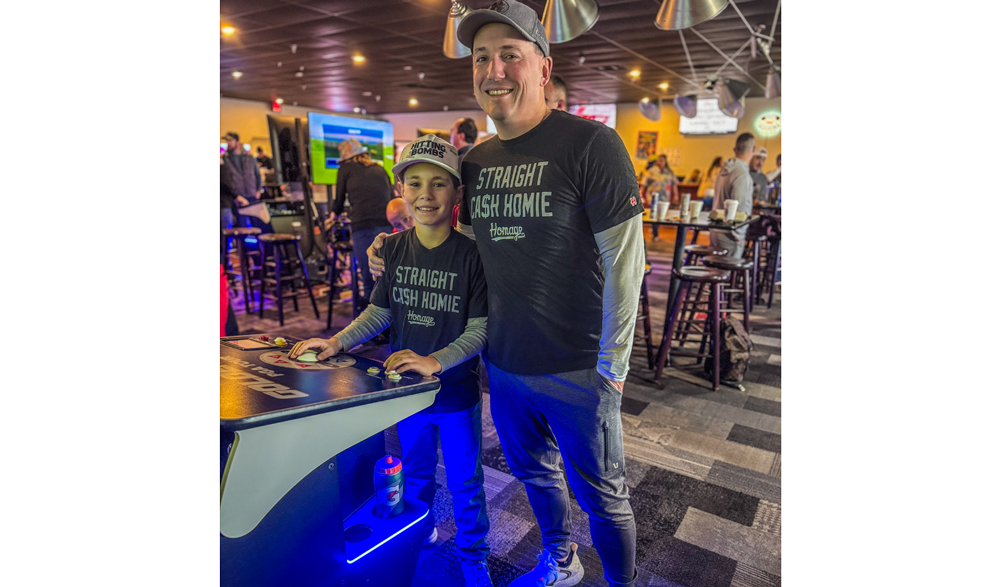
Caption: Andy Haas and his son, AJ
Source: Andy Haas
For most of the past year, Andy Haas was the guy we never spoke to. He'd wiped his social media. He wasn’t searching us out. In a scene where everybody talks — into podcasts, into group chats, into the camera at every tournament — one of the most decorated players in the game's history had gone silent, and it was hard not to think he didn’t want to be found.
Then, in the lull after Worlds, with the help of Paul Luna, he picked up the phone and talked openly, and warmly. The vanished Facebook account wasn't a door closing. It was just a man who got tired of his phone.
"I would just default to Facebook and scroll for an hour," he says. "I just don't need it. If something happens, somebody will tell me about it."
Unsurprisingly, the full picture of Andy Haas assembles into something almost aggressively wholesome. He found the game in college, in 2003, a broke kid at a happy-hour bar, staring at a placard announcing that the machine’s champion had won five thousand dollars that month and thinking, I can shoot that. Of course, he soon discovered exactly how far off he was. He found a message board, then a tournament in northeast Ohio, then a man 15 minutes from his house with a machine in his basement and an open-door policy. He graduated college with no plan. “I don’t think I was ready for the real world,” he says, and got lucky that it coincided with the game going online. He started paying out on every game rather than one big prize, and a person who does not mind obsessing, playing eight and 10 hours a day, could suddenly live on it. Golden Tee was his sole source of income from 2005 to 2013. There were 20 or 30 Golden Tee guys at his wedding. When a friend’s father offered him a job at his Allstate agency, Haas took it, figuring the game had a couple of years left in it at most. Now he owns his own agency, and the game that was his job is his hobby, “which makes it much more fun. I don’t feel like I’ve got to squeeze every dollar out of it.”
Ask him about Paul Luna and the rivalry dissolves into something better. “I absolutely love playing against Paul,” he says. “I love playing the best, and we’re such good friends.” He narrates the 2016 final — the one where he beat Paul twice — like a shared possession. He'd been knocked down early, in the third round, by an overtime hole-in-one from a player named Andy Fox. Then he’d won seven or eight matches in a row to climb back and catch Paul, who was King of the Hill, playing what Haas remembers as a very aggressive game and playing, for the first time, in a Worlds final. "He actually made a couple mistakes in the last game," Haas says, with the gentleness of a man describing his friend's nerves.
On the click chip, he says that if the company could remove it, “I would be supportive.” But he does not believe they can, and he is not going to litigate physics. “It’s the technique that exists, whether I like it or not. It works for me too, so I’m gonna do it.” Where Mouth sees a dying game, Haas sees the normal progression of change. “As long as I’ve been around, there’s always been some sort of controversy.”
Andy Haas has won more national tour events than anyone — 40-some, he thinks — and there are exactly four men with two world championships. Graig Kinzler, Mark Stenmark, Chris Eversole, and him. “Nobody has three. Getting a third would just kind of cement it. That’s really the only thing I have left to play for.” Then, asked what the prize money would even be for, the two-time world champion and insurance-agency owner gives the answer of a dad: he has promised his son that if he ever wins Worlds again, he will buy a home edition for the basement. “He’s really rooting for that.”
LAS VEGAS, JUNE 2026
They leave for Vegas on June 11, a Thursday, and the loop closes. The Palms, the same hush the instant the matches start, the same trackball and the same physics that have not changed since a husband and wife outside Chicago built a game to be played with a beer in your hand.
The new tee boxes — reworked versions of the courses — dropped only a few weeks before the championship, so close that Paul Luna was still tweaking his club setups, his “bags,” a couple of days ago. In an ordinary year he’d have had them locked for a month. He is fine with it. “I actually like it,” he says, “because I think other players will be less prepared.” An even field of underprepared players is a field where the man who makes the fewest mistakes does best. He has been drilling two courses hardest: Gunnison Gap and Alaska Lakes. He does not sound nervous, though he admits he gets a little jittery on stage. Mostly, he sounds like a man who has done the work and is trying to draw good courses and avoid Andy Haas in the first round.
At some point during the matches, Rachel will do the thing. She will feed him Pringles, one at a time, between shots. Because if he eats them himself his fingers get oily, and oily fingers slip on the trackball, and a slipped trackball is a mistake, and Paul Luna does not make mistakes. It looks, for a second, like the most absurd thing you have ever seen. But then you understand it. A man takes a bar game so seriously that the people who love him have engineered the snack food out of the equation. Rachel, whom he met because of Mark, keeps his hands dry so he can keep the promise he made to a game Mark gave him.
There is a wildcard this year. There is a shortage of the standard trackball assembly, which means the machines on the floor in June may have different hardware in them — a different ball, a different housing, different sensors. And Paul Luna has quietly noticed that a different trackball might blunt the click chip. The trick is tuned to a specific feel, a specific physics. Change the ball under everyone’s hands and the thing that has been hollowing out the game might simply stop working as well. “That could just be such an insane equalizer,” he says. “If everyone’s starting with something they’re not used to.” There is no way to prepare for it. It is, he admits, a little scary. Mouth spent years insisting the company could legislate the click chip away. It would be exactly like this game for a parts shortage to do it instead. Though even that is uncertain. Massara told Paul a couple of weeks ago that he’d heard it got sorted out, and the standard trackballs will be back. Nobody quite knows. They will find out when they get there.
The field’s own read on itself is also worth one last look. Richard King runs a Calcutta before Worlds every year. It’s an online auction where backers bid on players to win, like they do for the Masters. This year, when the bidding closed, Paul Luna had gone first, bought for over $4,000, with Andy Haas second around $3,600 and Joe Massara close behind. A player who is bought can buy half of himself back and hedge his own tournament; Paul never does. “It’s just more pressure to do good in the competition,” he says. However he finishes at Worlds is where he finishes in the Calcutta, and he would rather carry that straight. The man who refuses to make mistakes also refuses to take the pressure off himself.
So the room is set. Jamie Arrington is here, headphones off. Andy Haas is here, in his quiet way, chasing the third title no one has ever won, 10 years to the night since he took one from Paul Luna on this same stage. Paul Luna and Rachel are here, readying their routine. Bryce Aubart is not here; baseball won, and somewhere in western Pennsylvania a young man who could have been in this room is calling balls and strikes, at peace, wearing something in his ears. And Mouth is not here, either. Well, not yet. No one would be surprised if the loudest person in every room might just appear and walk up to the last-chance qualifier because something in him could not stay. “He could just show up,” Paul says. “That would be a very nice thing for him to do.” Nobody is betting on it.
And then it begins. A field of 112. The glow of the machines. And of course, as in all great sports stories, nothing unfolds the way anyone expects.
Andy Haas comes in as the top seed and loses his opening match. His opponent makes a couple of early mistakes, Haas goes two up and shifts into cruise — and then hits one shot, by his own measurement, "one pixel long," into the water. The momentum turns and does not turn back. "Anything can happen in one game," he says now, which is what the greats say instead of screaming. He fights through two elimination matches before Turk ends his run. The curse holds at 10 years. The basement in Ohio still does not have its machine.
Graig Kinzler — one of the four two-time champions — never makes it to Vegas at all. A storm hits Chicago the day before and floods his basement. Even the immortals answer to weather.
Jamie falls short of the Gold bracket. But she’ll be back to try again.
Paul Luna finishes fourth. To almost anyone alive, fourth in the world is a triumph. But to the man who does not make mistakes, it’s hard to stomach. Kevin Lindsay has known him since December 2011, when Paul was “having a few too many drinks, rolling around in an office chair, and Golden Tee was like the third or fourth thing on his mind.” Watching that guy become one of the five best players on earth has been, Kevin says, genuinely heartwarming. He also knows exactly what fourth place does to him. Four men have won two world championships. One of them was Paul’s teacher. “I think Luna really wants to be one of those guys,” Kevin says. “Not only win a second, but win a third.” The debt to Mark Stenmark, it turns out, has an arithmetic.
Mouth does not walk in. But “up until Friday night,” Kevin says, “I kind of expected him to just pop up and say, hey, I’m going to qualify.” He doesn’t. A few weeks ago we touched base with him again. He reiterated that he’s chosen to lay low for the time being.
And this year’s champion is no stranger. Jeff Lannen, comes from an Illinois village of a thousand people with no stoplights and two Golden Tee machines at Rip's Tavern, which is two blocks from his front door. He has been in these rooms for the better part of two decades — a Worlds finalist as far back as 2016, five wins on the national tour, a man who gave up his day jobs because the game paid better. What he had never done was win it. He came through the biggest field in the game's history and did it, beating Andy Fox in a final so thick with click chipping that the company is cutting it into an ESPN special even now — the same Andy Fox whose overtime hole-in-one once knocked Haas into the losers bracket on his way to the 2016 title. Fox and Lannen are friends. Fox forced a winner-take-all final. Lannen ended it with an eagle on the last hole. And the new world champion's first act was promising to buy his beaten friend dinner.
However it happened, it ends where it began. A room gone silent the instant the matches start, a low rumble, a field fuller of strangers and emptier of the ones who made it a home, everyone bent over a machine doing a thing the world walks past, taking it as seriously as anyone takes anything, because it is where they became who they are, and where they found each other. And on every one of those screens, available to select, a little pixelated now, is the man who was the best of them — who got great the hard way and spent it lifting other people up, who welcomed the change that exposed him and drew the line at the one that hollowed out the game, who is the reason half the people in the room found the room at all. He is not here, and never will be again, and he is still inside the machine, watching them play.
You have walked past it a thousand times. You had no idea what it was, or who was inside it, or that the thing they were playing for was never on the screen at all. It was always about the people — in a room, on purpose. It’s the one part of the game no update can change, and no machine can ever replace.

Celia is a New York based documentary filmmaker and the owner of Dial Tone Films. The only thing she loves more than a good story is the New York Mets (who rarely provide a good story).

James is a self-taught filmmaker. He has directed 11 short films that have won awards at multiple film festivals including SXSW, Slamdance, Fantastic Fest, Palm Springs and Seattle. His latest short, Wrecked a Bunch of Cars, Had a Good Time had it’s world premiere at TIFF in 2024. His previous film, Deerwoods Deathtrap premiered at Sundance 2022 and went on to screen at over 30 festivals, winning a Special Jury Mention at the Aspen film festival and Oak Cliff. In April of 2023 it had a theatrical run in 7 cities across the USA. Online, his films collectively have over 500k views and have been selected as Vimeo Staff Picks and featured on sites like Roger Ebert, Wired, Upworthy, Short Of The Week and NoBudge. As a freelance director, James has created engaging work for The New York Times, Nordstrom, HGTV and GQ.
