
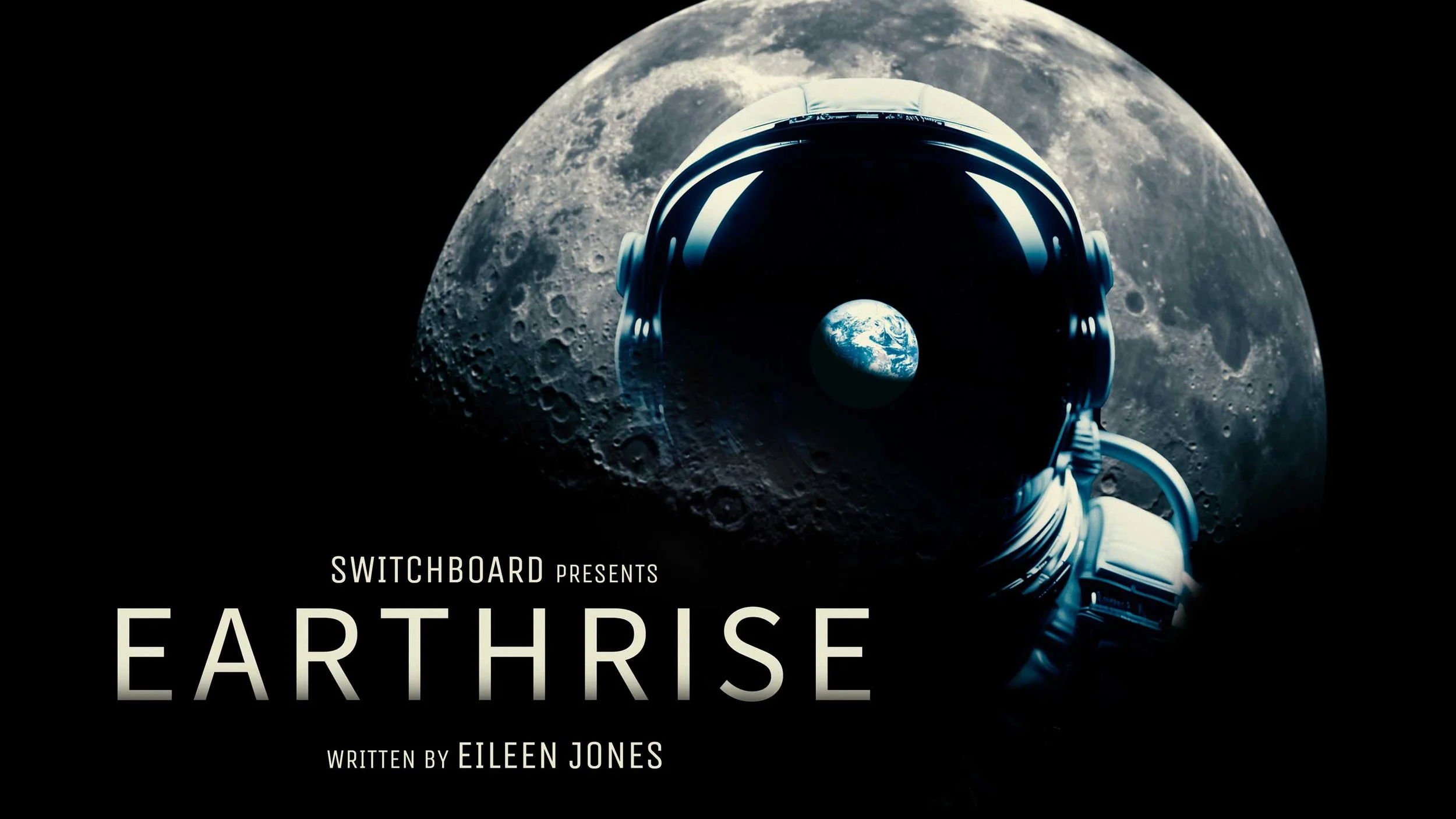
Earthrise
By Eileen Jones
PART 1
Anna’s face was all I could see.
The curved glass of our visors had a way of distorting things — throwing reflections, bending the edges of your vision like a fish-eye lens — but Anna was always steady, the heart of it all. Standing with her now, I couldn’t help but laugh. That’s how our friendship was. Get the two of us together, and we were like kids at summer camp.
Only difference? We were on the moon. And it still made us giddy.
That’s why SpaceX had us do so much press, and we knew it. Look, female astronauts! They’re moms, too! And friends! Look at them, so brave! But our enthusiasm was real. How many people actually get to live out their childhood dream, let alone go to the moon?
Anna and I had grown up geeks in different small towns, staring up at the same big stars. We were used to being the only girls in our classes, so when we ended up in the same group at SpaceX, I knew instantly: She was my person. We loved one another before we fell in love with our husbands. Before our babies. During training, we had joked that it was space camp for grownups, but the truth was, it was hellish, and when we graduated, Anna gave me one of those cheesy “BEST FRIENDS" necklaces — you know, the heart that’s broken in two pieces — the kind of thing I would’ve worn when I was 9, if I’d had a best friend then.
Now we were on our third mission at Earthrise, SpaceX’s permanent lunar station, standing inside the airlock. Done with our pre-breathe, I double-checked the latch on her helmet. “Okay in there?” I asked. Anna was gazing briefly past me.
“Yeah,” she said after a moment, looking back at me. Her voice was fuzzy through my earpiece. “Just lost in space for a sec.” I stared at her in mock disbelief, and she cracked a smile.
“Oh my god,” I said, starting to laugh again.
“I know,” Anna replied with a grin. “Benji thought it was so clever the other day! I didn’t have the heart to tell him. Here, turn around.” She reached over to inspect my suit.
Safety in space is all about redundancies — hence the buddy system — and we went through the protocols like the old pros we were. Communications? Check. Oxygen? Pressure regulation? Check. Check. Finally our commanding officer’s voice crackled in our ears: “Have a nice walk.”
As the airlock light turned from red to green, we briefly touched our helmets together. Just a moment, a little ritual to say: I got you. I love you. We’re good. And then I stepped to the hatch.

Ten minutes later, I was standing on a lift 20 feet above the lunar surface, twisting a ratchet.
The rows of double-paneled solar arrays descended a slope, a design to maximize sun exposure. Earthrise was built on Hadley-Apennine, the volcanic rille where the Apollo 15 mission landed in 1971, and that old rover was still parked nearby, covered in regolith. It was a relic by any standard, but it made an excellent work bench. Anna had her laptop open on the seat.
Our task was to inspect and secure all equipment for the coming lunar night, when temperatures would drop below -200 degrees Fahrenheit — far too cold and dangerous to be outside. Just another day at the office, at least for a mechanical engineer and a computer scientist in space.
“Moving to Inverter 3, String 12,” I said. “Think they’ll have robots doing all this next tour?”
Anna was quiet. Because of the blinding sunlight, we had pulled the gold sun shields on our helmets down, covering our faces, but I could hear her breathe. It was comforting.
“Kit?” said Anna slowly. “Not sure there’s going to be a next tour. I think I’m done.”
The news hit me like a blow, and I paused. Anna and I had always shared this striving ambition for the stars. We were at the top of our game. We had never talked about the end.
“You want to retire?” I looked back at Anna, and at Earthrise behind her.
The comms array. The Human Landing Shuttle, upright and ready for liftoff. All I could see of the station itself was the observatory dome — the other three floors were underground. It was named after that iconic Earthrise photo taken during Apollo 8: The pale, cratered surface of the moon. Earth, half-illuminated by the sun, glowing in the void. Up there, Earth is four times bigger than the moon in our sky at home. Up there, the stars don’t twinkle — no atmosphere — they shine, bright and constant and infinite. The view could take your breath away.
“I don’t want to miss any more,” Anna said. “I’ve missed so much already. You should think about it, too. Caleb idolizes you now, but Harper’s a teenager, she needs—”
“Harper understands,” I interrupted. “She’s proud of this.”
I heard Anna sigh with exasperation. “I’m just saying, it might be time to think outside the box about what the next chapter is.”
“Outside the — this was the dream!”
I was furious. But I understood, too. We had supportive families, but I had spent 10 months and four days on the moon over the last few years. I’d missed birthdays. Milestones. Earthrise was the first step to deep space exploration and a permanent lunar colony — not for one country, but for all of humanity — so it had always been worth the sacrifice. But it could be a brutal trade.
I shook my head, already full of regret. “I’m sorry. I just… I’m surprised. But I understa—”
“Kit? You’re breaking up. Kit?”
I responded, but Anna couldn’t hear me. “Pettit,” she said, “I’m switching to Space-to-Space.”
I switched to our private channel. “Anna?” Silence. “Anna, do you read?” Still, nothing. Then I heard a shaky breath. Concerned, I whipped around—
And saw a stream of oxygen spewing from Anna’s primary life support backpack, shimmering in the brilliant light. A leak.
“ANN—!”
But I couldn’t even finish her name. In an instant, the leak ruptured and the backpack exploded, blasting shrapnel in every every direction—
Including mine.
The force of the impact knocked me back, and as I slid down the boiling-hot surface of the solar panels, I realized with horror that something had torn my suit. I slammed my hand over the gash in my torso, then tumbled off the panel onto the sloping regolith below — and kept sliding.
Somewhere Anna screamed — “KIT!!!” — and I clawed at the powdery surface with my free hand, desperate to find her. To grab onto something. Anything. To stop. But I was blind in the whirling dust. As the tether I’d clipped to that first row of solar arrays suddenly snapped taut, it jerked me to a stop — and I caught hold of something.
Anna’s hand.
The explosion had sent her plummeting downhill, and she gasped in fear now. Without her primary or backup tanks, Anna had maybe 90 seconds of oxygen left in her suit before she’d suffocate. Less with her breathing so hard.
“I’ve got you,” I said, with calmness I didn’t feel. “Grab on with both hands. Come on!”
I held steady as Anna climbed to her feet. She put one arm around me, holding on tight, then grabbed the tether. As we heaved ourselves up the slope, I kept a hand on the gash in my suit.
“Kit,” she panted. “Your suit—”
“Save your breath. Just a bit further.”
By the time we reached the solar arrays, Anna was wheezing, and I carried her, staggering, the last few steps to the rover. I grabbed the flare gun and fired it. But even as the red blaze arced through the black over Earthrise, I knew — suit up, pre-breathe, depressurize — there was no way anyone could get to us in time. It was on me.
I dropped the gun and lunged to catch Anna as she fell to her knees. She was straining, each desperate breath ragged in my ear. “You’re gonna be alright,” I said, keeping my voice steady for her sake. “I can manually attach my secondary tank.” But Anna started to cry.
“Shh, it’s okay,” I said, soothing. “It’s all gonna be okay…”
I said it over and over and over again while I frantically worked. I pulled one arm from my backpack. Switched the hand covering the tear. Pulled my other arm free. But working one-handed was slow, and my gloves made me clumsy. Fuck… FUCK!!!
As I wiped the dust from my helmet with my free arm, Anna put her hand on top of mine, pressing down on the gash in my suit. She was telling me to save myself.
“No, no, no,” I said, hearing the urgency in my voice now. “I can fix it. I can fix it!”
But Anna went limp.
“No — Anna!” I cried. “No…” She collapsed on the pale dust, her hand still on my suit. Bending over her to block the sunlight, I flipped up our sun shields so our faces were visible.
I hope seeing me was some comfort to her. But I heard every agonized gasp. Every aching breath. Every last one. I held her gaze as she shuddered in pain. So I sincerely doubt it.
Anna died, and my face was all she could see.
I sat on the edge of Anna’s bunk, trembling.
I was still in shock. I’d been in Anna’s pod many times — it looked exactly like mine — but in that moment, it all felt fake. The beach read on the pillow. The photos of her twins, Andy and Benji, when they were little and toothless. Of her husband, Scott. Our commanding officer had offered to call him, but I shot that down.
It couldn’t be anyone else. I owed Anna that much.
I leaned forward to the screen opposite the bed and dialed home. As the tone rang, I tried to take a steadying breath. Then a beep as the video call started and — “MOM!”
I cringed. Why? WHY did her kids have to answer the fucking call?
Benji was grinning ear-to-ear, video game controller in hand, and when he saw me, he laughed. “Aunt Kit!” he exclaimed. I’d known Benji since he was four hours old—I was the twins’ godmother—and now he was 11, still a carefree kid. For a few more minutes, anyway.
It took everything I had to keep it together and smile back. “Benji, buddy!” I said, putting on the performance of a lifetime. “How long you been on the PlayStation? Does your dad know?” I got shrugs and single-word answers in response. “Is he around?”
Benji tumbled out of the room, shouting for his dad. After a moment, Anna’s husband Scott came in. I don’t have to tell you how the conversation went.
“Drink,” Pettit said, setting two fingers of Jack Daniels in front of me.
A decade or so older, Pettit was our commanding officer. We were in the module that served as his office, and as he sat down behind his desk, I did what I was told. I hate whiskey.
Pettit was famously stoic, but he’d always shown me kindness. Unlike other guys, he’d never been bothered by Anna’s and my status as poster girls for SpaceX. But he was also one of the few who’d actually flown for NASA. He had the coveted gold pin to show for it — it was right there on his desk — and he picked it up, then began turning the golden wings over in his hands.
“I want to go home,” I said eventually. Pettit shifted in his chair. “I quit.”
“You’ve done more spacewalks than anyone. You’re my recommend for commanding offi—”
“I don’t care,” I said. “ I want to see my kids — and Sam — I have to bring Anna home.”
My voice caught in my throat, and I started crying. I couldn’t help it. “They asked me to bring her home. And I can’t…” I trailed off as I realized it. “I can’t do another walk — I can’t go out there again — I can’t do it! Okay?” I looked up at Pettit, desperate and humiliated and pleading.
His expression was neutral, then he nodded. “Okay,” he said without argument.
Relieved, I glanced away and wiped my face. “Thank you,” I said.
“But you’ll have to wait,” he said, then poured me another drink. “Nothing I can do about that.”
I grimaced. The next flight wouldn’t arrive for another two weeks. I would have to stay on Earthrise through lunar night, the freezing 14-day stretch without any sunlight.
“You won’t even know I’m here,” I said. I would bury my head for 14 days, see one last sunrise, then go home. My best friend in tow. That was the plan.
Fourteen days later, I looked like shit.
I stared at my face in the little mirror above my sink. Frail. Hollow. That bright, telegenic person that SpaceX had depended on for so long? That I’d been for so long? She was long gone.
I turned away from the mirror. Whoever this new person was, I didn’t want to see her.
The window in my pod looked out onto grass and trees — our backyard in Houston. Or at least, a digital image of it. I was counting down to standing in that grass. Just three days to go.
I wandered into the galley on auto-pilot. There were cameras in every public area on Earthrise, an internal system for us to see and communicate with one another, and a live-stream that anyone on Earth could watch. It was a marketing gimmick, really, and the shine had worn off for most people. But even so, I had no desire to be the unwitting star of whatever sad reality show people back home might suddenly be tuning in to watch. So I kept my head down.
Once upon a time, I had been mesmerized by every little detail at Earthrise. It was a cylinder, exactly 60 meters in diameter. It gently spun at exactly 2.5 revs a minute to create artificial gravity. And each level was laid out exactly the same, with modules and pods connected by hallways around a central elevator, like spokes on a wheel. The layout meant that each individual area could be locked down, but the effect wasn’t claustrophobic. It was zen. Which is really saying something considering the station was built in a lava tube to protect us from radiation.
Level 0, on the surface, housed the observatory dome and mission control, with a 24/7 feed to Houston. Level -1, the first floor underground, was home to our research labs and aeroponic garden. Level -3, the bottom floor, was engineering and power. Life support systems. Emergency shelter. Water reserves and random storage. An upgraded basement.
But who am I kidding? I hadn’t left Level -2 in days. Between the living quarters, bathrooms, and galley, I had no need to. And besides, no one here wanted to see me.
I was a reminder of what could actually happen.
We all knew the risks of the job. Equipment could fail. People, too. But the risks never felt real.
Once you’ve ridden a rocket, walked on the moon — hell, once you’ve had a baby — you feel invincible. I had convinced myself that I was. But Anna’s death changed all that.
Anna died, and I realized the truth: That I had never been brave. I had just believed, naively and recklessly, that we were the shiny, happy people bad things never happened to.
An investigation into Anna’s life support pack had revealed a faulty valve. I had checked our life support systems — I was a mechanical engineer for Christ’s sake — but I had missed it.
Anna’s death was my fault, and everyone knew it.
I was mindlessly stirring water into cereal and dry milk when a man’s voice crackled through the intercom. “Hey, Kit?” It was Hardy, a mathematician on his first tour.
I turned to the security panel on the wall. Resembling a smart-home system, they showed all the rooms on the station, and there were several on each floor. I touched the screen to enlarge the video. Hardy was in mission control with Cusk and Diaz, staring sheepishly up at the camera.
I took an exhausted breath and pressed the intercom button. “What do you need, Hardy?”
“Yeah, so, we’re about to go live with the third graders at Seacrest School,” he started. It was a task Anna and I usually did, and I could guess what came next.
“I gave you the script,” I said. “Just read it. Show them around.”
“Right, but — you know, we’re not really kid people, and we — hey, Kit? Kit?”
But like I said, I was long gone.
I was packing up Anna’s stuff when my daughter called.
I had been putting it off, but with new crew members arriving in a few hours, I couldn’t avoid it anymore. Beach read. Family photos. Slippers. We weren’t allowed to wear jewelry when we suited up, so Anna’s wedding ring and watch were in a little pile, beside her half of that cheesy BEST FRIENDS necklace. She had still worn it, too.
I held the charm in my hand for a moment, then put the chain around my neck so both halves of the heart hung next to each other. I hoped Scott and the boys wouldn’t mind.
As I zipped up the PPK, the personal preference kit that Anna had brought with her when we set out for Earthrise, I heard ringing in my pod across the hall.
We didn’t have a call scheduled, so my brain instantly jumped to catastrophe. I rushed to answer it. “Hello?” The video popped up, and there she was — my daughter, Harper. My actual heart. She looked low. “Sweetie, are you okay?”
“Just wanted to see you,” Harper said.
“I’m so glad,” I replied with a smile, and it was true.
When I was a new mom, sleepless and exhausted and sure I was doing everything wrong, it didn’t make a bit of difference — Harper would gaze up at me with pure adoration and love. But she was 13 now, and I knew she’d be looking at me with disdain soon enough. I dreaded the day.
“Are you sure you want to come home?” she asked.
A heavy sigh escaped from my lips. “Oh babe,” I said, afraid that day had finally come. “You know, all of this — I’ve always wanted to make you so proud. But I don’t want you to ever get a phone call like Anna’s family did… Do you think I’m a coward?” I certainly did.
“What? No,” Harper said. “I just, umm, I wanted to ask you something, and I didn’t want to make you feel bad if you’d decided to stay.”
A smile crept over Harper’s face, and she blushed. “Cameron kissed me,” she said. “We’re going to the dance. I don’t know what to do — or wear — and it’s not like I can ask Dad!”
I laughed, thrilled for her, and simultaneously tried not to cry. Anna had been right. We had missed so many things. But Harper wanted me home. She needed her mom.
I hadn’t missed my chance. Hadn’t failed her. Not yet.
Before I could reply, footsteps thundered and my son came crashing in, followed by my husband, Sam. Caleb shouted my name as he tumbled onto Harper, and she groaned. “Oww, Caleb!”
“How’s the packing?” asked Sam.
“Done,” I said with genuine enthusiasm. “I will be heading home in T-minus 14 hours.”
“Roger that,” Caleb said. He was 9 and a geek after my own heart.
“Can’t wait to see you,” Sam said. “I can’t wrangle these monsters anymore!” He wasn’t actually complaining — there wasn’t a better dad on the planet — and as he pulled Caleb into a playful hug, Caleb ran away. A quick “I love you,” then Sam followed, leaving me alone with Harper again.
“So,” I said carefully, “was it a good kiss?”
“Mom!” Harper squealed, and we both laughed. “You’ll be home in time to help?”
“I can’t wait.” I glanced at my watch. “Two days 9 hours transit time, that’s 57 hours… Liftoff at 0800… I will be home in 71 hours and… 12 minutes. Set your watch?”
She did. I counted down — three, two, one! — then our watches beeped as we synced them, and the seconds started ticking away.
71:11:59… 71:11:58… 71:11:57…
When the Human Landing Shuttle launches and lands, you don’t hear a thing. You feel it. What would be an ear-splitting roar on Earth is just a rumble in your bones on the moon.
There are typically 8 astronauts on Earthrise at any given time. Every four months, a flight arrives, and the HLS goes up to meet the module, then brings the four new crew members down to the station, like an elevator. The next day, it ferries the four departing crew members up. The purpose of the overlap is to read the newcomers in on the status of projects and systems, and 12 astronauts together usually meant the energy was high.
But the mood at this briefing was tense.
Two of the new arrivals had stayed behind on the HLS to fix a comms issue, so there were 9 of us in mission control — plus the massive pink elephant of Anna’s death, yet to be addressed. All eyes were on the big screen that showed the 24/7 feed with Houston, and I hung back, keeping a low profile, while Hohler, our Flight Director back home, ran through the systems checks.
“Solar? We’re seeing battery reserves at 21% SoC. Bit low for our liking.”
“We lost connectivity with an array when, uh — well,” Pettit cleared his throat. “Houston, we are prepared for staged shutdowns, but see no risk of hitting the 10% threshold before lunar sunrise.”
A newcomer, a former Navy pilot named Foreman, spoke up. “That’s 9 hours out. The batteries will last, but I’ll go out at first light to handle the repair.” I had only met Foreman once, but suspected he was gunning for a promotion now that I’d bowed out.
Everything at the station was functioning as intended, and when Hohler reached the end of his checklist, there was only one thing left to discuss — Anna. I ducked out.
Standing under the observation dome, I had a clear view of Earth. A little over half the planet was visible, what astronomers call waxing gibbous, and shining with a soft earthlight. The rest disappeared into the void, invisible save for the prickling sparks of light. A storm.
I closed my eyes, 240,000 impossible miles from home, and imagined the sound of rain.
After a moment, I heard a commotion and turned. The briefing was over. The others passed by without looking at me — easier for everyone, really — then Pettit put a hand on my shoulder.
“End of an era,” he said, and walked on.
Hours later, I couldn’t sleep. All I wanted was to close my eyes, sink into oblivion, then get off that goddamned station, but my brain was intent on punishing me.
Anna’s face. Her choking breath. Her terrified eyes. That’s what I saw when I closed mine, so finally I just sat up. “Forget it,” I muttered and slipped into my shoes.
The station was quiet, all the pod doors closed. It took a moment for the elevator to arrive. I figured I would go up to Level 0 and wait for the sunrise. They had stored Anna’s body in the cold cargo bay there, in an aluminum casket I guarantee you no one ever expected to use.
Anna was the first fatality at Earthrise. That was my legacy.
I got in the elevator and went upstairs. But as the doors opened, I frowned. The large screen that showed the 24/7 feed to Houston was dead — that was never supposed to happen — and there was a stack of equipment by the airlock.
“—no, Meeks, you take this downstairs. Moreno—”
Foreman was standing there, talking with two men I’d never seen before—the crew members who had stayed behind on the HLS. Their backs were to me.
“What are you doing?” I said.
As they whipped around, I saw it—the gun on Foreman’s hip.
A prickle raced down my spine, and a split-second later, I lunged for the security panel. Slammed the panic button without even thinking. The alarm was ear-splitting. As Foreman raised the gun and the others ran after me, I tumbled across the concrete, sliding back into the elevator.
“Come on,” I begged, frantically pushing the close button as they approached. “COME ON!”
They were yards away when the gunshot rang out and the doors finally shut and it all went silent.
PART 2
My breath came in gasps. What the fuck? WHAT THE FUCK?
I didn’t understand. Couldn’t comprehend what had just happened or why — how — Foreman had a handgun on Earthrise. His personal kit? My head was foggy. Slow.
What do I do? WHAT DO I DO?
As the Level -1 button lit up, I pulled the emergency stop. The elevator jolted to a halt, and the doors opened to reveal chaos.
Sirens screamed. Emergency lights flashed, drenching the hallways in eerie red. All around me, steel doors were lowering, locking down the hallways.
Hide. Hide. WHERE CAN I HIDE? And then I saw a flash of movement in Lab 4.
“Help me!” Hiro shouted over the blaring sirens as I burst into the lab. He was standing beside a small open safe. “Quick!”
I stumbled past the tables and microscopes. “Foreman,” I panted. “And two others—”
“They’ll be here any minute,” Hiro said. A Japanese biologist, Hiro was soft-spoken. I had always respected his steady calm, but he was shaking now. Terrified.
“They’ll turn off the alarm,” he said, “and tell Houston it was an accident. Help!”
Lab 4 had the only other airlock on Earthrise — a small device, 18-inches wide, that vented directly outside. With trembling hands, Hiro was filling it with vials from the safe.
As I grabbed one—
“STOP!” Hiro shouted, and I froze. “Careful. You cannot break it. Do you understand?”
I did not. The vials were small and black, made of biophotonic glass. “What is it?” I asked.
Guilt flashed across Hiro’s face. “I didn’t want to. They took over my research.”
“Hiro,” I repeated. “What is it?”
Hiro stammered. “A pathogen,” he said. “It activates when exposed to light. The Orion probe brought it back last year. I’ve been testing it… Replicating it.”
I stared at him, not wanting it to be true. “Are you saying we’ve been developing a weapon?”
“Like sarin and mustard gas combined,” Hiro said. “Lethal. Painful. Valuable.”
In a second, it all became clear. That altruistic mission I’d devoted my life to? Sacrificed time with my family for? That Anna died for? Bullshit. Earthrise wasn’t about tomorrow. It was about tomorrow’s war. Foreman and his guys were trying to steal the weapon that would win it.
And I was holding that weapon in my hand.
“We must destroy it,” Hiro said urgently. “All of it. Hurry!”
Moving as quickly as caution would allow, I placed the vial in the airlock beside the others. The glass clinked as the sides touched. Then I carefully took another from the safe. I was holding it in my right hand, keeping my left underneath just in case, when the sirens suddenly stopped.
Hiro and I froze. Locked eyes. Then the steel doors began retracting.
“Now!” Hiro urged. We could hear Foreman and his men shouting. Right outside.
I set the vial in the airlock and Hiro closed the hatch. Slammed the lever to lock it. Destruction of whatever was inside was the point, but still, the airlock had to depressurize for our safety.
The red light blinked…
As Foreman and the others appeared beyond the steel doors, I glanced back at the safe. There was one vial left. “Wait!” I said. “There’s one more!”
But as the red light turned green and the vials shattered, releasing the gas into space, Hiro shoved the last sample at me. “Get to the airlock,” he said.“Destroy it. GO!”
I squeezed myself through the narrow air shaft.
The vial was in a pant pocket, and I was prone, pulling myself forward on one hip to avoid smashing it. But I was moving in inches. Moving too slowly.
Below me, I could hear Foreman and the others with Hiro. Their voices floated up, echoing off the aluminum. Hiro sounded steady as he explained that he had destroyed every sample.
“And what about O’Keefe?” I heard Foreman say. Hearing my name, my palms began to sweat.
“What about her?” asked Hiro, playing dumb.
“She climbed into the vent.”
“She has nothing to do with this.” I heard an edge in Hiro’s voice.
I dragged myself silently forward, my hands slippery on the metal.
“We saw you give something to her. Does she have a vial?”
Shit. I needed to be faster! I pulled my arm in. The shaft was barely wide enough for me, and in the crush, I strained to reach the vial in my pocket. When I did, my fingers were clammy.
“No,” I heard Hiro say.
A metallic click. The gun. “Don’t lie to me, Hiro,” Foreman said. “Does she have one?”
I listened, frozen with fear.
Hiro’s voice wavered.“I told you. I destroyed them all. They’re go—”
BAM. As the shot fired, Hiro crumbled and I flinched—
Then panicked. The vial! I instinctively opened the fists I’d just squeezed—and the vial hit the aluminum with a clang, then rolled forward, away from me.
No-no-no! I reached for it. Further… Further… The vial was rolling toward a vent with slats that opened to the room below. I strained, pulling myself forward, my fingers grasping at the glass.
Just as it dipped over the edge of the vent—
I caught it. A miracle.
Panting, I clutched the vial in both hands. Willed myself to be silent…
But Foreman and his guys hadn’t heard. Below in the lab, they were arguing. “Jesus, Foreman!” one of the guys shouted. Meeks? Moreno? I didn’t know their voices.
“What?” said a third voice. “You’re okay with a bomb, but not this?”
“Fuck you, Moreno,” I heard the first voice say. So that was Meeks. “We were supposed to get in, get out, and blow it while they slept. No one was supposed to know!”
Blow it? I felt sick. The equipment by the airlock — it was a bomb.
“Meeks,” said Foreman. He sounded annoyed. “We killed the sat feed. They can’t tell anyone.”
“They could escape!”
“Which is why Moreno — you go upstairs, guard the airlock and the Lifeboat,” Foreman said. “Meeks? Get to work. I’ll get the sample off Kit.”
Metal smashed metal as someone bashed in the airlock hatch, destroying it. Then I heard footsteps and the lab door opened. When it closed, I dropped my head. Squeezed my eyes shut.
But the tears seeped out anyway. How was this happening? What was I supposed to do?
After a moment, I opened my eyes. The narrow air shaft ahead of me was dark. I could barely make out the vial in my hands. But the face of my watch glowed on my wrist:
64:32:01… 64:32:00… 64:31:59…
I kept crawling blindly forward, trying to get as far from Lab 4 as I could. Arriving at an intersection with another air shaft, I paused. Left? Right? Straight ahead?
Before I could think, I heard a rush like wind. And then I felt it — heat.
Foreman was trying to force me out of hiding, and within moments, I felt the sweat on my face. I wiped it on my sleeve and tried to think. Okay… Where am I? Where do I go?
I crawled to the left. Ahead, a pink light shone up through a vent. Peering down through the slats, I saw that I was above the aeroponics garden — our food supply. Stacked trays of plants. Leafy towers of green. But there was nothing directly beneath me. Just air.
I was still holding the vial. With my free hand, I carefully lifted the vent. One foot, then another, I started shimmying down through it — then stopped. Fuck! I was going to need both hands to lower myself down. But if I put the vial in a pocket, the tight squeeze would surely smash it.
So I did the only other thing I could—
I held the vial in my teeth.
I lowered myself, scraping past the vent’s metallic edge, wincing… And then I fell.
My head rang and I blinked, trying to clear my vision. I had landed hard on the floor and rolled. But the vial was safe, in my hand now. I hadn’t broken it! I almost cheered with relief.
All around me, pumps hummed and fans whirred. The aeroponic towers stretched from floor to ceiling, and the rows of grow racks created a maze, all glowing a disorienting shade of fuchsia under the blue and red UV bulbs.
I climbed to my feet, tucking the vial back into my pant pocket for safe-keeping, then I peeled off my long-sleeved shirt — it was soaked through with sweat. Mists sprayed at regular intervals, clouding the air, and it was humid in the lab, but I held out my arms anyway. In just my tank now, I savored the feel of the air on my skin. Took a deep breath—
Then the door opened.
I dropped to the floor as the hinges swung. Scrambled behind a grow tower. I could hear Foreman’s shoes squeak across the damp cement…
Coming toward me.
I peeked around from behind the tangled roots — and saw my shirt, in a pile on the floor. Foreman was almost there. I’d never get it in time.
Foreman bent to pick it up, then furiously shouted, “KIT!”
It’s over, I thought. I’m dead.
Foreman glanced around, then started to walk through the rows of plants. Slowly. Methodically. The gun still in his hands. As he briefly disappeared behind a vertical, I crouched down, frantically scurrying across the path then scooting under a tall stack of grow racks.
I laid there, flat on the ground, and watched his shoes pass me by.
Then they stopped.
The pink light cast shadows like bruises, but from my low angle, I could see what he was looking at: A smear on the damp floor. A sign of movement, leading straight to me. Heart pounding, I slid out from under the shelves and disappeared into the leafy maze on the other side.
“Just come on out, Kit,” Foreman said somewhere behind me. “This doesn’t have to go badly.”
I knew better than to believe him. I slipped into a dense row of grow towers, running for the back. But in my haste, I brushed one of the plants.
The leaves swayed, bouncing in the air…
And Foreman saw. He was casual, nonchalant as he approached. “Give me the sample, and we’ll get you home to your kids. Easy.” Then he sprung forward—
But all he found was a robotic arm, moving from plant to plant.
I was nowhere to be found. I had squeezed myself in between the last tower and the wall.
As Foreman moved down the row, examining each grow tower, I inched further out of sight, careful not to cause any movement, until there was nowhere else for me to go. I was cornered.
And Foreman was just inches away. He had reached the end of the row.
I cowered on the other side of the slim tower. If Foreman so much as glanced in my direction, he would see my face through the leaves. I held my breath, not daring to move…
Then Foreman turned—
And mist suddenly fogged the air, hiding me from view. The automated watering cycle had started. I exhaled, my shaky breath disguised by the whoosh of water.
A radio on Foreman’s hip crackled loudly, and Moreno’s voice came through. “Find her?”
Out of the corner of my eye, I watched Foreman take the radio. “Not yet,” he said.
I emerged when I heard the elevator doors close. Nearby, the arrow pointing down glowed—Foreman was going to a lower floor. I was safe. I could get the vial to the airlock!
I sprinted for the access door. An emergency ladder ran from the basement all the way up to the surface, yet another redundancy for safety in case the elevator broke down. But just as I reached it, I saw movement on the nearby security display:
Foreman was exiting the elevator onto Level -2. Good news.
Then something flickered in another square on the screen — Hardy. He and four other crew members were also on Level -2. They were stepping out of a pod, peering warily down the hall.
I touched the intercom button. “Hardy,” I whispered urgently. “Hardy!”
But they couldn’t hear me. The security panel was too far away. I groaned, almost in pain.
Would Foreman kill them? I couldn’t live with another death on my hands. But the pathogen could kill millions — destroying the vial was the priority. Right…?
I opened the access door and stepped onto the small landing. Three meters of ladder rungs above me. Nine below. A dizzying drop. I climbed onto the ladder. Clung to the steel.
Then I started climbing down.
PART 3
I cracked open the access door and peered in. Level -2 stretched out before me, quiet and still.
I snuck inside, moving silently toward the nearby security display.
Level -2 was the residential floor, and as I flipped through angles showing empty hallways and closed doors, I felt a surge of anxiety. Where was everyone now? There were no cameras in the pods — I had no way of knowing who might be inside them. Foreman could be anywhere.
But just as I spotted him in the galley with Hardy, Cusk, Diaz, and Singh — the other four crew members from my mission — a voice came through the speaker on the display. “Kit…”
I couldn’t believe my ears. I pressed the intercom. “Pettit? Oh my god. Where are you?”
“Level -3,” Pettit replied. “The emergency bunker.”
“Hiro, he—”
“I saw,” Pettit said, somber.
I rested my forehead against the wall for a moment. Squeezed my eyes shut. “This is insane,” I whispered. “They’re going to blow the station. Kill us all. I have what they want — Hiro told me to destroy it — but the crew is down here, I couldn’t —”
“You did the right thing,” Pettit reassured me. “Let’s get everyone to the bunker. It’s safe, there are supplies. We can tackle it all together. Okay?”
I nodded, overwhelmed with relief to know that Pettit was on my side. That I wasn’t alone.
“Foreman just set his radio down,” Pettit said. “I want you to get it. There are several down here, so we’ll be able to talk wherever you are. Can you do that?”
I crept down the corridor toward the galley, my heart pounding harder with every step.
Sneaking up on Foreman was a crazy risk. He was looking for me! But it was worth it. If I had Pettit quarterbacking from the safety of the bunker, my chances of destroying that pathogen — of surviving and making it home, not to mention saving innocent lives — would go up exponentially.
The galley was a long room, part of the open space around the elevator. In addition to the tiny kitchen apparatus, tables and benches were bolted to the floor.
As I peered around a corner, I could see Foreman perched on one of the tabletops, his gun and radio a few feet behind him. His back was to me, but Cusk, Diaz, Hardy, and Singh were sitting in front of him. If anyone spotted me coming, it would be them.
“Everyone knows she hasn’t been herself,” Foreman was saying, “and now you know why — Kit was working with Hiro on this weapon. That may even be why Anna died.”
Bullshit! I was scared, but now I was angry, too. I exhaled, trying to steady myself, then got down on my hands and knees and started to crawl. If I stayed low enough — quiet enough — the tables and benches might give me just enough cover to get the radio and get out of there.
“We don’t want any more casualties,” Foreman said. “So y’all just stay put.”
Sure, I thought. Keep them out of the way so you can get the vial — and then leave us all to die.
“Sorry, is this for real?” asked Hardy. I appreciated his skepticism. “I just…It’s a lot to take in. But if we’re in danger, I’m not just going to sit here. We’ll help you find her.”
Uh oh… I scurried the last couple feet to Foreman’s table. Keeping my head down, I reached up, inching my fingers toward the radio.
“I respect that,” Foreman said. “But these are orders. Houston sent me to deal with it.”
As the guys started to debate, I grabbed the radio and slid it back toward me. Almost there… But as I tipped it over the edge, the radio tumbled and clattered to the ground—
And the guys’ voices went briefly silent. “What the—”
I grabbed the radio and bolted.
“HEY — KIT — STOP HER!”
As they jumped up and gave chase, I sprinted down a hallway, careened around a corner—
And slammed into Belsky, the young female astronaut who had arrived earlier that day. As she shrieked, I covered her mouth. “Shhh!” This was Belsky’s first mission. I’d recommended her for it, and I remembered thinking she looked up to me. I hoped she still did.
“It’s not what you think,” I whispered urgently. “Please. Please!”
Belsky stammered in shock. Then she nodded. “Go. Go!”
As I locked the door behind me, I heard Belsky shout, “She went that way!”
All the furniture in our pods was bolted to the floor save for a small desk chair, so I grabbed that and jammed it under the door handle. I was out of breath, and I kept my voice low as I started spinning through the channels on Foreman’s radio.
“Pettit, do you copy? Pettit, come in. Pettit, do—”
Pettit’s voice suddenly interrupted the static. “Where the hell did you go?”
“I’m in a pod,” I said. “Can you see where they are?”
A moment of silence, then Pettit responded. “On the far side of the elevator. You have an opening. Get to the elevator and come down. You can make it if you go now!”
But before I could make a move, I heard Pettit mutter. “Damnit…”
“What?” I asked. “Pettit — what?”
“Foreman’s walking… He’s heading in your direction. Belsky’s trying to distract him.”
Just then, I heard Belsky cry out and doors start opening down the hall — Foreman was getting closer. And quickly. I frantically spun around, searching for some way to defend myself. Some way out. But the door handle rattled and a fist pounded the aluminum door.
“Open up, Kit,” Foreman said sternly. “We know you’re in there.”
Fuck! I grabbed the large screen and pulled, but it didn’t budge — it was bolted in place, too.
“OPEN THE DOOR, KIT!” Foreman banged harder. The chair scraped backwards.
I turned to the nearby desk. Tore out one drawer. Another. There was a small cloth bag inside—one of our personal preference kits. Yes! It might have something I could use, but as I dumped out the contents, only one thing tumbled out—
A photo of Meeks and his family. He hadn’t brought more. He wasn’t planning on staying.
I could’ve screamed.
Outside, I heard Foreman shout for someone to find him a drill or wrench — something to dismantle the door — and suddenly an image popped into my head: My backyard. I looked to the small screen that served as our “window.” Meeks had chosen an image of the beach.
“Kit? You there?” Pettit sounded nervous. “What are you doing?”
“Thinking,” I replied into the radio.
I stoppered the sink. Turned the faucet on, running the water as hard as I could.
“Do not be reckless,” Pettit said. “Do not do anything that could start a fire or drain batteries. If we lose power before sunrise, we’re dead, and I don’t feel like dying tonight. You hear me?”
The water started spilling over the sink, spreading across the floor.
“Do you hear me?”
“Yeah, I hear you!” I said, exasperated. But reckless was my only way out.
I bashed my elbow into that image of the beach, knocking the small screen loose, then tore it from its frame. Grabbing the bundled cables, I ripped the length from inside the wall and began picking at the PVC coating with my nail. I wanted the wiring.
Foreman started pounding on the door again. “Kit! If you don’t come out in the next 10 seconds, I swear to god, I will shoot another crew member.”
I flinched, accidentally touching the live wire, and gasped at the shock.
“Listen to me, Kit,” Pettit said through the radio. “You don’t want any more blood on your hands. Maybe you should go out. I’m his CO. Maybe I can reason with him. Talk him down.”
I glanced at my pants pocket. I could see the outline of the vial, still tucked safely inside. If I went outside, what were the chances I could actually keep it from Foreman?
He started to count. “Ten… nine… eight…”
I kept peeling back the coating. My fingertips were raw, prickled with blood. But I almost had it.
“Seven… six… five… Don’t be stupid, Kit.”
As I touched the two exposed wire ends together, sparks flew and the overhead lights flickered. “Where is he?” I said into the radio.
Pettit replied immediately. “Right outside. Kit. Kit?”
I jumped on top of the bunk. Jammed a wire into the light socket overhead.
“Four… three… I'M NOT FUCKING AROUND!”
Water was pooling around the sealed door, and as the handle rattled again, I dropped the wires to the wet floor — and a massive jolt hit the aluminum with a violent buzz and blew the pod’s lights.
A split-second later, Foreman’s body hit the floor.
I knocked the chair aside and broke out. Foreman was on the ground, moaning, and as I darted past him toward the elevator, I shouted at the crew. “LET’S GO!”
Belsky ran toward me, and the others followed. As the elevator doors closed behind us, the radio in my hand crackled. “Nice work!” Pettit said. “Now come on down.”
“I will,” I said. Then punched the button for the surface.
The elevator doors opened onto Level 0, and I rushed out, alongside Belsky, Hardy, and the three other crew members. By the airlock, Moreno jumped up in alarm. I saw him lift a radio to his lips, but I barely gave him a second thought. We were sprinting.
“This way!” I shouted, gunning for the emergency exit. Beyond it, a passage led directly to the escape vessel we called the Lifeboat.
As I opened the exit, an alarm sounded, and I shouted over it. “Hurry! HURRY!” Hardy, Cusk, Diaz, Singh—I held the door open, waving them through. Belsky was last, and as she ran into the passage, I closed the door behind her. She spun around, shocked.
“What are you doing?” Belsky shouted, her voice muffled. “No — Kit!” She banged on the glass, but I jammed the door shut with my foot. Further down the passage, I saw Hardy turn back.
“Kit — you have to come!”
“I will,” I said. “But I have to destroy the sample first. Pettit will help — and he can pilot the HLS — we’ll be right behind you. So lock the door and go. GO!”
I saw the realization register on Hardy’s face. The remorse. But Moreno was tearing toward us now, closing in, and Belsky nodded. As she locked the door from the inside, I ran. Hardy and Belsky were disappearing down the passage when Moreno reached the emergency exit. From my hiding place in the cargo bay, I watched him shake the locked door, roaring in fury.
A few moments later, Earthrise rumbled, and I looked up. Through the observatory dome, I saw the blast of fire as the Lifeboat launched, then rose into the darkness, starting its journey home.
While the station was still trembling, I pulled a nearby lever and the cargo bay began to descend, taking me deeper into Earthrise.
Away from the airlock. A deadly pathogen still in my pocket. Anna’s casket by my side.
I threw my arms around Pettit. He staggered back a little, surprised by the show of emotion. But I couldn’t care less. I was overwhelmed with relief to find him safe in the emergency bunker.
“Thank you,” I said. “Thank you.”
“Yep,” he said, then stepped back. “That was really something, you sending the crew home. You do realize I’m still your commanding officer, even — especially — in a crisis.”
I grimaced. “I told you that I would come.”
But I was defending myself on a technicality. I had defied an order and done so knowingly. Still, I didn’t regret it. “How could I make them stay?” I asked. “You said it yourself — I don’t want any more blood on my hands. Destroying the sample is my burden, my… penance.”
It was true. Hiro had given me no choice, but in shoving that vial into my hands, he’d also given me an opportunity. Not to right a wrong — what happened to Anna could never be undone — but to protect people when I had so catastrophically failed to do so before.
“They’ll know I’m down here,” I said, moving quickly. “If we want to keep the sample from them — and get to the airlock to destroy it — we have to find a way to defend ourselves. Fast…”
Large chests of emergency supplies lined one wall of the bunker, and I started digging through them. Fifty-year water. Freeze-dried food. Flashlights and ropes and assorted medical supplies.
“Are there no flares? Or zip ties? I thought there’d at least be laptops so we could alert Houston.”
“There were,” Pettit replied. “Several. But I destroyed them all earlier.”
I frowned. But before I could clarify, a radio suddenly crackled and I heard Moreno’s voice — right behind me. “Pettit, you get her?”
“Affirmative, Moreno,” Pettit said, “I have Kit.”
A shiver of terror rushed over me, and I froze. Pettit had lied. The radio, the help — he’d manipulated me. Tricked me into coming down here.
And now I truly was trapped.
I was still facing the emergency supplies, my back to Pettit. I glanced down at my watch.
63:04:11… 63:04:10… 63:04:09…
My reunion with Harper — the promise of my family — was ticking away by the second. So I swallowed my fear, then turned around. Pettit held up the radio, waving it a little, and smiled.
“You’re working with them?” I asked.
“No, no,” Pettit said, almost amused. “They’re working for me.”
I didn’t understand. He knew us. Our families. “Why would you do it?”
Pettit chuckled bitterly. “Divorce is expensive, for starters,” he said. “I spent all this time away, and for what? We won’t see the ‘tomorrow’ we’re supposedly building. Our kids, either, not the way things are going. And if I’m being really honest, Kit? It gets old, getting none of the glory.”
Ego. Of course. I almost laughed it was so pathetic. “You’d let us die? For that?”
“You would’ve died a hero!” Pettit said. “They would’ve named elementary schools after you. What a legacy for your kids! All you had to do was spend one more night moping on Level -2. But you snooped, Kit. You just had to make it about yourself. So I will, too. I’ll blow this place and tell the whole world it was your fault. And your kids will grow up with the shame of knowing their mother was a coward.”
His words hit me, relentless, but I closed myself off to them. Stopped listening. Because I was staring at the two tiny pinholes in the breast pocket of Pettit’s shirt.
“Why aren’t you wearing your wings?” I asked. Pettit frowned, as if confused by the question.
“Your NASA pin,” I said. “The one you’re so proud of — you always wear it. But it was on your desk after Anna died.”
Pettit’s eyes narrowed. “It came in handy. She snooped around, too.”
The revelation almost knocked the breath out of me. Anna’s sudden announcement that she was quitting, her urging me to do the same — she hadn’t actually wanted to retire. She was trying to protect me. Anna had found out about the pathogen, and Pettit had killed her.
Her death wasn’t my fault after all.
Fury rose in my chest, arm-in-arm with resolve. I looked up at Pettit.
“Give me the vial,” he said. “And I’ll get you home.”
As Pettit stepped toward me, I tripped backward and caught myself on the emergency supplies. It was intentional — I thought seeming afraid of Pettit might flatter him. Might buy me some time. Because behind my back, my hands were blindly searching for anything to use as a weapon.
Pettit came closer. Two more steps and we’d be face to face.
Hurry, I thought. Find something…!
“I have no problem taking it off you,” he said. “Last call.”
Finally my fingers grasped at something long and plastic. Fumbled with the cap.
As Pettit lunged and grabbed me, I stabbed the syringe into his neck and slammed the plunger. His eyes rolled as he lost consciousness, then I watched him hit the floor with a satisfying smash.
PART 4
I stashed the vial in the ceiling above the water processing module on Level -3 — better there than on my person, especially if I got caught again. Climbing on top of the massive blue canisters with the vial had been harrowing, but now that I was free of it, I felt clearer. Faster. Less afraid.
A weight had been lifted, but it wasn’t just because I was no longer carrying a deadly pathogen.
I was finally free of the guilt I’d been carrying about Anna’s death.
I had sacrificed so much, lost so much to these missions — time with my family, my best friend, my reputation, my confidence. I had given my absolute best for a lie, and I wasn’t about to let it all be for nothing. There was no one to help me, not for hundreds of thousands of miles. But I wanted to survive. I wanted to destroy that vial, get off that goddamned station, and see my family again—and to do that, I had to find Pettit’s guys before they found me.
I had to fight back. And I could use Earthrise to do it.
I slipped into the life support module down the hall. Towering electrical panels. Thermal controls. The oxygen generation system and backup oxygen candles, marked “FLAMMABLE.”
At the center of the room, an onboard computer with a wide bank of screens showed the status of every system: Satellite array. Security cameras. Solar batteries. The charge had fallen to 13% — blowing that fuse to escape the pod had cost me. How long could it last? I glanced at my watch.
“Three hours until sunrise,” I said to myself, doing the math, “The station’s using 0.695 megawatt hours per hour…” I sucked in a nervous breath. We’d be cutting it close. Very close.
But I had a way to save some power.
I flung open the electrical panels, revealing complicated tangles of colored wires and endless rows of circuit breakers. Each was labeled with arcane abbreviations.
“Bunker, bunker…” I searched the circuits, then my fingers landed on a switch.
I flipped it, killing the power to the emergency bunker. Onscreen, I watched the steel doors lower in the hallway, locking down that module — with Pettit inside. Yes! Next!
I swiped through the security feeds. “Where are you assholes,” I muttered, searching the frames. There was Moreno, still at the airlock… But Foreman? Meeks?
A moment later, I spotted them — they were inside the robotics lab on Level -1. Meeks had been using that tech to assemble the explosive. Of course. And now, I could see that he was showing Foreman what he’d built — the bomb. He was done.
“Holy shit…” But as quickly as I felt a jarring stab of fear, I grinned. At least they were together.
My hand hovered over another switch. A nervous breath, then I punched it — and killed the power to the robotics lab, too, trapping Foreman and Meeks inside. “YES!” I shrieked, then actually laughed out loud. Fuck, that felt good! Maybe naive and reckless wasn’t so bad after all?
There was only one thing left to do down here. Our link to Houston was still offline — but if I could restore communications with them? Game-changer.
“Okay, Anna,” I whispered, wishing she were next to me now. “Let’s get Houston on the phone, and get us home.” With a few keystrokes, I pulled up the satellite system. But just as I initiated a hard reboot of the array—
The machinery around me suddenly shuddered, and the entire world went black.
A breath later, dim emergency lights flickered on, and as a few screens came back to life, I gasped — the solar battery readout now showed us at 8%. The reboot had used too much power.
We were below the 10% emergency reserves.
Battery levels falling below 10% meant that non-essential equipment would disconnect in staged shutdowns. The live camera feeds were dead now. The elevator, too. Critical systems would stay on the longest. But hit 5%? We’d have a hard power cutoff. Hit 5%? And we’d all be dead.
“Oh my god,” I whispered, horrified. “Earthrise is shutting down.”
It was already colder when I heard that unmistakable click. A gun. I don’t know why — too many movies, maybe? — but I put my hands up.
“Always thinking you’re so smart,” Foreman said.
“Someone has to be,” I replied, my back still to him.
Hands jostled me. Foreman started roughly patting me down, searching for the vial, then he spun me around. A few feet behind him, Meeks watched, his cheeks flushed with, what — exertion? Shame? I hoped it was the latter.
I had been climbing up the emergency ladder when they found me. With Foreman, Meeks, and Pettit trapped, I’d decided to make a run for it — to try and leave them and the vial behind and get to the HLS, where I could talk to Houston. But when that first shutdown happened, those steel doors had retracted — a redundancy so people could move through the station without power.
So there I was. Back on Level 0. Surrounded yet again. Only this time, I shivered beneath the dim emergency lights.
“Batteries are at 8%,” I said as Foreman checked my legs. “The second shutdown will happen at 7.5. I turned off the heat and the oxygen generation system to try and save power.”
Meeks’ eyes went wide in alarm. Good, I thought. I wasn’t saying it for Foreman’s benefit. Or for Moreno, still guarding the airlock. I was saying it to scare Meeks. To get him on my side.
Foreman rose from crouching. “Where’s the vial?” he asked angrily. I didn’t answer. But as he put the gun to my forehead, I cringed. I knew how this would end — the same way it had for Hiro.
“Where did you put it?” Foreman pressed the gun harder against my skin.
“I’ll show you — I’ll show you! Okay? You can’t find it without me,” I said. I was surprised by how easily the lie came out of my mouth. How convincing it sounded. “But you have to promise not to kill me.”
“Fine,” he said casually. “But if you’re lying? I won’t just hurt you. I’ll send our buyers to hurt your kids.” My kids. A new kind of fear gripped me.
Foreman had called my bluff, and he meant every word. But I couldn’t back down now.
Foreman tightened the harness around my hips.
I had told them I’d left the vial at the very end of an air duct and that the quickest way to retrieve it was via the elevator shaft. It would require a complicated setup — and I was trying to stall.
As Foreman stepped into his own harness, I feigned confusion. “What are you doing?”
He looked at me like I was an idiot. “What, you thought I’d send you down unsupervised?”
Before I could respond, Moreno shouted from the cargo bay. “Foreman! How many ropes?”
As Foreman stepped away, I glanced at Meeks. The remote detonator was hooked onto his waistband. “I know you don’t agree with them,” I said quietly. Meeks looked away. “You were in the robotics lab while I hid. You didn’t give me up. It’s not too late to do the right thing!”
Meeks scoffed. Out of the corner of my eye, I saw Foreman heading back toward us, winding the ropes around his elbow. I didn’t have much time.
“I did the math. We have 11 minutes until the second shutdown,” I whispered urgently. “Maybe 10. You could dismantle the bomb before then — get the sat feed back onli—”
“Shhhh!” Meeks implored. As Foreman folded in, I kept my mouth shut. And hoped.
The sound of whirring ropes and clinking metal echoed around the elevator shaft.
When the first staged shutdown happened, the elevator had dropped to the lowest level and powered off. It was an automated precaution to prevent damage or injury — and it meant there was nothing but 50 feet of air below me now.
Foreman and I were rappelling down the two long ropes he had rigged, using assisted-brake carabiners to control our speed. I paused, hanging with my feet against the wall, and glanced down. The elevator was hydraulic, so there weren’t cables — just brackets and rails framing the shaft, and a fluid tank and pump inset into the wall several floors below us.
“Keep going,” Foreman ordered, a few feet away.
“Yeah,” I said. My breath fogged the air, visible in the growing cold. I was still in just my tank. I released the brake. One step. One more. I glanced at my watch.
Four minutes… I had to find a way to kill four minutes.
“Pick up the pace,” Foreman said.
I nodded, then released the brake again — and dropped, falling too quickly on purpose. The rope whizzed through my hand, then I stopped with a jolt. “Owww,” I groaned, opening my hand as I dangled to see the rope burn I’d just given myself.
Foreman zipped down to me, visibly annoyed. “What the hell is wrong with you?”
“I’m a scientist, not a soldier!” I said. “Just give me a sec. The vial’s not going anywhere.” I stretched my hand, using it as an excuse to glance slyly at my watch again. Three minutes…
“Air duct’s right there. Go get it.”
I couldn’t stall anymore. With Foreman looking over my shoulder, I held onto the guide rail and shuffled across the bracket toward the air duct. Once there, I reached my left hand in.
“Got it?”
“Almost,” I lied. I glanced at my watch again. Still three minutes to go… Shit!!
“What’s taking so long?” demanded Foreman.
“I’m trying to reach it!” I strained forward, willing time to move more quickly. But of course it didn’t. My plan wasn’t going to work.
As Foreman kicked off the wall, swinging over to me, I braced myself. But suddenly the emergency lights flickered — Earthrise creaked —
Then stopped spinning.
We’d finally hit the second staged shutdown, and as the artificial gravity died, we abruptly became more buoyant and my stomach lurched.
But this was what I’d been waiting for — an opportunity to make my escape.
Now at one-sixth the Earth’s gravity, Foreman swung wildly on his rope, and I clung to the wall. But as I started scrambling into the air duct, Foreman swiped at me, knocking me loose. He held on and we grappled, careening high above the elevator —
And then I saw the gun on his hip.
As we reeled, I pitched forward to grab it and fired — not at Foreman, but at the hydraulic fluid tank below us. Oil. A massive burst of blue fire erupted from the tank and plumed out, bizarrely wide. But the flames didn’t flash upward, then die.
They stretched.
Because of the low gravity, the flames shot up — blue-white and thin, flickering almost in slow-motion, like spectral fingers reaching up for us — then stayed.
I kicked at Foreman, freeing myself. “FUCK!” he shouted.
Grabbing hold of the bracket, I flattened myself against the wall to avoid the flames — but Foreman went spinning into them. His clothes caught fire, and he screamed.
The fire was burning through the ropes above us, and as I climbed to the safety of a doorframe, Foreman fell slowly past me, onto the elevator below.
I pounded the floor, using a heavy weight from the rec room like a sledgehammer. Again. Again. I had put the vial above the ceiling on Level -3 — which meant it was beneath my feet on Level -2 now. Finally one of the tiles broke. But just as I spotted the vial, resting against a pipe —
I heard a smash, and pain ripped through me. My head rang and my vision blurred and before I could even open my eyes, I felt the air knocked out of me.
A boot. I think.
It was Moreno. A glimpse of him startled me out of my fog, and I scrambled toward the hole in the floor, hoping to get the sample first. But Moreno was carrying a shovel, and he swung it like a bat into my ribs. Same place he’d hit me the first time. I fell and rolled, grabbing Foreman’s gun from my hip, but Moreno kicked me again, and it slid across the floor…
Straight to Pettit.
He picked it up. Tucked it into his waistband beside the remote detonator. Then he just stood there, remorseless, watching as Moreno beat the shit out of me.
“Alright,” Pettit finally said. “She’s not going anywhere.”
Moreno stopped, leaving me crumpled and bleeding on the floor. Unable to move, I watched Pettit walk over and take the vial from beneath the floor. A rueful smile on his face.
“You sure did make things difficult,” Pettit said to me, then tucked the vial into his chest pocket.
“I’ll prep the suits,” said Moreno. “Forty-four minutes in the airlock, we can launch in an hour.”
“I’ll handle it from here,” said Pettit. Then he turned and shot Moreno. Just like that. I went numb as Moreno fell to the floor a few feet away. Instantly dead.
Then Pettit crouched beside me. “You shouldn’t have asked Meeks for help. Fussing with the bomb got him killed, too. A lot of blood on your hands, O’Keefe,” he said. “But that’s why we have redundancies — lose one, you still got another. Like you and Anna.”
I stared at my watch, longing for home, my vision fading.
60:02:01… 60:02… 60…
Pettit rose. “You could’ve gone home,” he said. Then he left me to die.
I dragged myself, shivering, into my bunk.
Pulling myself up to the bed, I caught my reflection in the dark screen on the wall. Beaten. Bloody. This person I saw? I’d never met her before. And I didn’t think I’d know her long.
But the gash above my eye, the surely-broken ribs — they were nothing compared to the pain of losing my family. That ripped me apart. The pull for home ached in me. Those 240,000 miles were a staggering, impossible distance I would never cross now.
I reached out slowly to touch the screen, and by some stroke of luck or god or some random spark of current, it turned on. I started recording a video. What on earth could I say?
I glanced down at my watch. Crawling to my pod had taken me 20 minutes.
“It’s early,” I said, trying to steady my voice. “Just after 5. Sam, your alarm just went off, and I bet you’re making coffee now. Caleb, you might be up too, if you slept in our bed last night. I hope you did. Harper — well — if it wasn’t a school day, you’d sleep ‘til noon.”
I felt my lip quiver and squeezed my eyes shut. I didn’t want them to see me afraid, but the tears streamed out anyway. I wiped my face with my hand.
“I, um… I wanted to make you all so proud. I wanted to be brave for you — and Harper, to show you what a woman could do — a mom — and I… I just hope you all know how much I love you. Because I love you so much. Okay? And I’m so sorry. I wanted to be there for all of it. I thought we’d have more time, but I… I think it’s run out. Okay. Take care of each other, please.”
I touched the screen, wishing I could touch them, then ended the video.
But it wouldn’t send. Of course. I tried again anyway. But just as I heard the whoosh of the message sending, the fucking screen went black. Dead.
I never knew if I believed in any god, but I screamed at him now. A primal cry, full of despair and heartbreak and rage. Pettit had won. He would go home. Make a fortune. The pathogen would kill innocent people — maybe even people I knew and loved — all because I had failed.
I was never going to make it off this rock. Never going to kiss my husband or hold my children again. I was going to die. Soon. And for what? Why had I come here? In my heart, I knew the answer: Because I wanted to matter. Now I had to hope I’d be remembered.
Defeated, I curled up in my bunk. My teeth were chattering. My shallow breaths, turning to frost in the air. I clutched the two broken halves of that cheesy BEST FRIENDS heart in my hand.
“We should’ve talked about the end,” I said to Anna, wherever she was. “Thought outside the box about —” I stopped talking. Opened my eyes as I realized…
There was still a way to stop Pettit. But I’d have to go outside the box.
PART 5
Nothing terrified me more.
After Anna died, I never thought I’d do another space walk. Never wanted to. And it was still lunar night out there — temperatures in the hundreds below freezing. Going outside was a death sentence. But if there was even a sliver of a percent of a chance that I could stop Pettit and see my family again, then it was worth it.
After all, what did I have to lose? I was going to die anyway.
The journey down the emergency ladder to Level -3 had been excruciating. But now that I was in the deep storage module, my brain was firing, adrenaline and logistics drowning out the fear and pain. I had to get to the surface before Pettit, and he was already halfway through his de-pressurization.
I had 20 minutes. Max.
Pistol-grip drill. Tethers and wrenches. Extra batteries and copper wires. SpaceX had designed specialty tools in the unlikely event anyone had to go outside in the dark, and I threw them all into a rucksack. It was enormous — a weight I could never have carried on Earth. But now? At 16% of Earth’s gravity, I could hike it onto my shoulder, broken bones and all.
But it would be cumbersome to carry. Especially once I got into the suit.
The EVA units were all in a row, and at the very end, Anna’s stood like a ghost. The sight of it was chilling, and I felt fear bubble up. The clock was ticking, but I had to see for myself.
The life support backpack was in shreds. The valves were all crushed. The O2 tanks had imploded. One of the oxygen umbilicals was ripped open, and as I uncoiled it, a tiny gold pin fell out. The back of Pettit’s fucking NASA wings. What started as a pinprick in a hose had ruptured violently — fatally — after a few minutes in low-pressure.
Anna’s pained face. Her dying breath. The memory flashed before me, and I squeezed my eyes shut. I couldn’t have that in my mind. Not now.
I turned to the other EVA suits with hardened resolve. These weren’t regulation — they were prototypes, with mechanical pressurization systems inside, designed to help in the event of rapid changes in air pressure. Had they been tested? Yes. Had they passed those tests? No. The MPS prototypes had been abandoned years ago — in 2022, judging from the badge on the sleeves.
I flicked on each life support backpack and grabbed the one with the highest remaining battery power. “You’re up,” I said.
The base layer was a flex-fiber bio-suit, and I pulled it on as quickly as I could. The stretchy fabric was intended to be compressive — skintight — but it absolutely drowned me.
It had been made for a man. Of course.
I grabbed a roll of duct tape. Wound it around my calves, my thighs, my arms and abdomen. Then I stepped into the EVA suit. Airtight zippers, layers of silver insulation — it was a complicated setup connected by a series of latches and locking rings.
I slid the torso into the pants. Click. Put one arm through a sleeve. Click. But as I slid my arm into the second sleeve, the bearing rings at the shoulder wouldn’t snap into place. I could twist just enough to see that the latch was loose.
“Oh, come on…” I muttered furiously.
Without a better idea, I yanked the two necklaces from around my neck, snapping the chains. Then I wedged one half of the broken heart into the narrow channel on one side of the latch, and the second half — Anna’s half — into the other. Click.
I could see my accelerating heart rate on the vitals panel on my forearm. And as I pulled the helmet over my head and locked it, I heard my own shaky breath. Each raspy inhale and exhale, rattling against broken ribs. I glanced down at my watch.
“Fifteen minutes,” I whispered, “and Pettit walks out that door.”
I could make it. And even if I didn’t — even if I died trying — maybe one day my family would know that I hadn’t given up. That I had been brave, one last time.
I slid my hands into my gloves. Click. Click. De-pressurized the suit. And closed my eyes. A little moment, a ritual to tell myself: I love you. I got you. You’re good.
Then I picked up a cutting torch. The flame shot out, bright and blue —
And I blasted a hole through the wall of Earthrise station.
I slammed against rock with indescribable force.
The moment the torch had cut through enough of the siding, the vacuum of space had sucked out everything inside — and me with it. Now I lay at the very bottom of the lava tube, between the curve of Earthrise and the side of the cavern.
I couldn’t move. Wasn’t sure I could breathe. Finally I forced one of my eyes to open, and what I saw through the glass of my visor terrified me.
Ice.
The explosion had burst the water reserves, flooding the basement — and the water had rapidly frozen all around me outside. My face was partially submerged. My body, too. If I didn’t move now, I was going to be stuck. I was going to freeze.
I had to start climbing.
I groaned with the effort, using whatever strength I had left to push myself up. I felt the ice give around my limbs. But how could I free my helmet? If my visor so much as cracked, I’d be dead in 15 seconds. The tape — where was the tape — why hadn’t I held onto the fucking tape?!
I inhaled. Then jerked my head up and grabbed my visor, hoping I could hold it together. But I didn’t see any cracks in the glass. As I heard myself sigh —
Static suddenly buzzed in my ear. “That you, Kit?”
It was Pettit. He was in his EVA suit, too, and our comms were apparently connected. Shit.
I stayed quiet. I didn’t want to give him the satisfaction of a reply — or give him any hints. Instead, I picked up the rucksack with tools and looked up. Lights on either side of my helmet shone upward, illuminating the tunnel above me.
Billions of years ago, volcanoes had erupted on the moon, and because of the low gravity, the lava flows had left massive tubes. One day, we’d build cities built in these caves — some were a mile high and 25 miles long — but at that moment, I just needed to get the hell out of it.
Earthrise was 15 meters tall — 49 feet. In normal circumstances, I’d be able to jump six times higher on the moon than on earth. But injured? And carrying heavy tools? I turned to the rocky cavern wall. Grabbed the grooves with my gloves. Tried find purchase in my clunky boots.
This will take forever, I thought. I don’t have forever.
So I jumped. I hit the side of Earthrise and slid down, scrambling to grab the tether I’d been aiming for. I caught the very end.
“Oh, Jesus,” Pettit said, annoyed by the struggle he heard. “I’m gonna have to hear you die.”
I had to hear Anna.
The memory filled me with rage now, and I pushed off Earthrise, aiming for a shallow ridge in the tube above me. I caught the edge and clung on, then started to climb. One hand. One foot. Up. One hand. One foot. Up. I was making progress. But my teeth had started to chatter.
“Won’t be long now,” Pettit said. Taunting.
I reached up. But as I grasped at the rocks, they crumbled and I slipped — fell — and hit the ice at the bottom of the tube with a horrible crack. I had landed on my life support system. Had I broken it? Was I going to lose oxygen and suffocate, like Anna?
I lay there, dazed, looking up. Beyond the tunnel opening, I saw black. The infinite void of space. And the stars, twinkling lightyears away.
That’s not right, I thought, suddenly clear-headed. Stars don’t twinkle in space. Then I realized: They only looked like they were because I was crying. The tears were blurring my vision.
“Uh oh,” Pettit said, his voice in my ear. “Whatever you’re doing, Kit — just give up. You lost.”
“Pettit,” I finally said, rising to my feet. “Shut the fuck up.”
I dragged myself over the rim and onto the lunar surface.
I was panting, out of breath. Glancing at the vitals panel on my wrist, I saw that the exertion had used up most of my oxygen. Too much. But I had done it. I was so close.
I stood up, hiking the rucksack higher on my shoulder, and switched off the lights on my helmet. I couldn’t risk Pettit seeing me. Or where I was going. I shuffled forward, shivering in the darkness. The absence of light was profound—almost tangible in its completeness.
But even in the pitch black, I knew where I was going.
I had done more spacewalks than anyone.
“What are you doing, O’Keefe?” said Pettit. He was starting to sound worried.
“Who, me?” I asked innocently. “Oh, I’m leaving you behind.”
Pettit laughed, but there was a nervous edge to his voice. “How d’you figure?”
I reached into the rucksack and cracked an emergency glow stick —
Illuminating that dusty old Apollo rover. Right in front of me.
“Easy,” I said. “I’m gonna beat you to the HLS.”
Pettit scoffed. “You can’t even fly it!” He was right — I couldn’t. But I could hear him muttering. Hear the buttons beeping as he furiously tried and failed to open the airlock mid-cycle.
In the eerie green light, I tried to jump the rover. Extra battery. Copper wire. My hands were trembling in the cold, fumbling as I twisted the parts together. Fuck… FUCK… COME ON!!!
But just as I was about to lose faith, lights flashed, and the rover powered on.
The rover sped toward the HLS, bumping across the lunar surface.
Back at Earthrise, the hatch opened. But before Pettit even took a step outside, a charge exploded out of nowhere, knocking him back and filling the airlock with red smoke —
Because I wasn’t on the rover. I had dropped that rucksack of tools on its pedal. Turned for the airlock. And pulled the trigger of the flare gun I’d dropped out there when Anna died.
As Pettit stumbled backward, I appeared in the haze, then slammed the hatch and punched the emergency override. Air whooshed back in, and I heard Pettit shout in shock. But as I ran past him, he caught my boot — and I fell.
I scrambled forward on my hands and knees, clawing at the floor as Pettit grabbed my life support backpack and dragged me toward him, then ripped it open and pulled the O2 hose loose.
I was going to suffocate. Just like Anna.
It was terrifying. My mind went blank and my muscles spasmed, and as I felt my lungs seize, I sucked in one last breath, then lunged for the inner hatch. Pettit was right behind me as I swung the door open—and slammed it into him, pinning him against the wall. The heavy door pressed against Pettit’s chest, and I pushed as hard as I could. Harder.
I held Pettit’s gaze as his eyes went wide.
A split-second later, he was screaming in agony. His skin bubbled and ruptured. His eyes bulged, bloodshot. I had used the airlock door to shatter the vial inside his suit, and the lights had activated the pathogen. It was killing him, and Pettit howled in pain, tearing at his helmet.
I staggered back into Earthrise, his wails in my ear. Then I slammed the hatch closed and vented the airlock, and the sudden vacuum finally put an end to Pettit’s gruesome screams.
Woozy from the lack of oxygen, I fumbled to unlock my gloves, desperate to get out of my helmet—to breathe. But just as I finally tore it off…
Earthrise rumbled. I felt it in my bones.
I gasped for air beneath piles of rubble.
Floors had cracked and walls had toppled — the bomb had gone off on Level -1, right beneath me. Pettit must have hit the detonator as he died.
But why didn’t the whole station blow? My mind raced. I was dazed. In shock. Had Meeks done something to the bomb before —
A sound interrupted my speeding thoughts. It was deep, shuddering — the unmistakable groan of Earthrise shutting down. We had finally hit the 5% battery threshold, and I had just heard the station’s dying breath. All the lights were off now. The power, too. The silence was absolute.
This was it. The end. I could feel it coming. Feel myself slipping away.
And then I heard the sound of rain.
I had never thought of myself as imaginative, but whatever trick my mind was playing on me now was a gift. The distant rush of water. The pitter-patter on a roof.
Then I heard a voice. “Mom? MOM! Where is she?!”
Harper’s voice.
But how? Where? I blinked, trying to open my eyes. Through the rubble, I saw shafts of blinding light. Had I died? I shifted slightly so I could see the dusty watch on my wrist.
58:57:11
The seconds were no longer whizzing away. My watch was dead.
But I wasn’t. I had survived — I had made it to lunar sunrise.
All around me, Earthrise chugged back to life as the batteries rapidly re-charged in the blinding sunlight, and I fought my way out of the rubble.
It was raining at home.
I could see it on the video feed. The downpour outside the window. My house. My daughter. I had limped into mission control and was staring up at the massive screen in disbelief.
“Harper?” I said, confused. My throat was dry. My voice, thick.
Harper’s eyes went wide with relief then shock. I was battered and bruised. “DAD!” she shouted. As I watched Sam and Caleb come running in, I couldn’t actually believe what I was seeing.
“How…” I said, trailing off. Was this real? How could it be?
“We got your video,” Sam said.
It had sent. Somehow, some way, my message had gone through.
“Good to see you, O’Keefe,” said Hohler.
I looked over. In my shock, I hadn’t even noticed that the feed with Houston was back online. The video streams were side-by-side, a live split-screen.
“Listen to me,” I said, trying to make my voice work. “The pathogen — Pettit was trying to steal it — but Hiro gave it to me to —“
“He gave it to the right person,” Hohler said, interrupting me kindly. “The whole world’s been cheering you on.”
I didn’t understand. “What?”
“Meeks successfully restored the sat feed,” Hohler explained. “That power surge caused the second shutdown a few minutes early, when you were in the elevator shaft with Foreman.”
Slowly, the pieces came together in my brain. “So you know,” I said. “You saw.”
“We saw it all,” Hohler replied. “Brave stuff, O’Keefe.”
“You’re a hero!” Caleb exclaimed.
I tried to smile. Don’t get me wrong — I was relieved to learn that everyone knew what had actually happened up there. But in that moment, all I wanted was to get the hell off that rock.
Harper was impatient, too. “Can you just get her out of there?”
“The HLS is still here,” I said, desperate. “If the rover hit it, the impact was minimal. Walk me through how to pilot it. I can do it!”
Hohler chuckled. “I’m sure you could,” he said. “But you won’t have to. The Lifeboat is in orbit. We’ve been in contact for hours, they’ll land on the next rev.”
The crew hadn’t left me after all. The news was too much to bear, and I broke down. Tears streamed down my cheeks, and finally I nodded. I couldn’t find any words.
“We’re gonna get you home, Kit,” Hohler said. “Anna too.”
Ten months, two weeks, and six days.
That’s how much time I spent on the moon over the course of my career. The flight home took an additional 2 days and 9 hours, and I watched out the window, simultaneously relieved and anxious, as the Earth got bigger and bigger, closer and closer. I couldn’t wait for the trip to be over. For my feet to be on the ground and my arms finally around my family.
Nothing had ever felt better than crossing that impossible distance one last time.
Well, almost nothing.
Before we landed at Edwards AFB, I had told Hohler that I was going to break protocol. No doctors, no debrief — not yet. There was only one thing I wanted to do.
As I was crossing the tarmac, I saw them through the automatic sliding doors. Sam. Caleb. Harper. So close. I was feeling wobbly, but I started to run. As the doors opened, they turned and shouted my name, rushing toward me, and I fell into them.
“Oh, I missed you,” I said, burying my face in their hair. And it was true — I had missed so much.
But I hadn’t missed my chance. I would be there for whatever came next. For all of it.
We were wiping each other’s tears when a faint chime started beeping. Belsky had gotten my busted watch working again on the flight home, and we all glanced down at my wrist.
00:00:00
Zero miles, zero seconds to go. I had made it back — to myself and to my family.
I pulled them so close, their faces were all I could see.
Eileen Jones most recently wrote MAD MADAM MIM, an original idea based on the character from 'The Sword and the Stone’, for Disney. Her other recent projects include TO CATCH A THIEF for Gal Gadot at Paramount, and HIGHWAYMAN and MARKS, which were both original pitches that she sold and wrote for New Line Cinema. She got her start in television through the Warner Bros. Writer's Workshop, staffing first on Fox’s LETHAL WEAPON and rising to Producer on Fox’s PRODIGAL SON, before pivoting to features.
Prior to becoming a professional writer, Eileen assisted President Joe Biden in the final leg of his Senate career, during his 2008 run for President. She then completed a master’s degree in creative writing at Oxford and moved to Los Angeles, where she assisted Kathryn Bigelow. Eileen made a name for herself as a go-to ghostwriter for several A-list directors, crafting some 250 treatments for branded short content, as well as documentary, feature, and television projects.
She is repped by Verve (David Boxerbaum), Northstar Entertainment (Tobin Babst), and Yorn Levine Barnes (Todd Rubenstein).
