
The Lockout
By Kavitha Cardoza
Taikein Cooper is bouncing his basketball on the sidewalk outside his mother’s office at Parkview Garden Apartments, waiting for her to get off work, when he hears two women shouting.
He follows the sound to the mailboxes. Two neighbors are going at it. One says the other’s music is too loud. The other says she’s tired of being told what to do in her own apartment. Back and forth, back and forth. Neither of them looks at the boy standing there with a basketball under his arm. They don’t care who’s watching.
Then one of the women stops, and something in her face changes. She doesn’t raise her voice. She almost smiles.
“Say your ABCs,” she challenges.
The other woman freezes. Her mouth opens, then closes. Her face crumples and she turns and walks away, without another word. The first woman watches her go, satisfied.
Taikein stands at the mailboxes, confused. He knows what an insult sounds like, and that was one. But the ABCs? Every 5-year-old he knows can sing them. Why would a grown woman ask another grown woman to do something a kindergartner could do? And why did it make the woman who walked away so upset?
He goes back to bouncing his ball. It’s a fall day in 1995. Taikein is seven. He has drills to practice. But he can’t quite shake the feeling he gets from watching these two women. It will be years before he understands what he saw: that the woman who walked away had never learned to read or write, and that the other one knew it. And, that in Prince Edward County, Virginia, she was not the only one. Something had happened here to a whole generation of children and it had haunted this community for more than half a century.
Brown v. Board of Education is the civil rights case everyone learns about in school, but most people have never heard about what happened in Prince Edward County. Here, a generation of children — caught up in the viscerality of the civil rights movement — had their education stripped from them in an attempt to fight the integration of schools. It’s a town where hatred was met with perseverance and ingenuity. And where a generation of people decided that they would refuse to be erased.
It started with a 16-year-old girl who walked her entire high school out on strike in 1951 and led to something that has never happened in the United States of America — the closure of every public school in the county. More than 1,700 Black children were locked out of their classrooms for five years.
Many of them never learned to read. The woman at the mailboxes was one of them.
In 1963, Robert Kennedy told a packed hall in Louisville that outside sub-Saharan Africa, the only places on Earth without free public education were Communist China, North Vietnam … and Prince Edward County, Virginia.

Three U.S. highways intersect in Prince Edward County. A rural county, historically powered by tobacco, it’s both the geographical center of the state and its aspirational locus. As an 11-year-old, Taikein leaves his fifth-grade classroom each day and walks to his mother’s office in Farmville. It’s a longer walk than it needs to be because she’s made the 11-year-old promise to cross only at stop signs. Taikein dutifully obliges. He walks by the Magnolia and dogwood trees weighed down by blossoms and past the McDonald’s until he gets to the intersection of Main and Putney.
Pattie Cooper, Taikein’s mom, moved to Farmville from North Carolina 16 years ago to be the property manager of an 80-unit affordable housing community. She later married Stanley Jones, a native whose family had been here for generations.
While Pattie works, Taikein settles into a green recliner in the waiting room. It’s decorated with plants, some as tall as the ceiling. It’s almost halfway through 1999 and Taikein is happily daydreaming about summer vacation when an elderly man walks in looking for Pattie. He turns to Taikein.
“Can you read this to me?” he asks, holding out an envelope from the Social Security Administration.
Taikein is surprised. I’m just a kid! Why is he asking me for help?
“I’ve left my glasses in my apartment,” the man mumbles. Taikein unfolds the letter and tries to read it, sounding out the words carefully, stumbling over the big ones.
“But what does that mean?” the man asks.
Taikein tries to explain, but it’s obvious neither one of them understands. The man leaves.
That evening, as Taikein and Pattie walk back to their three-bedroom apartment on the housing grounds, he tells his mother about the encounter. Taikein is suspicious that the forgotten glasses are a ruse.
“I don’t think he can read,” Taikein tells his mom. Pattie goes quiet.
“Taikein, many grown-ups in Prince Edward County can’t read,” she says softly.
“What?” Taikein is astounded. “Why?”
Pattie inhales. She struggles with how to explain it. And she’s exhausted from a long day of helping folks fill out forms for Social Security, disability and food stamps. Then she gets an idea.
“Actually,” she says to her son. “That’s a great project for you to research this summer.”
That summer, Taikein falls into a routine. Each day, he dribbles his basketball along the half-mile walk from his home to Longwood College. He tucks it under his arm as he enters the library, then sits in a wooden chair and begins reading. It’s an incongruous sight — an 11-year-old boy in his Ken Griffey Jr. black and red sneakers, sitting alone in the research stacks with books piled up around him. He sifts through periodicals and microfilm. He carefully writes down what he’s learning in his notebook. Taikein knows that at dinnertime his mother will ask the question she always asks: “What did you learn today?” And he wants to be prepared. Pattie knows what she’s doing. She started her career as a teacher’s aide. She’s very serious about education. So serious that soon after President Bill Clinton’s 1997 State of the Union speech — where he talked about the importance of the “information superhighway”— Pattie began saving and sacrificing so they could buy a $350 Dell home computer for Taikein to use. “There was a sense that if you didn’t have a computer in your house, in 10 years you were going to be lost. My family took it seriously,” he says, looking back. Taikein thinks the computer is super cool. He’s proud and excited to be able to type up his research notes and save them on a floppy disk.
He starts with what he knows — that public education had historically been segregated in Virginia. And that his stepfather Stanley’s older sister and 10 cousins had all attended the Robert Russa Moton High School. His research begins there.
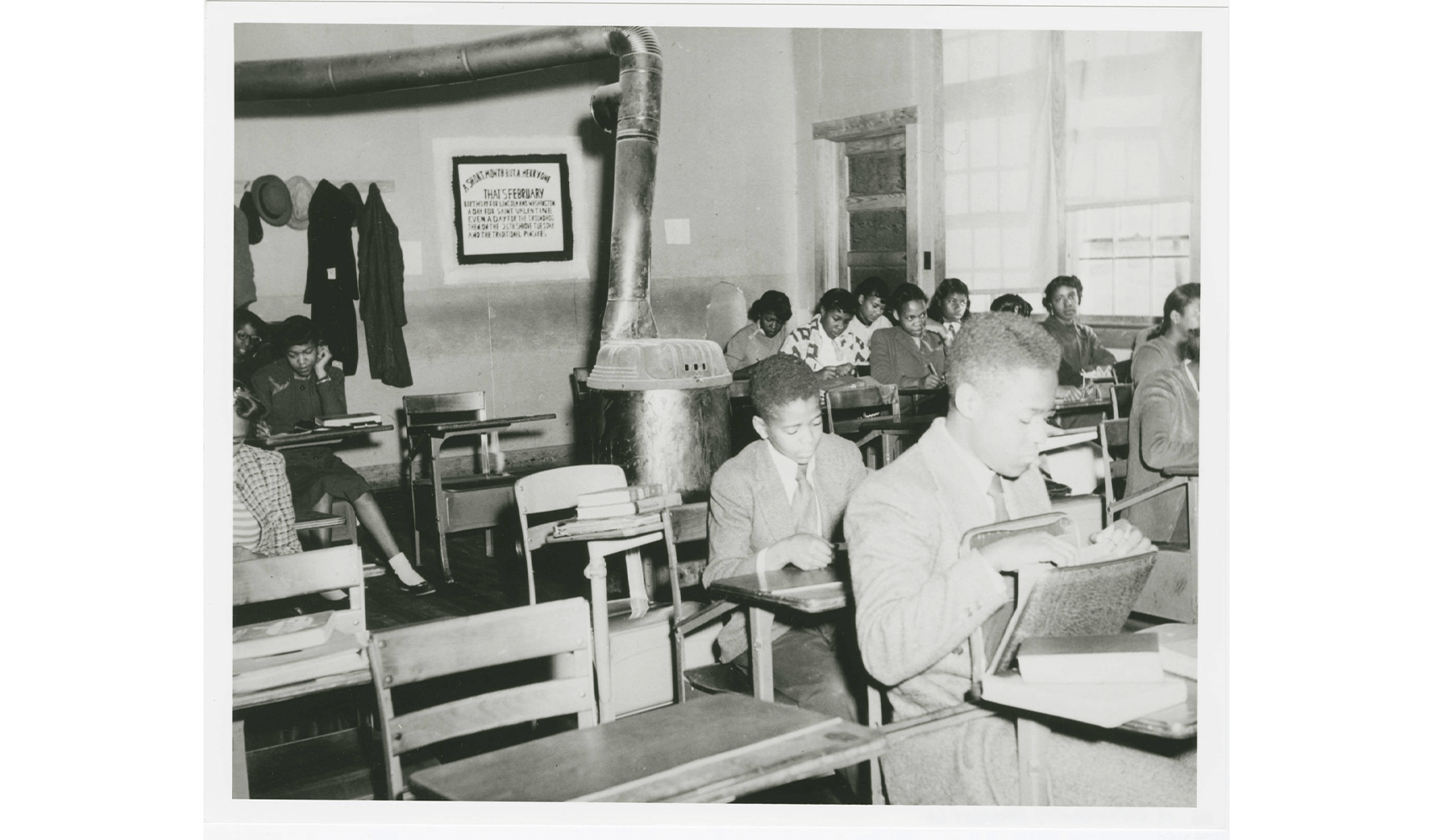
Students in a 9th grade English classroom at Robert Russa Moton High School, the segregated school for Black children in Farmville, Virginia. Source: Pond5
It’s 1950, and children are streaming into Moton High School as the morning bell rings. A building made for 180 students now crams more than 450 into its halls. County officials have decided the solution is to create temporary classrooms using the thin, semi-waterproof black material, typically used to cover chicken coops.
“Tar paper shacks.” That’s what everyone calls them.
Taikein reads about how students who sat next to the big black pot belly stoves in the center of the room got too hot, while students next to the door got too cold and had to keep their coats and sweaters on. Teachers had to pause lessons to stoke the fire. Taikein is used to having central air in school, so he can’t imagine how children learned without it. He is even more appalled when he reads what one student said about what happened when it rained. “You had to put up an umbrella so that the paper that you were taking notes on did not get wet.”
Teachers create makeshift classrooms in the auditorium. Even on the school bus. There is no gym, no cafeteria. Labs have barely any scientific equipment. The outdated and tattered hand-me-down textbooks from the white school often have pages missing and vulgar, racist comments scribbled in the margins.
The entire school shares four water fountains and two toilets.
When a teacher asks the superintendent for toilet paper, he replies, “They don’t know how to use it anyway. Get a Sears catalog.”
For years, Black parents in Farmville have pleaded for improvements to the school. One PTA leader writes up a plan, but when it’s presented to the all-white school board, one board member replies: “If we build a school like that, every Tom, Dick and Harry will be going to school.”
The parent realizes that it’s not about logistics. “That was the first time it dawned on me that there wasn’t any intention for us to go to school.”
Meanwhile just a few blocks away, Farmville High School — the white school — offers Spanish and Latin classes. It boasts a large gym, a cafeteria, an infirmary and a well-stocked library. The lowest-paid white teacher at Farmville, makes more money than the highest-paid Black teacher at Moton.
Taikein scribbles this all down. To him, it’s inconceivable. He’s in the gifted and talented program in the same public school system. Most children in his class at school are white. He has good friends who are white. Some of his favorite teachers are white.
Then he remembers the man he met at his mother’s office — the man who couldn’t read. He realizes there’s a lot he needs to learn about the past.
“Schools were separate, but it definitely wasn’t equal,” Taikein writes in his journal.
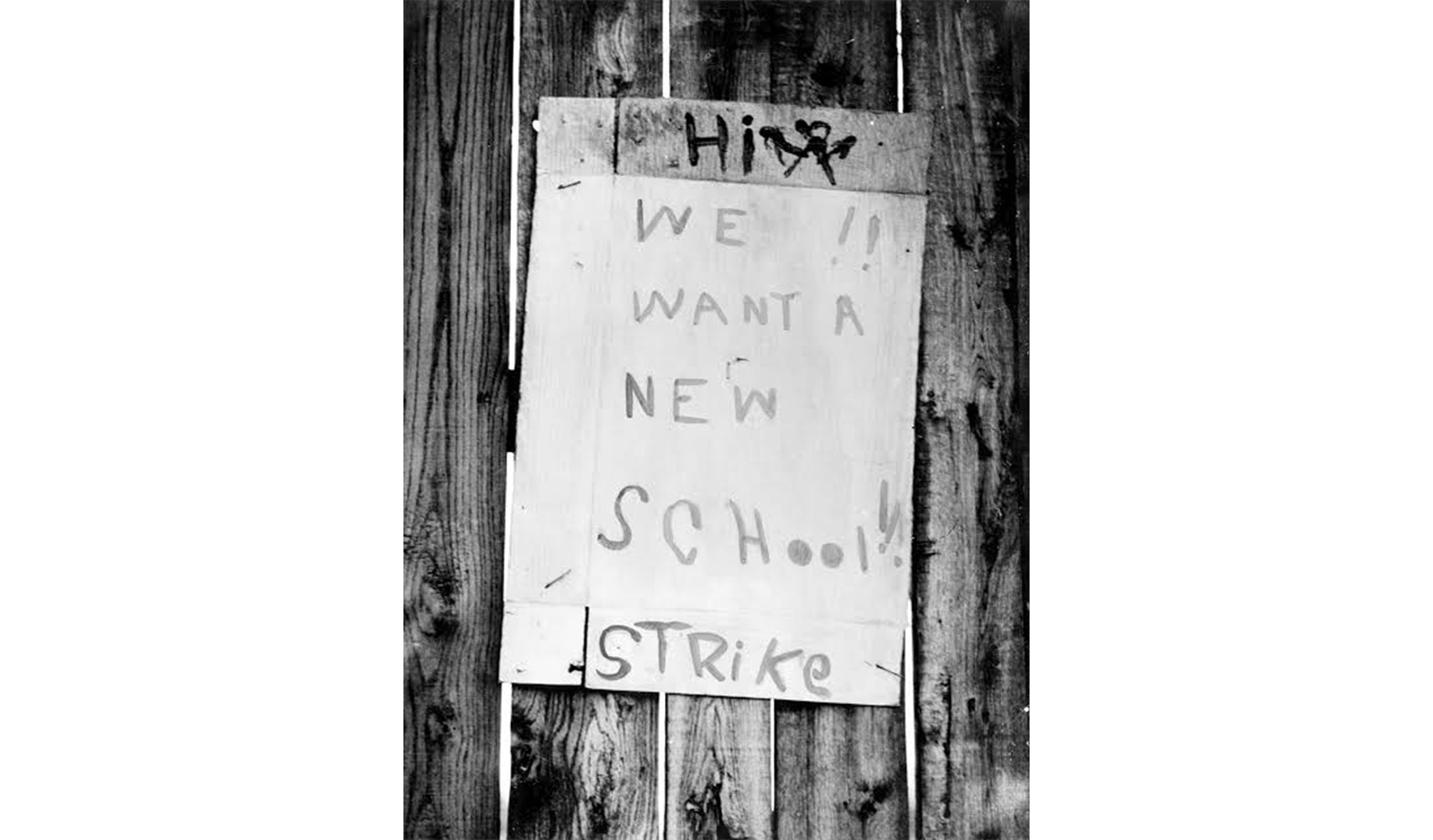
Protest sign from the student strike in Prince Edward County, Virginia. Source: HUMANITIES, September/October 2013, Volume 34, Number 5
“Did you know Vernon Johns, Barbara Johns’ uncle, used to live on this property?”
Pattie and Taikein are fishing in one of their favorite spots in Prince Edward County. It’s a long-abandoned property in Darlington Heights about 25 miles away from Farmville. Oak trees line the pond on the more than 100-acre property. It’s peaceful and quiet and one of the reasons Pattie loves living in this community. Taikein marvels at the plump largemouth bass, channel catfish and crappie that swim in the pond.
Vernon Johns.
Taikein is surprised. The name keeps coming up in his research. He’s starting to make a lot of present-day connections to his research. “And your stepfather is related by marriage to Johns,” Pattie continues.
Taikein can see the remnants of a burned-down house on the property. “Accidental fire” was the official cause, but he had always heard whispers in church that it was arson.
He puts all these things together. Barbara Rose Johns was 16 years old in 1951. With her parents busy working, she and her siblings had moved from New York to Prince Edward County to live with their grandmother. Her uncle Vernon Johns owned a large farm and visited often. He was an influential leader in the civil rights era and had been the pastor at Dexter Avenue Baptist Church in Alabama before Martin Luther King Jr. took over. When Barbara visited the farm, she would read books from his extensive library and listen quietly as the elders discussed social justice issues.
One day, Barbara missed the bus and watched helplessly as the bus for white students passed but didn’t stop because she was African American. When Barbara complained, her favorite teacher replied: “Then do something about it.”
So she does. Barbara and a small group of student leaders trick the principal into believing that he’s needed downtown. He leaves campus and on April 23, 1951, Barbara calls an all-school meeting.
Just before noon, the entire school — all 455 students — squeeze into the auditorium, a space meant for 300. “Breathing was difficult,” remembers one student. Barbara walks to the stage, takes off her shoe and bangs it on the podium and asks the teachers to leave. Everyone falls silent. She quietly outlines her plan to walk out of school unless their education improves.
“We are going on strike and please cooperate and don’t be afraid.”
“What if we are all put in jail?” shouts one student.
“The jail isn’t big enough to hold all of us,” she replies.
Cheers and clapping erupt. The entire student body follows her out.
When the school superintendent refuses to meet the students, Rev. L. Francis Griffin, the minister of Farmville’s First Baptist Church, refers them to the NAACP. Barbara and a friend quickly type out a letter to the lawyers, asking for help.
“Gentlemen,” they begin, “We hate to impose, but…” The letter goes on to explain that this is “a very serious matter because we are out of school, there are seniors to be graduated, and it can’t be done by staying at home. Please, we beg you to come down at the first of this week…”
Taikein is impressed. He can’t believe that someone just a few years older than him did something so bold and radical. “A kid who was still in school changed America,” he marvels.
Pattie is delighted by how invested Taikein is in his summer project. Born 15 years after his next oldest sister, Taikein has always had an instinct for storytelling. She watched proudly as he tried to read as a toddler, devouring anything with letters — street signs, the mail, menus.
Partly, she assigns him this project to keep him busy. Partly, because she knows he’ll be good at it. And partly, because she is growing worried about her cherub-faced son’s safety as he gets older. She hopes that, perhaps, learning about the history of the county where he was born will educate him about some of the dangers he faces.
Families crowd into the First Baptist Church on Fourth and Main. The glow of the setting sun is shining through the stained-glass windows. Some are proud of what the students have done. Others think it’s foolish. Many are bewildered. All are concerned about the implications for their own children’s education.
They’ve received a mailing from Rev. Griffin, a moral authority in town, inviting them to discuss the strike.
“REMEMBER. The eyes of the world are upon us,” he writes. “The intelligent support we give our cause will serve as a stimulant for the cause of free people everywhere.”
But the approximately 1,000 people who have attended this 8 p.m. meeting — their faces tired from a long day of work — aren’t just worried about their children; they are also worried about what could happen to them. They know their store credit and bank loans and their jobs can disappear at a moment’s notice. Worse, they know the Ku Klux Klan is still active in their area.
Then a lawyer from the NAACP speaks. He makes it clear that the organization will only get involved if the community promises to fight to end segregation. Simply accepting equal facilities is not an option.
Murmurs ripple through the pews. They aren’t expecting this. They think they are here about a new school building. The former principal of Moton School speaks. He believes — like some parents — that the students should focus on equality. He can’t imagine that the town leaders will agree to anything else. Some heads nod in agreement. Integration seems inconceivable.
Then Barbara stands up and addresses the parents directly. In her clear and impassioned voice, she urges them not to listen to naysayers. She reminds them of the school’s overcrowding. The terrible conditions. The tar paper shacks. She ends by simply saying, “we are depending on you.” The mood changes. The meeting takes on the spirit of a rally, with claps and cheers. Some people have tears in their eyes. Barbara’s grandmother is in the audience, bursting with pride.
In the end, the students agree to return to school and the NAACP lawyers promise that — if the school board doesn’t meet their demands — they will file a federal lawsuit.
On May 23, 1951, one month after the walkout, Davis v. County School Board of Prince Edward County — named after 14-year-old Dorothy Davis, who is the first of 117 plaintiffs — is filed in the Eastern District of Virginia, Richmond division, asking the court to stop Prince Edward County from operating separate schools for Black and white students.
Unsurprisingly, the lawsuit is the talk of the town — at the Randolph Tobacco Warehouse, the Craddock Terry Shoe Corporation and the Farmville Manufacturing Company. Everyone has an opinion. Several prominent white leaders try to justify segregation by arguing that desegregation would put immense pressure on teachers who would have to bridge the learning gaps between white and Black children. Others argue about infrastructure. And some believe Black children don’t need college preparatory courses at all.
They’ll be farm hands anyway. That’s just a waste of taxpayer money.
But mostly, whites are afraid that desegregating schools will lead to integration in other areas of their community, too.
Attorneys for the all-white school board take the tack that “segregation and discrimination are not the same thing.” And they are determined to prove it.
Each side believes that their children’s futures, their way of life and their belief in the justice system are at stake.
“It seems like reaching for the moon,” Barbara writes in her diary.
“They didn’t want no pinto babies.”
Stanley’s mouth is half-full with one of Pattie’s dinners. She’s known for the recipes she whips up in her pressure cooker. Ribs, pig feet, greens, butter beans.
She believes a tasty, home-cooked meal every night is important and Stanley and Taikein love her for it. Weekends like this one are special to the family. Stanley doesn’t have to work the 2 p.m. to 11 p.m. shift, which means the three of them can eat dinner together. They sit under a clock with Pattie and Stanley’s wedding date inscribed on it. When Taikein talks about his research, Stanley always perks up. His family has lived here for generations. He personally knows a lot of the characters from Taikein’s research.
“They didn’t want no pinto babies.” The term refers to horses that have black and white coloring. “That’s what we were told.”
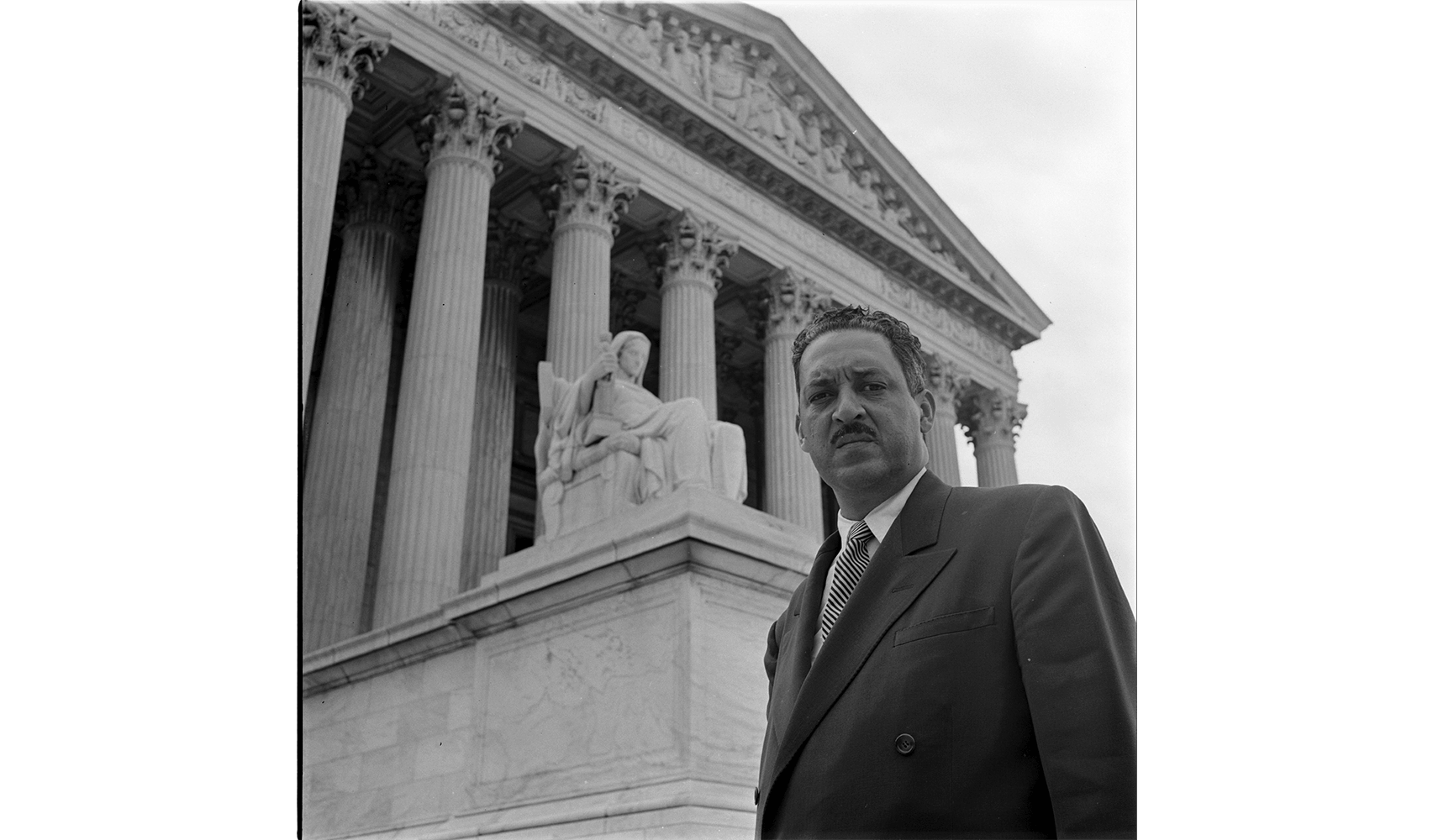
NAACP chief counsel Thurgood Marshall outside the U.S. Supreme Court in 1955. He successfully argued in Brown v. Board of Education that "separate but equal" educational facilities was inherently unequal. He earned the nickname, "Mr. Civil Rights." Source: Pond5
The white community in Prince Edward County is slow to realize the significance of the student walkout in 1951. At first, it is casually dismissed as “apparently student-inspired mass hookie,” by The Farmville Herald. When it becomes clear that the Black community is serious, county officials insist that there was always a plan all along to build a new school for Black children and that they have already greenlit construction on R.R. Moton 2. They hope this will appease Black families. But even as construction begins, the lawsuit has left the hands of the locals. The case winds itself through the legal system, and the Prince Edward County case becomes one of five that the NAACP is using to challenge segregation nationally. Eventually, they’ll be reviewed by the U.S. Supreme Court.
The landmark decision is the one memorialized in textbooks — Brown v. Board of Education. It is handed down on May 17, 1954, and it unanimously finds that “separate but equal” is unconstitutional. Blacks across America are ecstatic and hopeful. Thurgood Marshall, the lawyer who argued the case, says he’s so happy he feels numb, calling the ruling the “greatest victory” in the NAACP’s history. Dr. Martin Luther King Jr. refers to the decision as “a joyous daybreak to end the long night of human captivity.” It’s a leap forward in racial equality.
Much of the initial reaction in the South is stunned silence. As the shock turns to fury among white citizens, elected officials, community leaders, parents and newspaper editorials begin arguing passionately against the ruling. Senator Harry F. Byrd, one of the most influential politicians in Virginia, warns that the decision “will bring implications and dangers of the greatest consequence.” Even the governor who had issued a call for “cool heads, calm study and sound judgment,” when the ruling came down, reverses his stance five weeks later. He insists that he will use “every legal means at my command to continue segregated schools in Virginia.” A year later, many districts still have not desegregated. So the Supreme Court issues another decision known as Brown v. Board of Education 2, which asks districts to desegregate “with all deliberate speed.” The wording is vague. There’s no hard deadline attached. Plus, Virginia answers the ruling with defiance. It launches a campaign called “Massive Resistance.” In direct contradiction to the Supreme Court ruling, the state vows to place students in schools according to race and cut off funding for those who try to integrate.
Most of the state’s newspapers back the movement. So do almost all the influential Prince Edward County leaders, including the mayor, the board of supervisors and prominent business leaders. They start raising money for a private school system for white children.
Taikein sits in the stacks, sifting through the headlines. He’s shocked by the Farmville Herald editorials. His interactions with the press have been positive. His mother Pattie had proudly displayed a newspaper clipping from when he was 5 years old — he’s driving a little plastic white car down Main Street as part of the Christmas parade. Taikein read it cover to cover as soon as it was delivered home.
Now, as he turns the dial of the microfilm, racing through his county’s history, page by page, day after day, he sees just how much has changed. Back then, about 45 percent of residents were African American but they were very poor. Many worked as farm hands on white owners’ properties. They’re not allowed in social clubs or the public library. They have their own segregated hospital and drive-in movie theatre.
Unlike whites, who are addressed by formal titles like Mr. and Mrs., Black people are called by their first names only. Sometimes, they’re just called “boy.” No matter how old they are. Taikein sees all of this, right there, in ink, on the slides in front of him. He takes note. And then he comes across a headline from January 20, 1959, the day after the U.S. and Virginia Supreme Courts struck down laws to resist desegregation. “Key School Segregation Laws Killed by State’s High Court,” reads The Richmond Times Dispatch.
Massive Resistance has been ruled unconstitutional. This means Prince Edward County has to desegregate schools in time for them to open again that fall.
The outrage against the court’s decision swells. In a speech soon afterward, the governor vows an “unyielding fight” against racial integration of Virginia public schools. “Don’t think we have given up hope,” he says in a 15-minute speech on the radio and television. “We have not.”
Prince Edward County has a decision to make. And they’ve only got a few weeks to do it.
The all white Board of Supervisors in Prince Edward County, Virginia votes unanimously to close public schools, rather than integrate them. The schools sat empty, with chains and locks around them for five years. Source: Pond5
It’s June 2, 1959, an overcast but warm and humid Tuesday in Farmville.
Children are playing on the playground of the Black elementary school when three white men come in and tell them to leave.
“There’s going to be no school,” they say.
The men wrap chains and a big lock around the school doors. The children watch in confusion. Moments later, the men begin to strip the playground of all the equipment except for the tall metal slide.
Before they leave, they put up a sign. It reads:
Closed
School property
No trespassing
Under penalty of law
Prince Edward County School Board
The children run home. They burst through the front doors, screaming the news to their parents. Within days, it’s everywhere — the churches, the radio, in The Farmville Herald.
After Massive Resistance failed, the all-white board of supervisors met to decide what to do next. It’s a pivotal moment. They can comply with the courts, integrate and move forward with the rest of the nation, or they can dig in.
They choose cruelty.
The board votes unanimously not to levy any taxes for public education for the following year. “After careful and deliberate study,” the Prince Edward Board of Supervisors later explain, and “with the most profound regret that we have been compelled to take this action.”
Everyone is talking about it, though, at first, most in the Black community are in denial. Even the NAACP attorney working with the community doubts it’s anything more than an empty threat.
If it is, the reality is gut-wrenching.
A Farmville Herald editorial explains that nearly 3,000 students — 1,300 white and almost 1,700 Black — won’t have a public school to attend. Eighteen elementary schools and three high schools will remain empty and 70 Black educators will have to find different jobs.
But it goes on to justify the decision with twisted logic, saying it isn’t about “defiance or bigotry, or, ‘race hatred.’ ”
The county is not defying any court. The county was ordered not to deny any child admission to a public school by reason of race. And the county will obey that order to the letter. In September, no child will be denied admission to a public school for any reason. There will be no public schools.
Instead, they encourage people to donate money to the Prince Edward School Foundation, an organization formed to open a school for white children only.
White county leaders would rather shut down every public school in the county than integrate them.
Stanley was only 2 years old when the schools closed. By the time he got to elementary school, it was basically a forbidden topic. No one discussed it. But Stanley was a curious kid. He peppered his mom and four older siblings with questions about what it was like. They would never tell him.
“I didn't get nothing,” he says, scraping the last of his meal from the plate.
“A lot of kids I went to school with didn’t know about the schools closing. It was seen as shameful. Parents never talked about it.
And maybe they didn’t want their children to become bitter.
Melvin Nunnally is 9 years old and a delicate child. He suffers from asthma and “a bad foot,” so he limps to school each day. The dust sometimes makes it hard to breathe. He has just finished fourth grade when he sees the “No School” sign.
“No school?” Melvin thinks. “That is great!”
But weeks go by and every time Melvin and his mother come to town to buy groceries, they look to see if the sign is still there. It is. “Nothing changed except the grass growed around it,” he remembers.
Taikein knows Melvin Nunnally. His daughter LaKara is in his class at school. They’re both in the gifted and talented program. Taikein sees Mr. Nunnally every time they shop at Walmart, where he works a second job as a greeter. Taikein realizes that the Prince Edward County education story isn’t just history. It’s personal.
When Melvin Nunnally is a little boy, he lives with his family on a farm. For chores, he helps look after the animals. For fun, he likes to draw. He copies cartoons from his favorite TV show, Sailor Bob. But the excitement of being home from school wears off. As the months drag on, Melvin is ready to start fifth grade.
“You’re out for the summer, and you’re glad it’s summer, but then summer gets to be long,” he says. He misses playing marbles with his friends and pitching for the school baseball team. He’s yearning to learn again.
Meanwhile, the white community is busy mobilizing to get private schools open on time for their children.
On September 10, 1959, nearly 1,500 white students attend classes at 16 makeshift locations, while Black children like Melvin have nowhere to go. Many begin working full time on farms, in the hot sun for hours, where they milk cows, chop wood, slop hogs. Melvin starts working full time in the tobacco fields. It’s a major crop in the area and it’s extremely labor-intensive. Cheap Black labor means higher profits for white owners.
“You’d plant it in the ground, then as it grow, you had to keep the weeds out and worms off it. When the sun start turning it a certain color, then you got to get it before the sun damaged it too bad. And then you got string it on a stick and hang the stick up in the barn and then you dry it out. And I done help with all that.” Melvin’s little fingers get red and raw from the work. Occasionally, he goes to the market and watches as the fruits of his labor are sold at auction. He holds his breath, waiting to see how much it sells for.
For a barnful of tobacco, Melvin takes home roughly $5 to his parents. Taikein is stunned by how little they make. He earns roughly $5 for a few hours of work sweeping the floors at a barbershop. Sometimes, if it’s busy, he gets paid $15. And he can use the money to buy baseball cards or rent VHS cassettes on the weekend.
When Taikein tells Stanley, Stanley reminds him that it was common for white people to underpay Black workers. He tells Taikein that when he was growing up, there was a farm across the road. “When my older brother was 15, my mama said, ‘go and ask the man to work.’ So he went on to the hay field and I sat at home watching him work. After he was over, the man gave him 25 cents.”
“For a whole day of work?”
“From sun up to sun down.”
Stanley pauses.
“My mama was a very proud lady. She said, ‘You should have gave it back to him and say, “You need this more than I do.”’
Many Black children, some as young as 12, get jobs cleaning white families' houses. Some take care of white children, even getting them ready for schools they’re not allowed to attend. Melvin watches the yellow school bus roll down the road in front of his house. It doesn’t stop, but he can see and hear the white children looking out the windows.
“They would holler at you, laughing, pointing,” he says. Some remember them spitting on Black kids as the bus rolled by. “You were told to ignore it, so you did,” Melvin says. “But it’s terrible when you see them going to the private school and you ain’t good enough to go.”
Melvin is old enough to understand what’s happening, even if he can’t quite comprehend the hatred. People here don’t want Blacks and whites to mix. But on the farm, there are two white kids who are too poor to afford the private school tuition. So they work alongside Melvin in the tobacco fields. He sighs and shakes his head. “You could work with them on a farm, but you couldn't go to school with them.”
Six-year-old Shirley Davison packs her lunch every morning and goes to the end of the road. She stands there, waiting for a bus that won’t come.
She watches as the white kids’ school bus goes by without stopping.
Taikein comes across her story in his research. Only later does he realize that Davison is her maiden name. He knows her as Shirley Eanes, his fifth-grade teacher. She’s strict. Sometimes tough.
“No wonder,” Taikein says aloud. “The same place that locked her out was the place where she was determined that other kids would have an education.”
At First Baptist Church, the air is heavy with despair. Even those who have been trying to be hopeful are coming to accept that public schools are not reopening this year. One by one, they speak.
“I cried all night.”
“I feel it is like going back to slavery.”
*“My kids keep asking, ‘why can’t we go to school?’ It hurts me real bad but the only answer I can come up with is ‘because of the color of your skin.’ He keeps asking, ‘why do they hate us so bad?’ ”
Black families are desperate for their children to be educated. Some are driving to abandoned houses in the next county, where they’ve put up curtains and pretended to live, so their children can use the address to register for public school.
Some are found out, but others manage to fly under the radar. One extended family gets creative. They rent a four-room house and put eight cousins there together. The parents take turns staying with the children to make sure they eat, behave and do their homework.
Parents are particularly worried about high school juniors and seniors. How else will they graduate? Rev. Griffin and other pastors organize scholarships so they can attend Kittrell Junior College, a historically Black institution in North Carolina, about 100 miles away. It becomes a refuge for more than 60 students who want to graduate on time. Parents are grateful for the option, but mourning. It’s more sad than celebratory when, one morning amid tears and hugs, a caravan of 20 cars packed with children leaves town.
When the American Friends Service Committee comes to town and announces that they have arranged for northern and midwestern families to take Prince Edward County children into their homes so they can study elsewhere, some parents refuse.
“They have parents. They’re not foster children.”
But many agree. It’s not ideal. But they know the importance of an education and they are desperate.
*“I’m sending my son to Iowa and my twin girls to Philadelphia. I want them educated, so I made the decision to send them away.”
Nearly 300 students attend schools outside the county — in Ohio, New Jersey, Kentucky, Maryland, Massachusetts. Some are able to stay with relatives. Siblings are separated, families ripped apart. Some parents have to choose which kids to send away, and which to keep home. These divisions badly damage familial relationships and, in many cases, permanently sever ties between Prince Edward County children and their hometowns.
These students' stories might have been lost to history forever, had they not been preserved by oral histories.
“Going to a major city like Baltimore, you went from dirt and sand to sidewalks and many cars. It is quite an adjustment. I have a lot of self-blaming: am I good enough? Even your family says, ‘don’t talk about it’, but they didn’t tell you why you shouldn’t talk about it.”
“Every Monday I packed my bag overnight and I would get to the door and I saw my daddy tear up and I would cry. I don’t want to go. He tells my mom, ‘don’t make her go.’ My mom is strong and she tells my dad, ‘You go sit down. This child’s got to get her education, what do you think she’s going to do? Sit here the whole week and do nothing?’ The look on his face I know he is hurting. It broke the family union.”
“My mother says Kittrell College was too far away and there was not enough supervision, so she sent me to my grandparents. I didn’t want to go because they lived differently. In the backwoods. There were no electric lights and I had to study by lamp light. I didn’t want to be there in the bushes. My grandpa built his own house and it was far back off the road. Lord, it took a day and a half to get to it. I didn’t want to be that far off the road with people that old. They did the best they could but I was scared of bears, I was scared of the Ku Klux Klan.”
For those who stay, every day feels like a new goodbye. Some areas of the county resemble a ghost town.
Taikein knows that, here in Prince Edward County, the word “family” is loosely defined. People consider themselves related — not just by birth or marriage — but by friendship, geography and church connections. “Aunts,” “uncles,” and “cousins” are terms that are expansive and meant to accommodate all forms of close relationships. So, he understands what it means for his community to be torn up, and why many people he knows have children who live in other states because they never returned.
Taikein used to go with his mother to visit elderly people in the community whose children lived in different states. They often sat with an elderly woman named Flossie White. Flossie ran something called a training center. They couldn’t officially call it a school, but that was the goal. Rev. Griffin helped organize one in the basement of his church. Its official purpose was to serve as a “morale builder.”
Flossie was a widow, working as a beautician and living in a home with a large basement. When the schools closed, her clients were mostly in the evenings and weekends. Typical school hours were free. So, she recruited her two elderly aunts to help run her training center. They named it after her — the White Recreation Center. Flossie arranged for a truck to function as a makeshift school bus and go to different houses and pick up children. And from September to May, for five days a week, she opened her home to 50 students. The children used Ebony and Jet magazines to learn to read.
One year goes by, then two, then three. Nearly 1,500 out of 1,800 school-age Black and poor white children have been without an education for more than three years.
*“Every fall, everybody sat at the radios with their ears peeled to hear what the news was going to be and every year it is the same: ‘The schools in Prince Edward County will be closed this year.’ The county changed. It was almost like sitting in a room with nobody in it. The silence was deafening. Whole families left, friendships, I never saw them again. It’s like a death, so many deaths at one time.”
“I asked my mother and father if I could go to California and live with my sister because I want my education. ‘You want to go that far?’ mom asked. I said yes, I wanted to learn. But now my father died and my sister tells me they don’t have the money to send me back to…”
“I hadn’t started school when they shut down. In the third year, I went away to Ashton, Virginia but I didn’t stay. The gentleman I was staying with abused me so I told my mother and she brought me back home.”
Taikein is obsessed with sports. He plays baseball, football and basketball and he regularly plays soccer matches on the grounds of a private school in town. It’s called Fuqua School, but Taikein knows it used to be called The Prince Edward Academy. But he doesn’t understand why older residents often talk about “The Academy” like it’s a bad place.
Then, Taikein learns how white families kept their kids educated during the shutdown. It was with taxpayer money. County officials gave them vouchers to attend a newly created private, segregated school for white children only.
Donations come in from around the country. And they took whatever equipment, furniture and books they wanted from the now-closed public schools. For the first two years, children are at different temporary locations but in 1961, Prince Edward Academy — The Academy — opens with a gleaming 27-classroom campus, valued at $400,000.
Some Black children got jobs cleaning there. One child, Moses, should have been in the ninth grade. Instead, he spends his day cleaning the windows of the white school that is being built.
For Taikein, The Academy is just where he plays soccer. Sometimes, at matches, he overhears adults in the bleachers grumbling that their children are playing there. “You would hear bits and pieces, but the closing of the schools was one of those things that we never really talked about in Prince Edward County. No one ever directly talked about it.”
Now he understands.
Dr. Martin Luther King Jr. comes to town. It’s a stop on his 1962 get-out-the-vote tour for Virginia’s 4th Congressional District. He arrives at the First Baptist Church and stands before the crowd of Black residents sitting in the ornate pews. They look worn down and discouraged. He addresses their situation directly and praises them for not giving up. “You have not accepted half a loaf,” he says. “We all realize that if we are to be free, we cannot sell our birthright of freedom for a mess of segregated pottage.” There are 60 southern school districts that are quietly desegregating elsewhere in the country, including in nearby Norfolk, Arlington and Charlottesville. So King tells residents to hold onto hope.
“Things will get better,” he says in an impassioned speech from the pulpit. “Do not despair, do not give up but just stand firm for what you believe in and people all over the United States will say there are Black people of Prince Edward County who have injected new meaning in the veins of civilization.”
Melvin has been out of school for three years. It’s changed everything.
“It took away all your thoughts of what you might want to do,” he says.
The kid who once dreamed of being a Disney artist and animator now can’t see a future beyond working in the tobacco fields.
His mother only ever finished the seventh grade. His father only got through fifth. So it falls to his sister to teach him how to read. They sit together for an hour each day for the first year until he reaches her level. And then even that education stops.
On March 18, 1963, Attorney General Robert F. Kennedy takes the stage at Freedom Hall in Louisville, Kentucky, to commemorate the centennial anniversary of the Emancipation Proclamation. The hall is one of the largest indoor venues in the U.S., and it is packed.
Under harsh spotlights and through a haze of cigarette smoke from the crowd, Kennedy begins speaking. He lists the disparities between Blacks and whites — in education, voting and housing rights — and forcefully reiterates the urgent need for immediate racial equality. Civil Rights advocates are thrilled; white segregationists are furious. And people in Prince Edward County, Virginia, are shocked to hear him call them out by name.
“We may observe with much sadness and irony that, outside of Africa, south of the Sahara, where education is still a difficult challenge, the only places on earth known not to provide free public education are Communist China, North Viet Nam, Sarawak, Singapore, British Honduras — and Prince Edward County, Virginia.”
“MOO!”
Nineteen-year-old Jean Stein bolts upright, confused and disoriented. It takes her a second to realize that her alarm clock has been replaced by a cow named March. For a moment, she forgets that she’s no longer in her own bed at her parents’ fifth-floor public housing apartment in Flushing, New York. She’s now a boarder in Mr. and Mrs. Reid’s country house in Prince Edward County, Virginia.
“My new home was as foreign to me as any I could imagine,” she writes in her diary. She doesn’t mean that because her hosts were Black and she is white. The Reids are gracious and kind and treat her like one of their own daughters. It’s the cow, now joined by a very enthusiastic rooster. It’s the big open spaces. It’s the quiet at night.
Mrs. Reid cooks using eggs from the family’s chickens, vegetables she has grown herself and homemade ice cream from March the cow. The newspaper classifieds have ads for steer sperm!
Mr. Reid is a deacon trustee at First Baptist Church and his wife teaches Sunday school there. In the evenings, as the sun goes down, the family sits around the porch and listens to Mr. Reid in his rocking chair, singing his favorite gospel hymn in his thick Southern accent.
Give me that old-time religion.
It was good for Paul and Silas,
It's good enough for me.
It was good for the Hebrew children,
It's good enough for me.
It was good for our mothers,
It's good enough for me.
Makes me love ev'rybody,
It's good enough for me.
Jean grins at her roommate, Phyllis, who is just waking up, looking a little disoriented herself. “We’re in the South!” she exclaims.
“I’ve got a funny story,” says Debby, as student educators from Queens College sit around in a circle.
Prince Edward County is in the middle of a heatwave that is 97 degrees and she has already tanned a deep brown. “Two of the little girls in my class, six or seven years old, came over to me, very politely. ‘Missy Yaffe, we wanted to know, are you Black or are you white?’ ”
The group bursts out laughing. Jean thinks of their weekends of cultural preparation back in New York where they discussed books like Class and Caste in a Southern Town. Experiencing this is so different from training for it, Jean thinks to herself. “You can’t really learn about others solely through books.”
There are 16 students who are chosen through a Queens College program to become volunteer tutors for six weeks during the summer of 1963. They are mostly Jewish, but as Jean noted, they all come from very different backgrounds with one common goal: “To restore a sense of pride and human dignity” to children who had been denied an education.
Jean remembers each tutor introducing themselves. There’s Mike, from Long Island, who had never met a single person of color during his public-school education. His mom encouraged him. She’d “never met a peace march, civil rights march, or pro-choice march that she didn't want to be part of.”
Rosalind’s parents were self-described communists who believed in equal opportunities for all races. On her first evening in the South, Rosalind met some children at a local church. She picked up her guitar and started singing, “there was an old lady who swallowed a fly,” and the kids joined in delightedly.
Stan, whose parents had berated him for being involved in civil rights organizing, “wanted to make democracy real.” He had tried to invite Malcolm X to speak on campus the year before.
June went to high school with Stokely Carmichael.
Jean sees the others as a bit rebellious, but she has a surge of affection for them. Even her quiet roommate, Phyllis, was once kicked out of the Queens College café for wearing pants. Jean is proud of how they had worked together to raise the $7,000 they needed to underwrite this trip. In just six months, they managed to organize a fancy fundraiser with Dick Gregory at Carnegie Hall, get enough publicity that strangers sent them checks for $25 to “buy supplies for the children,” and make the seven-hour Greyhound bus ride to Prince Edward County.
The group looks earnestly at Rachel Weddington, an African American professor in the Education Department at Queens College, who has come along as a faculty advisor. “Doc,” as all of them called her, holds Sunday afternoon weekly check-ins. The meetings are a way to celebrate wins and process their new lives. They laugh about things like how much poison ivy there is, how much weight they are putting on from eating Southern food and how the Farmville mayor uses terms like “hippity hop!”
There are certainly challenges. The volunteers have all read a University of Michigan study that found more than 60 percent of the approximately 1,700 Black children had been out of school for four years already. During that time, the number of them who could not read and write had skyrocketed from 3 percent to 23 percent.
The college students are teaching 8-year-olds who cannot hold a pencil, 10-year-olds who do not know the alphabet, and 13-year-olds who cannot write their own names. Many don’t even know how old they are.
Very few homes have access to any reading materials, and the majority of children younger than 12 have lost their ability to communicate. There are teenagers unable to tell time, and many students who do not understand instructions like “turn the page.”
The students decide that, while in Prince Edward County, they will only go where Black people are allowed to go. That means no movies, bowling or library visits.
Jean takes this pledge seriously. One night, she and some friends pull into a gas station so she can use the bathroom. “I saw a sign that said, ‘WHITES ONLY.’ I stopped short. I couldn’t go in. I quickly turned and returned to the car.”
It’s the first time she had personally felt the sting of racism.
They all have stories like this.
During group meetings, they share the outright hostility.
“Some stared at us as if we were some hideous creatures,” Jean shares. Some yell out taunts like “n***** lovers” as they walk by. Many have seen police officers taking photographs of them.
Phyllis is growing increasingly uncomfortable, realizing that white people posed a real danger in Prince Edward County. “I was scared of white people here,” she confides.
Doc, with stylish cat eyeglasses, has a gentle voice, but a spine of steel. Stan calls her his “godmother,” Mike calls her “the rock.”
They’re all still a bit shaken about one encounter, a few weeks prior.
Some of them had gone to the local Tastee-Freez for malteds late one night, around 11 p.m. “We were all ordering ice cream and two cars pulled up, full of young white teenage guys,” Mike recalls. “And before we knew it, we were surrounded.”
The boys kick a young Black pastor who is with them and call the students white trash. “I was pretty scared,” Mike recalls. “We didn’t know what to do.”
Doc steps in. “She just started walking right through the circle of white guys, and we followed her right through, got into our cars and went back to call the police.”
Rosalind, who usually considers herself pretty fearless, is so terrified that as soon as she is dropped off at her host family’s house, she runs up the stairs and hides under the bed.
Jean can’t understand the hatred. She writes in her diary. “What makes people this way? I can't understand them. They think Negroes are less than human beings, yet they are the animals.”
The students have a nickname for Rev. Griffin. It’s Mount Rushmore — because of how strong he is.
He holds meetings in his home. He and Doc are friends. Jean knows they are waiting for an update on the two truckloads of donated books collected in New York. It’s been delayed.
“CRACK!”
Someone screams. All the students look stunned. There are more pops. Maybe firecrackers?
“Everybody just lie down on the floor,” Rev. Griffin says quietly. The young students lay flat.
“It’s shots,” someone whispers.
“Those are guns!”
Jean can’t see Rev. Griffin, but she wonders what he is thinking. June is right next to the phone, so she grabs it and calls the sheriff’s department.
“I think there are people shooting at us.”
“Where are you?” the sheriff asks.
“We’re in Reverend Griffin’s house,” she answers.
“We’ll be right over.”
June hangs up and crawls to the other side of the room, next to Rev. Griffin.
“I called the sheriff and told him,” June says in a whisper.
Rev. Griffin looks at her and says, “Oh, he will be right over? He’s probably going to round up his deputies who are out there shooting at us.”
June is genuinely stunned. She realizes how little they understand about Prince Edward County.
Taikein reads the account of what happened that night. Suddenly, he understands what Stanley meant when, a few months ago, he warned him about encounters with police.
“Do whatever you have to do to stay alive; we’ll deal with everything else later.”
It’s 9 a.m. and Jean is in front of her class of eager 11- and 12-year-olds. She teaches reading and math to them every day. Rev. Griffin’s younger son, Mignon, is among her students. A few days ago, the Long Island Press printed a story with the headline “The 3 Rs after 4 years.” In it, Jean is photographed surrounded by Black children. She wonders what her mother will say when she sees it.
As children from more rural parts of the county hear about the new classes, enrollment increases. Children and teachers get shuffled around. More than 530 have now signed up for school and classes are held in various churches and community centers — basements, auditoriums and lofts — until 1 p.m. every day. After that, it’s too hot. There is no air conditioning.
“I have Bobby Lou, Bobby C., Bobby I., Bobby Tre, Bobby Jr.,” says June, talking about her students at one meeting. The other volunteers laughed. “Southerners love to change names. And then there’s the name in the book versus the name that they actually respond to.” She warms to her story. “So Bubba was not on my list. Bubba was like Gregory Marshall Smith, the third. And I'm going, ‘Gregory Marshall Smith, the third?’ And they're all sitting there politely wondering if they should point out to me that, ‘you're talking about Bubba?’” More laughter. “And then there was one student, Ralph was his name. And he was ‘Fly.’ F. L. Y. Fly. Why was he called Fly?” Everyone looks at her expectantly. “Because if school got boring, he would fly out the window.” June waits till the laughter subsides. “It was a really good measurement for me. If Fly remained in his seat, I knew that I was keeping them engaged!”
Students have been out of school for so long that they aren’t used to sitting down in one spot. Keeping them engaged is a constant struggle. Volunteers try to give them frequent breaks, so they don’t get restless.
Lessons have to be improvised because the book trucks still haven’t arrived. Many classes are held outside, so the tutors nail blackboards to the trees. The teenagers scrounge for planks that students can put on their laps and use as support as they write. They put up alphabets and numbers on whatever wall space they find in church — as long as they remember to take them down before Sunday services.
Jean tries to teach her students new words by having them look at pictures she has cut out from magazines. She makes up stories. She marvels at the eagerness to learn. Many bring back more homework than she has assigned. Some walk five miles on dirt roads to attend school. Others get up at 5:30 a.m. to finish farm chores or go to paying jobs before classes begin. One 13-year-old in the third grade skips recess to study. Children who are just learning to read proudly talk of going home and tutoring their younger siblings.
Some children will only speak in whispers; they are so self-conscious. Some confide in the mentors that they spent every afternoon for years walking around, kicking rocks because they had nothing else to do. Some have never played a group sport; others play baseball with socks rolled up as a ball and a two-by-four as a makeshift bat.
The children feel responsible for their lack of education. They are embarrassed.
It breaks the tutors’ hearts.
Melvin Nunnally is delighted to go back to learning. He also enjoys being around the Queens students. One volunteer realizes Melvin loves art. They give him a camera and show him how to develop the film in a dark room. It’s the start of a lifelong hobby.
Jean shares that her mother has seen the article in the newspaper and has received threatening phone calls. “She was terrified.” But the volunteers also know that publicity from The New York Times, the New York Post, the Washington Post, CBS and The Herald Tribune, among others, is good for the cause. So, they continue to allow reporters to interview them.
The sweltering heatwave continues.
More student volunteers have started hanging out in the Reids’ backyard in the evenings, singing freedom songs around a bonfire. They realize that many of the civil rights or freedom songs they know are gospel church songs. “So when they were singing, ‘Ain’t so hard to get your mind set on Jesus,’ we learned ‘Ain’t so hard to get your mind set on freedom,’” says Rosalind, delighted by her discovery.
They discuss The Farmville Herald editorials, which have become more feverish in warning white citizens that “outside sources are using your children as pawns in a national, if not international conspiracy.” Every piece ended with the exhortation: “Stand steady, Prince Edward.”
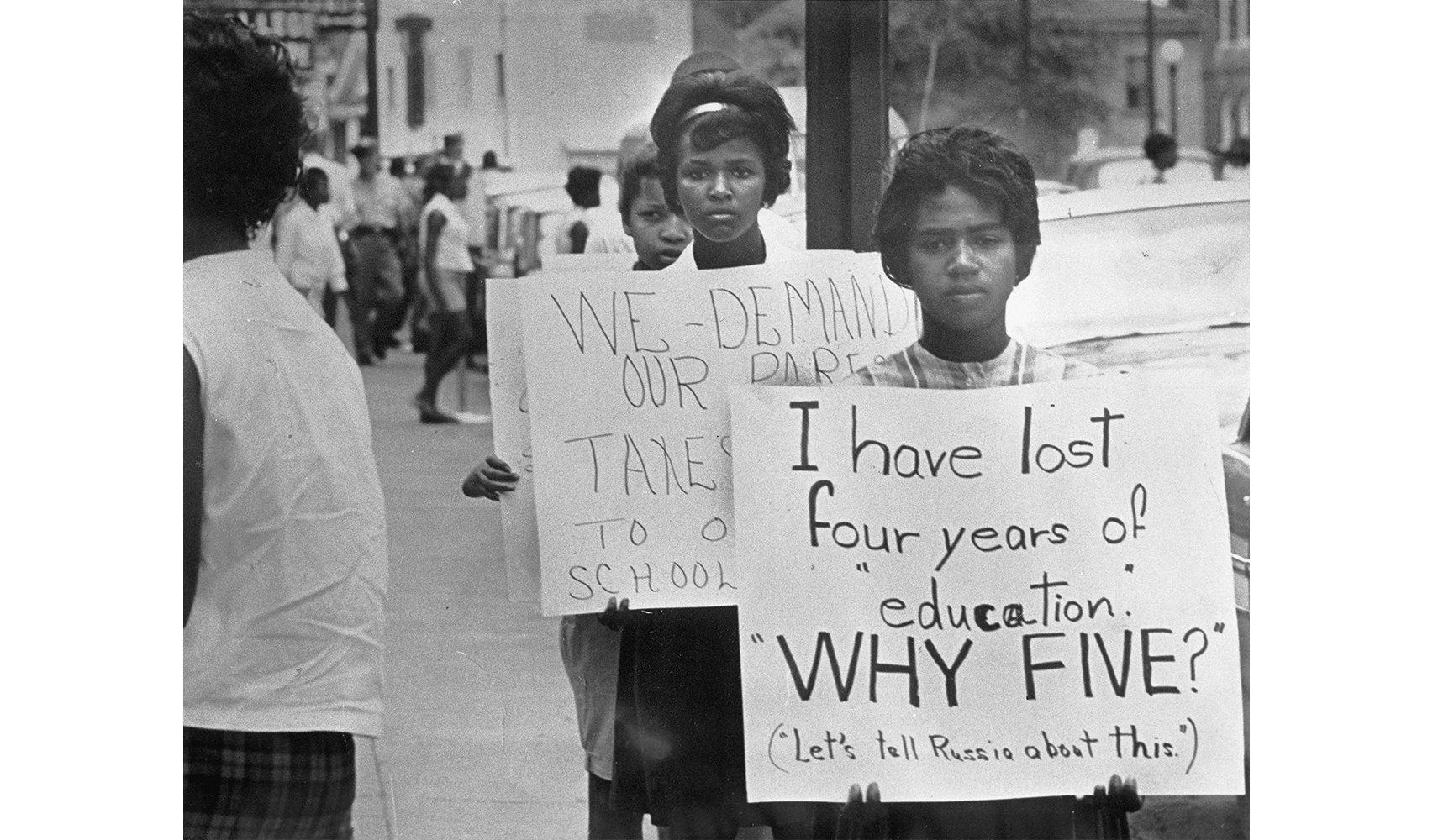
Civil Rights Protest Farmville, Va., in July 1963. Source: Richmond Times-Dispatch via Getty Images
That summer, the tone begins to change.
Several teenagers who had left Prince Edward County return home for the break. They are inspired by what they’ve learned elsewhere. They are not worried about losing jobs or store credit, like their parents are.
The local NAACP Youth Council invites field organizers to train young people in direct action and nonviolent methods of protest. Area churches and pastors are heavily involved in organizing sit-ins and boycotts of movie theaters, department stores and restaurants.
Blacks hold “kneel-ins” in white area churches. When students walk to Farmville Baptist Church and begin singing hymns outside, police officers arrest them.
The book trucks finally arrive. And Debby sits in the basement of First Baptist Church sorting them out into different piles into six balanced collections for the six tutoring centers. But as the older children get more involved with the protests, they start missing school to go to demonstrations. They sing freedom songs as they march down Main Street or hold signs that read: We Learn Our Civics in Jail.
High Rock, where Melvin studied, has had average attendance drop from 80 percent to 63 percent. So, Jean and the other volunteers go to the children’s homes in the evening to tutor them.
Melvin isn’t allowed to go to any protests. “My mama didn’t want us to go to jail,” he says. But because he is good at drawing, he helps make the demonstration signs. “I couldn’t go but my signs was there,” he says, even though he mixes up small and capital letters on a sign that reads: “I have lost four years of educAtion. WHY FIVE?” He feels enormous pride when he sees it in the newspaper the next day.
Children meet in the basement of First Baptist Church to discuss protest shifts. Rev. Griffin tells them, “You’ll probably get arrested.” And several are.
He tells his congregation, “The only power a poor person has is their pocketbook.” So as the protests intensify, many parents, including Stanley’s mother and Melvin’s, take part in an organized boycott of stores that discriminate against Blacks. They call it selective buying. There are handbills that read, “MAKE YOUR $$$$$$$ WORK FOR FREEDOM” and “MAKE FARMVILLE A GHOST TOWN!!!”
Calling for the main city in Prince Edward County to be “empty as a desert every day” until public schools reopen, they picket outside J.J. Newberrys, a department store, College Shoppe, a local restaurant, and Grants Safeway, where Stanley later tells Taikein, “you could buy a sandwich, but they didn’t want you to sit at the counter and eat.”
On Saturday, everyone walks across the bridge together to shop in nearby counties. The NAACP organizes transport for people returning with groceries.
Sometimes Black shoppers enter Prince Edward County stores but don’t buy anything. They look at the rotten, unsold food with pride. People form a circle around one Black man who is shopping. They shout, “Uncle Tom, Uncle Tom,” and he falls down and all his groceries spill on the ground.
Stanley is the coach for Taikein’s basketball team. One day, he tells him about an incident from his childhood where he saw a man who repaired cars with a cross in his yard.
“I asked my mama, ‘what is that?’ ‘Oh, this guy part of the Klan.’”
Stanley’s mom explains the Klan to him. At first, Stanley is confused because some Black people he knows still go to the man to get their cars fixed. Then he understands.
“They took off the hood, became policemen, became judges, became priests, but they still had that stuff in them.”
A rumor is running through town. The student teachers realize it’s true. There is a federally sponsored, privately funded effort underway to start an integrated school in the county. A new superintendent, Neil Sullivan, is tasked with opening it by September 1963, which is in three weeks. Sullivan is scrambling to hire 100 teachers, prepare a curriculum and organize transportation.
Mike, Stan and some other volunteers go to the Black high school to clean it up to get it ready for this potential September opening. The floorboards are rotting, plaster has fallen, water has seeped through the walls. Rodents are everywhere and the stench is sickening. A flag folded under dust has 48 stars.
“I went into one of the classrooms and there was a calendar open to the date in June 1959 that the schools had closed,” Mike recalls. “The last day anybody had been there.”
The college students exchange mailing addresses with children who promise to write. Summer romances end. They pack up. Some are going on to attend the March on Washington in August. Some are going straight home.
At their last meeting together in Rev. Griffin’s basement, they go around the circle, sharing stories and talking about how proud they are of their students’ growth and increased confidence. “Instead of ‘I can’t,’ it turned to ‘I’ll try,’ ” says one volunteer delightedly. But most of all, the New Yorkers say, they are the ones who have changed.
*“I had this sense that we were the white saviors, white knights on white horses coming in to save these poor Black people,” Mike later says. “It was a very, very clear lesson in humility. That this was everybody's fight, but we were foot soldiers in that fight and nothing more than that.”
“I would certainly agree,” Stan writes. “There is no doubt in my mind that we got a whole lot more out of it than they did.”
“I became an adult,” writes Jean.
“It’s like my eyes and ears are different,” Phyllis adds.
“I personally, selfishly love that I was here,” says June. “It feels like an ant, carrying the crumb up. But there’s a feeling that you were part of a movement and there was a way to change the world. That you do it one student at a time, one community at a time, one equity at a time.”
“Our poor parents,” Phyllis says with a rueful laugh. “Their Black-white prejudices will never be tolerated now.”
“I got you!”
“Tag, you’re it!”
Splash.
Squeals of joy pierce the air. About 100 students and their volunteer teachers run through the water at Prince Edward State Park for Negroes. They dance in the sand, play volleyball and guitar, ham it up for goodbye photos and celebrate the end of their time together.
Jean calls it “the highlight of the summer.”
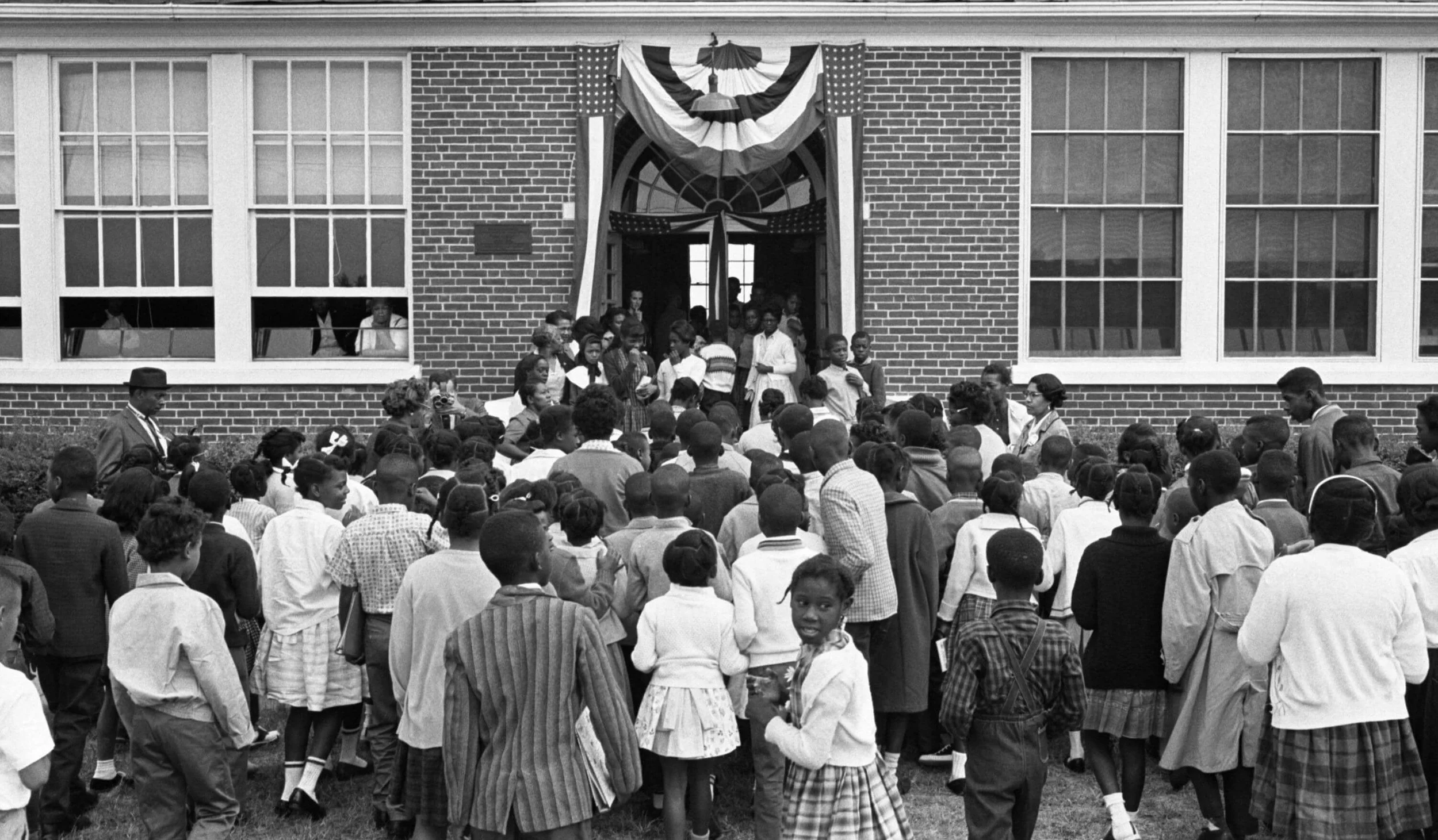
African American children entering the Mary E. Branch School in Farmville, Prince Edward County, Virginia on Sept. 16. 1963. Source: Alamy/Everett Collection Historical
Reporters from across the country line up, notebooks in hand. The flashbulbs of cameras go off in succession. It’s September 16, 1963. A 6-year-old raises the flag. When it comes time to recite the Pledge of Allegiance, one journalist notes that many of the children gathered don’t know the words.
The mood is somber, not joyous. Just the previous day, four little Black girls were killed in a church bombing in Birmingham and there is the unspoken fear that the same thing might happen here in Prince Edward County. But after the children walk quietly into their first day of classes in the Free Schools buildings, the day continues peacefully.
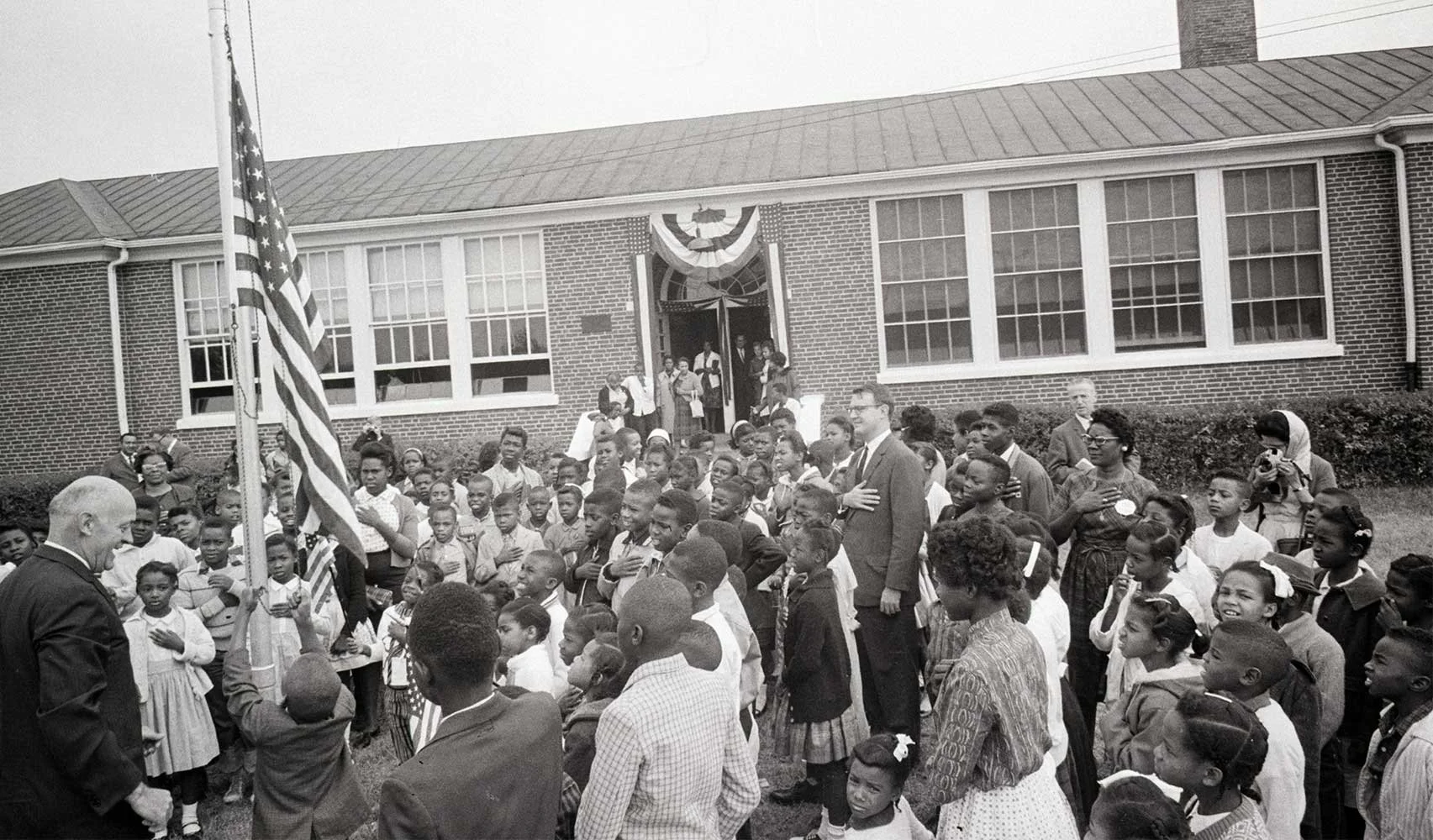
9/16/1963-Farmville, VA- School doors swung open 9/16 for children of Prince Edward County, where public schools had been padlocked since 1959 in avoidance of court-ordered integration. Source: Getty Images
Superintendent Neil Sullivan expects about 300 students to show up, but almost 1,600 attend. Opening the Free Schools is nothing short of miraculous. He has negotiated leasing four school buildings and 20 school buses. He got it done less than two weeks ago. Teachers are hired from across the country. About one-fourth of them are white. And the nation’s generosity is on full display. Donations pour in. General Electric donates 30 TV sets, the Institute of Textbook Publishers donates 40,000 books and Bell and Howell donates film projectors. Teachers’ associations send checks ranging from $100 to $5,000. The USDA sends surplus food. “’Cause the people felt sorry for the kids in Prince Edward, you know?” Melvin says.
The Free Schools serve hot lunches and have on-site health clinics that vaccinate kids and test their eyesight and hearing. In one activity, children are asked to “circle an activity they do in the morning” and many circle a hatchet instead of a toothbrush, because they chop wood as soon as they wake up.
There’s a dentist to provide dental care and all children are given a toothbrush and toothpaste. There are activities until 5:30 p.m. and on Saturdays. Older students can help in the cafeteria, library and playgrounds to earn money.
They start taking field trips to historical sites in Virginia in an old Army surplus bus. Celebrities like Leonard Bernstein and Harry Belafonte come. Athletes visit. When teachers find out that siblings are sharing warm clothes — so if one went to school, the others had to stay home — they ask for donations of winter clothes. Heavy jackets and rain boots are collected. The Motion Picture Association in Washington provides free films for the children every Tuesday.
As time goes on, children become more relaxed and less afraid of the white teachers. They don’t put their hands in their mouth when asked to speak or turn and face the wall in fear. They also improve in math and language skills. There are hardly any discipline problems.
Melvin is one of the approximately 1,574 students who attend the Free Schools. He walks two and a half miles every day in a buttoned-down shirt, ready to learn. The building has no indoor plumbing or heat and serves grades one to five. “Teachers would tell us we got to make it the best way we can,” he said. He is seated close to a girl named Joyce Nash. He has seen her in his church but never spoken to her. His sister sometimes plays with her.
At his last job, on Long Island, Sullivan had pioneered a novel concept called nongraded schools, where children are grouped by ability rather than age. And that’s how Joyce, who should have been in the sixth grade, ends up with Melvin and the third graders.
Joyce is raised by her grandparents in Prince Edward County. She is six years old and getting ready to start first grade when her grandmother tells her there will be no school because “white children didn’t want to study with Black children.” Joyce can’t understand how her grandmother is good enough to clean white people’s houses, but she can’t go to the same school as them.
Instead, she accompanies her grandmother every day to clean. They have to enter through the back door of the white people’s homes. They wash and iron their clothes. Sometimes Joyce helps to mop and clean.
Afterward, she listens to her grandmother play the piano and sing.
He’s got the whole world in His hands’
He got the whole world in His hands.
Sometimes as a treat, they watch TV together.
Her grandfather can’t read or write his name. He just signs ‘X’ on documents. But her grandmother studied until the seventh grade, so she teaches Joyce to spell her name and count to 100. She teaches her colors.
When the Free Schools open, Joyce is 11. She is terrified to go to school. She’s never been in a classroom before, nor ridden the school bus. But her grandmother says, “You have to go.”
“Education is important. Put God first, always. And then education.”
Joyce notices she is far behind her cousin Nancy. They’re the same age, but Nancy is one of the children who left town to continue her education during the closures. In the Free Schools, Nancy is placed in the seventh grade, while Joyce is forced to sit with third graders.
And for that, Joyce is bullied terribly.
“Oh you a dummy, you in my classroom, you older than me,” they tell her.
They point out her acne. They don’t understand puberty. All they know is she has bumps on her face. So they call her “Joyce the bomb.” She starts to get in trouble for fighting back.
She is mad at everything. The cycle of bullying and fighting continues until Joyce decides there’s only one way to break it: drop out.
“I quit,” she tells her grandmother. “I’m not going back to school.”
Her dreams of being a teacher are over. She goes to work at the Dunnington Tobacco factory.
In November 1963, President John F. Kennedy, a strong supporter of integration, is assassinated.
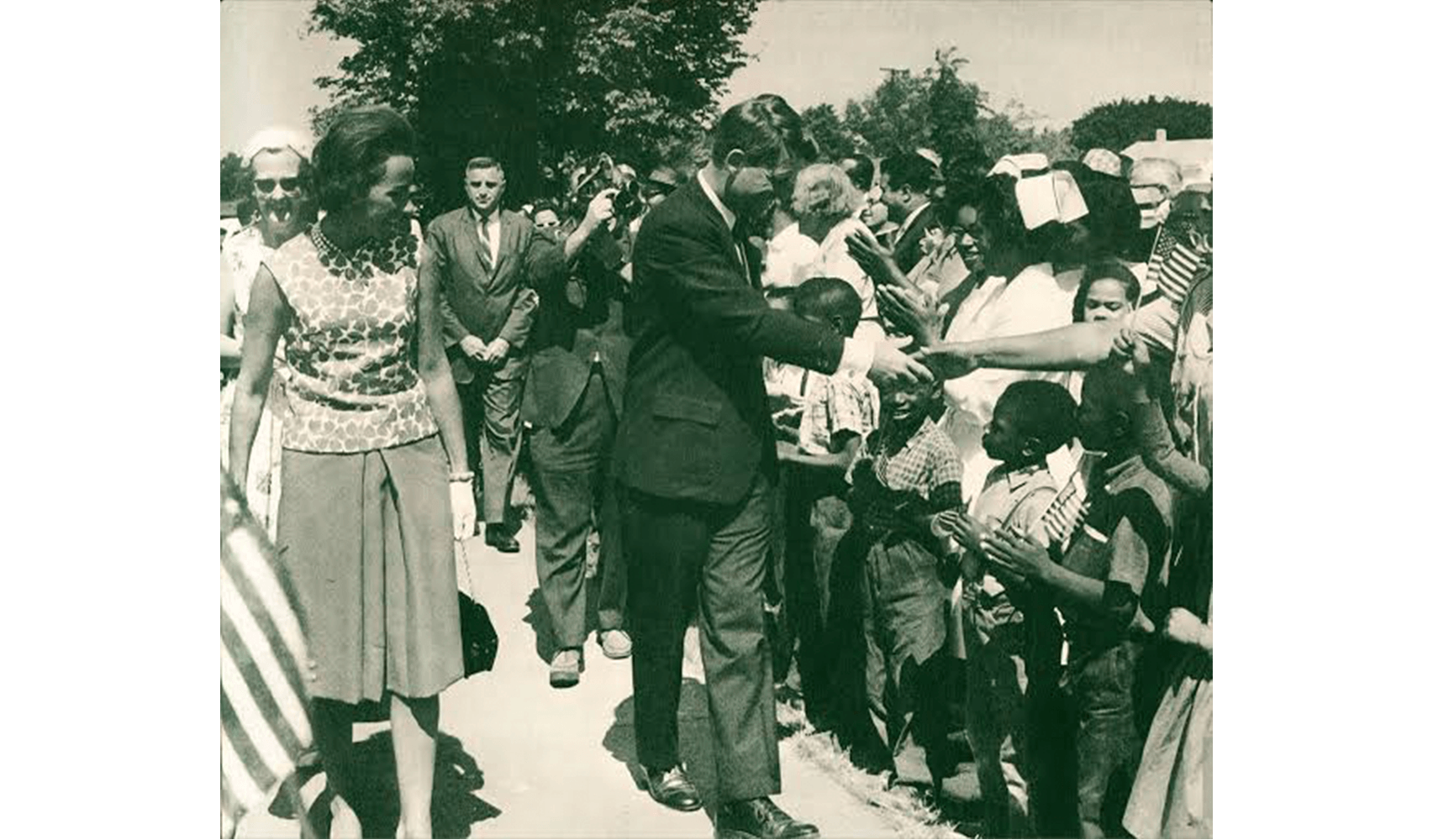
Former Attorney General Robert F. Kennedy (now Senator from New York) and Mrs. Kennedy visit the Free Schools. Source: Moton Museum
Taikein looks at his playing field outside the former Moton school and imagines the whirring helicopter blades descending on May 11, 1964. He can picture how excited everyone is when they see Robert F. Kennedy and his wife Ethel walk out. Teachers must have been smiling as the brother of the fallen president shakes hands with them. Hundreds of African Americans gather to wish him well, thrilled by the show of support from the federal government.
Melvin and his mother are in the crowd that day. They listen as a group of students play “America” and the “Marine Hymn.” A little girl presents the Kennedys with a bag tied with a red, white and blue bow. It is $99.64 in pennies that the children have collected towards a memorial for JFK. Melvin swells with pride that three pennies he donated are part of the bag.
Kennedy has lunch in the Free Schools cafeteria with children. Melvin can’t believe his luck when Kennedy shakes his hand as he walks by. This day is perfect.
And then Taikein’s mind drifts to a baseball game he had played on this very field. It was the end of the game. “We were going to shake hands with the other team. When one of the white guys on the other team spit in his hand and was going to shake hands with my Black teammate. And my teammate punched him in the nose.”
A big fight broke out.
Taikein reads about the endless lawsuits and motions that are filed until finally, on May 25, the Supreme Court decides unanimously — 9-0 in Griffin v. County School Board of Prince Edward County — that the county can’t continue to close public schools and use the money to fund private ones. “The time for ‘deliberate speed’ has run out,” the justices rule.
At last.
“For five years our community was without any public schools, and because of this a generation of our children are permanently crippled and disabled educationally.” The words of Rev. Griffin feel heavy to Taikein as he reads them. “For years, we have suffered the ways of peace and sought from the law the justice we have been denied so long. We suffered our children to be destroyed in order that the law might speak.”
Jean opens her mailbox in New York and finds a bundle of letters from her former students. Personal details mixed with the political.
“I’m doing well in school if I must say so myself. My report card had all S on it. I mean satisfactory. I try very hard.”
“The March on Washington was very interesting. I hope you enjoyed it, I did. I miss you very much and posit that everyone else does too. I heard that the store managers were going to hire colored people.”
“O! I am very excited about school opening here. I am planning to get two new dresses for school and I am going to make a brown blouse.”
“I hope you are having a good time in New York. My 21-year-old cousin Sunny West said to send him your picture.”
Segregationists have one more plan up their sleeves. There is a rumor that a federal judge is expected to stop the Board of Supervisors from distributing the taxpayer money they have appropriated for white parents to use to send their children to the private academy.
One night in July, white parents start getting calls around midnight.
Race down to the armory.
Some 1,250 checks are cut by 2 a.m. Banks open early so parents can cash them before any court hearing begins.
President Lyndon Johnson signs the Civil Rights Act of 1964.
September 8, 1964, 1,520 Black children and four white children return to an integrated Prince Edward County school system.
Taikein is 15 and a sophomore in high school when he is selected to be a marshal for a 2004 honorary graduation ceremony for students who had been locked out of Prince Edward schools years ago.
His job is to help the graduates off stage after they collect their diplomas.
He is surprised to see so many people he knows. Like Ricky Brown, his school resource officer. And Edwilda Isaac, his fifth-grade music teacher who taught him the saxophone. Even Lorenzo Clark who made it to the AAA for the Orioles.
“I just never put in perspective that my teacher, who demands excellence from me every single day, this is what she’s had to overcome. My resource officer who always told us, ‘You represent something greater than yourself.’ Those folks were really hard on us in many ways and I think it’s because we had opportunities that they never had and they didn't want us to squander it.”
“So many people hugged me and said, ‘you don’t know what this means to get this.’ ” Some cry, others cheer. One says, “it’s about time.”
Still, many are missing. The humiliation they had endured and the opportunities they were denied are too painful to confront. They don’t attend.
*“What’s the point of a piece of paper now?”
“It took years to wash away the hurt and shame and embarrassment that embedded itself deep within the crevices of my human body. The hurt would dig its way into my pores like auto mechanic’s grease would underneath the fingernails.”
“I was 21 when I graduated from R.R. Moton High School. I tell people that and they look at me like, ‘you must have been a slow kid.’”
“For years I harbored so much hatred, anger and anxiety. My first public employment was with people of the white race. I never acted on or spoke of the feelings I had for them but I was always leery of being stabbed in the back. I always had in my mind that they hated me and nothing I did was good enough.”
Many former students speak of wanting to be police officers, teachers, doctors, actors, truck drivers, business owners — outcomes that had been stunted by a lack of opportunities because of the school closings. One man says it simply, “The main thing is, I probably would have done better than I did.”
Taikein thinks about his research. All the words he’s written on the subject. And still, he never truly understood how raw and visceral this was for the people who lived it. He is struck by the difference he hears when white communities talk about the same period of time.
“They say, ‘We need to move forward. This is just reopening old wounds.’ ”
Taikein graduates from Prince Edward County High School and moves to North Carolina for college. He studies education policy in college and becomes a fundraiser. He wants to make sure that there is enough funding so that every child can get a quality education.
Helping to make sure no student ever feels shut out of learning again.
Prince Edward County, where his mom and stepfather still live, boasts two universities — Hampden-Sydney College and Longwood University.
The brick warehouses that used to house the tobacco companies and shoe manufacturers are now renovated into upscale furniture stores. The newly created High Bridge Trail State Park is beautifully landscaped, and streets display brightly colored murals. Small businesses on Main Street include an antique store, a tattoo parlor and an ice-cream shop advertising “the sweetest buttercream.”
A Light of Reconciliation is always lit in the bell tower of the courthouse in Prince Edward County and a permanent memorial marker pays tribute to “all the children of our county for their historic role in ending public school segregation in the United States, and with sorrow for closing schools.”
“This is home,” Taikein says as he drives down Main Street, under the large wrought iron sign that reads “Farmville: Heart of Virginia.” Taikein talks about the people and places he loves here. He has continued to study his hometown — a place that back in the mid-19th century had the largest population of free Blacks in the state. A place where the last few days of the Civil War played out. A place that painfully, and with great sacrifice, helped desegregate America.
Taikein believes, as many here do, that Prince Edward County was the start of the civil rights movement. “It was the epicenter of American progress,” he says. “It was what made America the ‘United’ States.” “I believe Prince Edward County can play a role in the next phase of the American experiment.”
Postscript:
Taikein Cooper is the CEO of the Richmond Ed Fund, a nonprofit that raises money to support students in Richmond public schools in Virginia.
Pattie Cooper Jones just retired after 43 years as the manager of the same affordable housing community. She is also the first woman and first African-American to be the chair of the Prince Edward County Board of Supervisors.
Barbara Johns had to move to Alabama to complete high school because of all the harassment her family received after the walkout. She worked for 20 years as a librarian in Philadelphia. Johns died in 1991. Virginia celebrates April 23rd, the anniversary of the walkout, as Barbara Johns Day.
Melvin Nunnally graduated high school and went on to work at Piedmont Geriatric Hospital for 41 years. He hired one of the white girls from the neighboring farm of his childhood, knowing she missed out on an education as well. He continues to freelance as a photographer at weddings, cookouts and family reunions in Prince Edward County.
Joyce Nash worked as a custodian at the Prince Edward Elementary School and then with mentally disabled seniors at the Piedmont Geriatric Hospital before she retired. She received her honorary diploma the same year her daughter graduated high school.
Rev. Francis Griffin was known as the “fighting preacher” whose efforts in the Civil Rights Movement of the 1960s centered around educational initiatives. In 1962, Dr. Martin Luther King Jr. sent Griffin a telegram saying: “America will never be able to calculate what your leadership will mean in the future to public education.” Griffin died in 1980.
Dr. Rachel Weddington. After Queens College, she was appointed Dean of Teacher Education at the City University of New York. She mentored hundreds of students before she died in 2010.
Mr. Fred and Mrs. Lucille Reid continued to be pillars of the Black community and active members of First Baptist Church in Prince Edward County before they died in 1999 and 1987.
Jean Stein Kozol. After more than 40 years as an educator, she retired from The College of New Jersey. She is a co-author of two books dealing with family and school relationships.
Neil Sullivan. After the Free Schools year, Sullivan moved to California, where he desegregated Berkeley schools. He then served as the commissioner of education in Massachusetts, where he upheld desegregation during violent struggles over forced busing. He became chairman of the education administration department at Cal State Long Beach. He died in 2005.
Stanley Jones still lives in Prince Edward County with Pattie. They’ve been married for 33 years. He still loves Pattie’s cooking.
The oral histories in this story come from the following sources:
“Silence Broken: After 50 Years” by Rita Odom Moseley
Queens College Special Collections and Archives
Archives and Special Collections at Greenwood library at Longwood University
This reporting was supported by the Fund for Investigative Journalism
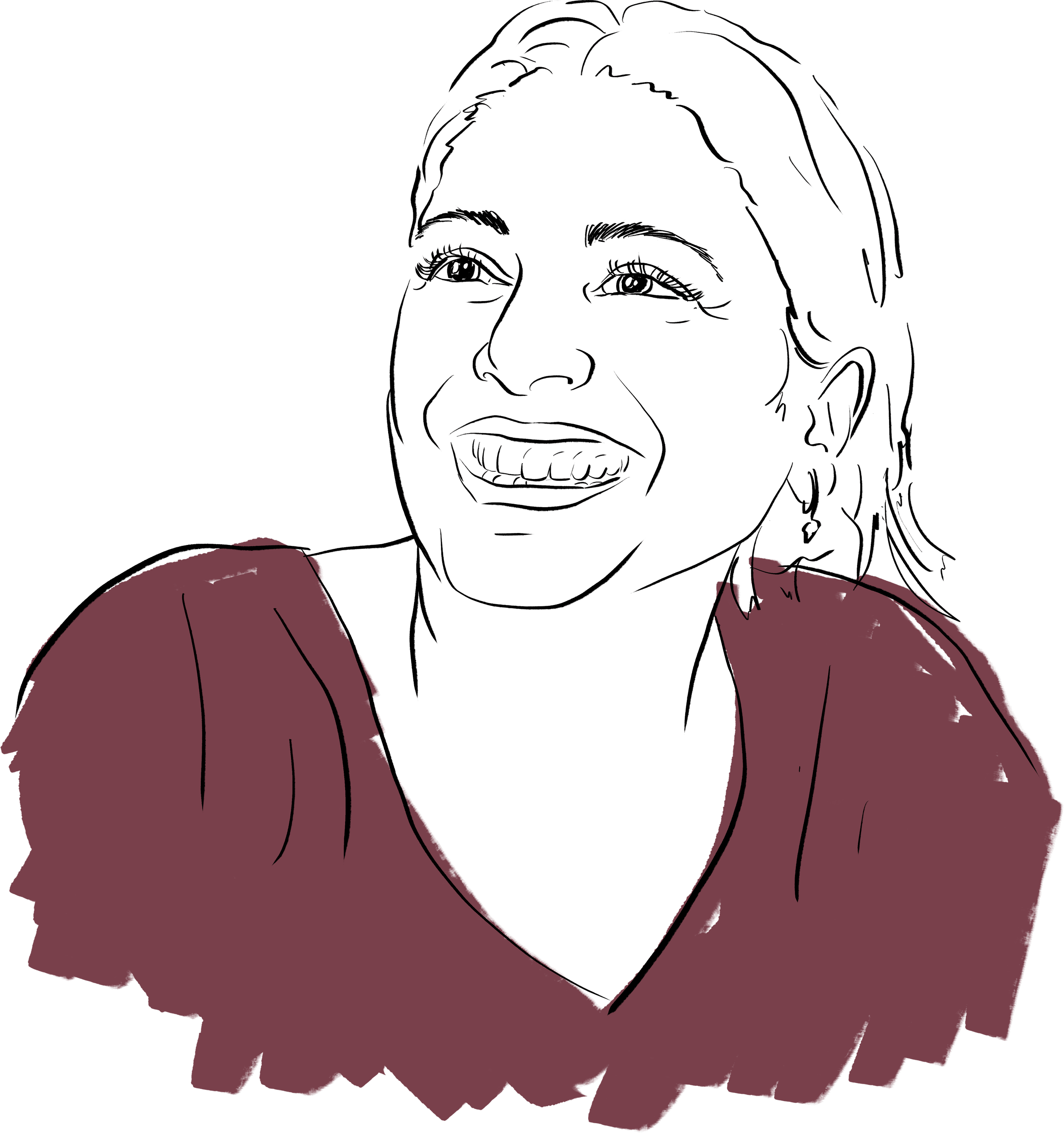
Kavitha Cardoza is an award winning journalist who covers children, poverty, education and health. She has been a frequent contributor to NPR and The Hechinger Report, and her work has appeared in national and international outlets. She has previously worked as an education correspondent for PBS Newshour/Education Week, at NPR affiliates in Washington D.C. and Illinois and has been public editor at the Education Writers Association.
